

Financial crime teams across the UK hire people at the start of their careers, but the job adverts can be intimidating. Many list degrees, previous banking experience and technical jargon, and it is easy to assume the door is closed. If you have been searching for aml analyst jobs no experience uk, the reality is more nuanced. Some employers insist on a degree or prior compliance work, while others will consider candidates from customer service, banking operations or administration who can show the right mindset and some relevant knowledge.
This guide explains what the work involves, what entry level aml analyst jobs typically ask for, what salaries look like and how to build a credible application when you have limited experience. It also shows how CIFA, an online provider of accredited finance courses, supports learners through its Introduction to Compliance and Anti-Money Laundering (ICAM) bundle, so you can decide whether structured study makes sense for you. You can read more about the provider on the About CIFA page.
An AML analyst monitors financial activity to spot and investigate suspicious or illegal transactions. In a junior role, that usually means working through a defined process rather than making high-level judgements. One typical advert for a team covering junior to senior levels describes carrying out Know Your Customer checks on new and existing clients, investigating suspicious transactions and reporting findings, keeping records accurate and tracking changes in AML and KYC regulation. Another, from a London law firm, focuses on daily AML checks including sanctions screening and identifying politically exposed persons.
In practice, a junior analyst’s week might include reviewing identity documents and corporate structures, screening names against sanctions and adverse media lists, escalating alerts that look unusual and documenting why a decision was made. The work rewards patience and accuracy. It is rarely glamorous, but it is a genuine entry point into financial crime and compliance, and it teaches you how regulated firms manage risk.
This is where CIFA training fits. Its Anti Money Laundering course covers customer due diligence, suspicious activity reporting and sanctions, which are the same topics that appear in junior job descriptions. Learning them in advance means you arrive at interview able to talk about the work in the right language.
Job titles vary. You may see AML analyst, KYC analyst, onboarding analyst, financial crime analyst or compliance assistant. Searching for kyc jobs alongside AML roles widens your options considerably, because many junior AML tasks sit within client onboarding and due diligence teams.
Employers hiring a junior aml analyst uk are rarely expecting deep expertise. They are looking for a handful of dependable qualities and a basic grounding in the subject.
Analytical thinking comes first. Analysts need to spot patterns, anomalies and inconsistencies in information, and to explain why something looks wrong. Attention to detail matters just as much, because a missed discrepancy in a customer file can have serious consequences for the firm. Clear written communication is essential too, since your findings must be recorded in a way that a reviewer, auditor or regulator can follow.
Knowledge of the regulatory framework helps you stand out. Familiarity with the Proceeds of Crime Act, the Financial Action Task Force recommendations and the idea of a risk-based approach tells an employer you understand why the checks exist. Comfort with data and basic systems matters as well, as does the ability to work in a regulated, process-driven environment under deadlines. Finally, integrity is non-negotiable. Analysts handle sensitive information and must be trusted to escalate concerns honestly.
CIFA courses are designed to build the knowledge side of that list, particularly regulation and professional integrity. For the presentation side, CIFA has published a guide explaining what a professional profile is and how it can help, which is a useful starting point for career changers.
This is one of the most common questions, and the honest answer is that it depends on the employer. A degree is often preferred, particularly in areas such as finance, economics, law, business or criminal justice. Some adverts state that an undergraduate degree in a related field is expected. At the same time, entry-level roles are also open to candidates with relevant experience in banking operations, customer service or risk and compliance departments, and some adverts only ask for education to A-level standard or equivalent.
So do you need a degree to be an aml analyst? Not always, but you may face more competition without one for the larger banks and graduate-style schemes. If you do not have a degree, you can strengthen your case with transferable experience, evidence of ongoing learning and a clear explanation of why you want the work.
For CIFA learners, the practical point is that a CPD-verified qualification will not replace a degree in the eyes of every employer, but it shows initiative and gives you a vocabulary to use at interview. Learners who later want to continue into higher education can look at CIFA’s university enrolments information.
Pay varies by employer, location and specialism, and published figures differ between sources, so treat any number as a guide. Payscale data for 2026 puts the average base salary for an early-career anti-money laundering analyst at around £27,900, with a range of roughly £24,000 to £39,000. Another industry guide gives a wider entry-level range of £25,000 to £38,000, rising to £40,000 to £60,000 for mid-level professionals with three to five years of experience.
Titles that sit alongside AML work can pay differently. Payscale’s overall figure for KYC analysts with AML skills is higher, at about £39,700 on average with base salaries from around £31,000 to £55,000, though that includes more experienced staff. London roles often pay more than regional ones, and large banks, consultancies and specialist financial crime teams may differ from smaller firms.
When researching aml analyst salary uk figures, check live job adverts rather than relying on averages alone. Adverts show what employers are paying now for the exact responsibilities you would be taking on. Before paying for any course, including those from CIFA, weigh the cost against the roles you are realistically targeting. Qualifications and experience can help over time, but nothing guarantees a particular salary, promotion or offer.
If you are targeting aml analyst jobs no experience uk, the goal is to reduce the perceived risk of hiring you. There are several practical ways to do that, and CIFA resources can support most of them.
Start with transferable experience. Time spent in banking operations, customer service, administration, legal support, accounting or any process-driven job counts. Describe it in terms recruiters recognise: verifying documents, handling sensitive data, following procedures, escalating issues and meeting service standards.
Next, build subject knowledge. Reading about money laundering stages, customer due diligence, suspicious activity reporting and sanctions will help, but structured learning gives you something concrete to put on your CV. It also gives you answers for interview questions such as how you would deal with a client who cannot provide source of funds. CIFA’s guide to the best online financial courses to boost your career can help you compare options before you commit.
Then tailor every application. Match the language of the advert where you honestly can, highlight any exposure to checks, risk or regulation and keep your CV easy to scan. Apply broadly across AML, KYC and onboarding roles, and consider temporary or contract positions as a way to gain experience. Many people move into financial crime through onboarding or operations teams and then specialise.
Finally, prepare for scenario questions. Employers like to test judgement with short examples, such as what you would do if two documents disagreed. A video resume can also help you practise explaining your motivation clearly, and CIFA’s advice on video resume best practices shows how to do it well.
CIFA lists the ICAM bundle as a Level 4 offering made up of two courses, with a bundle duration of 200 hours. According to the bundle page, it combines Introduction to UK Financial Regulation and Professional Integrity with the Anti Money Laundering course, and it is positioned for compliance roles, KYC officers and business professionals who want to understand AML, UK regulation and financial basics. CIFA also lists a scholarship version of the programme on its price list, so it is worth checking the CIFA courses page for what is currently available.
The first course, Introduction to UK Financial Regulation and Professional Integrity, gives you the wider regulatory context. Understanding who regulates what, and why professional integrity matters, helps you explain your decisions in interviews and in the job. Learners who want to add risk and tax knowledge can also look at CIFA’s Introduction to Investment, Risk and Taxation course.
The second course is the one most directly tied to day-to-day analyst work, and it is covered in the next section.
The Anti Money Laundering course from CIFA covers six areas: an introduction to AML, risk assessment and customer due diligence, suspicious activity reporting, AML compliance programmes, sanctions and terrorist financing, and current trends and developments. It is described as leading to a CIFA examination, with a free certificate issued once the exam is passed. The course page lists 40 CPD hours, mock exams per chapter, lifetime portal access and a digital profile.
Those topics line up closely with what junior analysts do day to day. Customer due diligence is the heart of onboarding and KYC work. Suspicious activity reporting explains what happens when something is flagged, and the sanctions module covers a screening task that appears in many job descriptions. The compliance programmes chapter helps you see how individual checks fit into a firm’s wider controls, which is useful context when you move from junior work towards more senior roles.
Pre-recorded webinars and PowerPoint presentations are listed as an additional-charge option, so decide whether you want that extra support before you enrol.
Check the CIFA price list for current costs, because prices can change. At the time of writing, the ICAM bundle is listed at £799 for enrolment, which covers an e-book, mock exams, a digital profile and careers panel access. An additional study support package of £180 adds pre-recorded webinars and PowerPoint presentations. The price list shows the Anti Money Laundering course on its own at £499, so the bundle gives you access to both courses at a combined price.
Exams are listed separately. The price list shows an exam fee of £149.99 for the first attempt per course, plus a proctor service charge and resit fee shown as $16.00 per exam. Confirm how these apply to your chosen bundle before enrolling, and use the CIFA FAQs or the contact page if anything is unclear.
CIFA describes its exams as taken online with facial-recognition verification, so there is no need to travel to a test centre. You can see the booking process on the exam information page. Because the course is delivered online, it can be studied around work or other commitments, although how quickly you finish depends on your own pace and prior knowledge. Once you pass, the certificate verification page lets an employer check a CIFA certificate. For eligibility, check the course page rather than assuming a finance background is required.
A qualification is more useful when employers can see it. CIFA learners receive a digital profile, and the provider also offers a Digital CV that can display course progress. A QR code on your CV can link recruiters straight to that profile, and the CPD accreditation page explains the provider’s CPD status.
Employers are part of the picture too. CIFA offers a hire candidates service for employers looking for qualified talent, a course tracking feature that lets learners share live progress, and corporate training for organisations upskilling their teams. These tools support an application but do not replace the hard work of tailoring your CV and preparing for interview. Think of them as ways to make your learning visible, not as a shortcut.
Entry-level analyst roles are a starting point. With experience, people move into senior analyst, investigator, team leader, MLRO support or wider compliance and risk positions. Some specialise in sanctions, fraud, transaction monitoring or enhanced due diligence, while others move into consultancy or technology-focused financial crime roles.
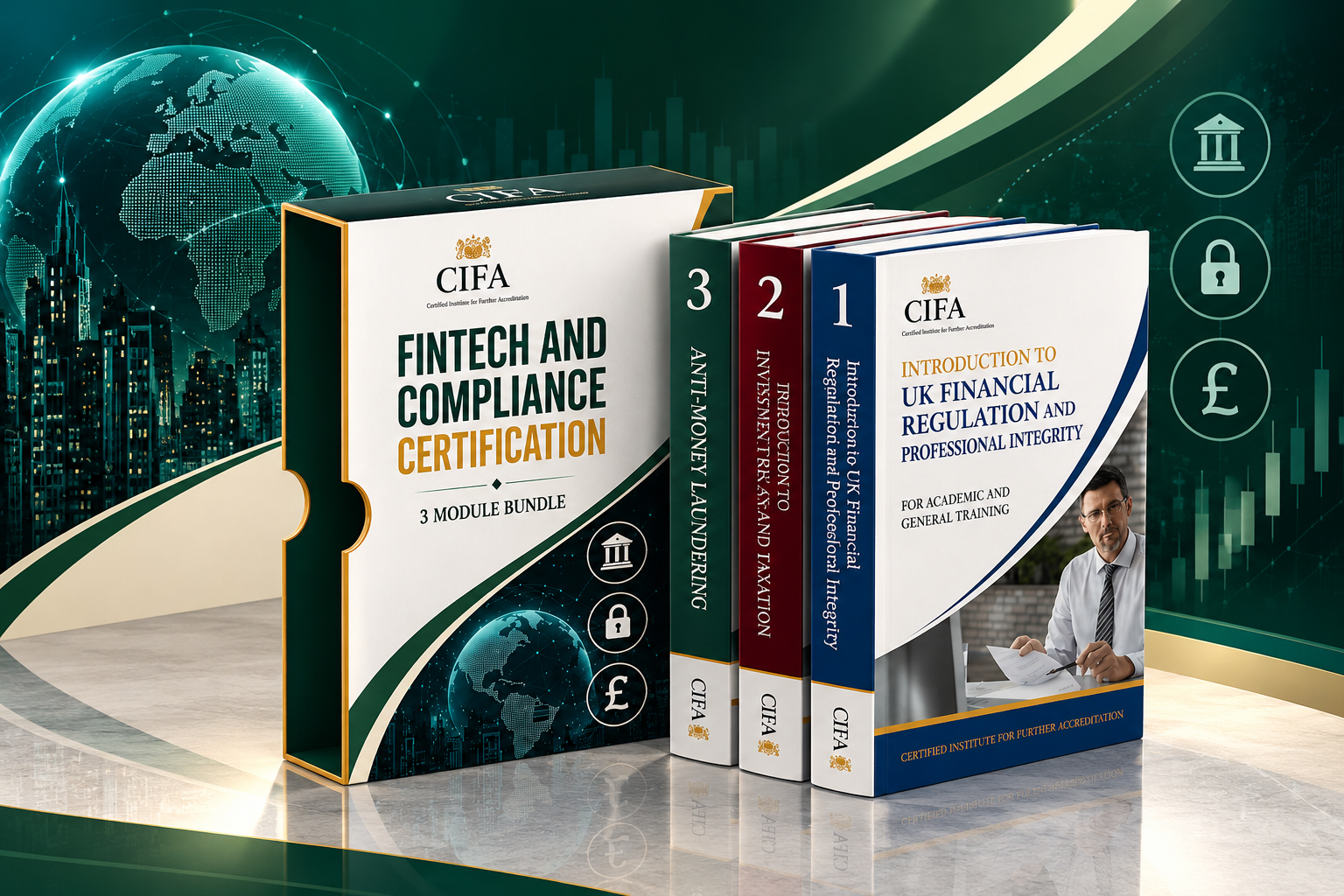
Further study can support that progression. CIFA also lists the FinTech and Compliance Certification (FCC) and the Introduction to Compliance and Accountancy for Business (ICAB) bundles for learners who want a broader compliance grounding. Those interested in advice and planning might look at the Financial Planning and Advice course, while those curious about markets could explore Securities and Investment. CIFA’s guide to CPD certification for financial advisers explains how continuing development works in practice.
None of these is a required next step. Employers set their own criteria for qualifications, experience and competence, and a course on its own does not guarantee employment, interviews or a particular salary.
There is no single right provider, and it is sensible to compare options. What CIFA offers, based on its own website, is a set of practical features that suit people starting out. Courses are delivered online, so you can fit study around work. The Anti Money Laundering course is listed as CPD verified, with 40 CPD hours. Exams are taken remotely, and mock exams are included per chapter. Learners receive a digital profile, and CIFA promotes an Employers Panel described as bridging the gap between education and employment.
Be realistic about what that adds up to. It gives you structured knowledge, a certificate on passing and tools for presenting yourself. It does not give you a job. If you want to talk through whether the ICAM bundle suits your situation, you can get in touch with CIFA before you decide.
Starting an AML career without direct experience is realistic, but it takes preparation. Understand what the work involves, build transferable skills, learn the core concepts and apply widely across AML, KYC and onboarding roles. Salary expectations vary, so rely on live adverts and be wary of any promise of guaranteed outcomes.
If you want a structured route into the subject, take a look at the ICAM bundle from CIFA, check the current details and compare it with the requirements in the adverts you are targeting. You can also browse the full range of CIFA courses to see what else might support your plans.
0 comments