
FinTech compliance jobs sit where finance, technology and regulation meet, and they are among the most practical career paths in UK financial services. Every payments app, digital lender and crypto platform that serves UK customers has to follow Financial Conduct Authority (FCA) rules, prevent financial crime and prove it to regulators. Someone has to make that happen, and that someone is a compliance professional.
The good news is that you do not need to be a lawyer or a software engineer to get started. You do need current knowledge of UK financial regulation, anti-money laundering (AML) and risk, plus evidence that you have it. That is where CIFA, the Certified Institute for Further Accreditation, comes in. CIFA offers CPD-accredited online certifications designed to help learners build job-ready knowledge and show it to employers.
In this guide you will learn which roles exist, what skills employers want, whether fintech is in high demand, how to compare qualifications and how to start. We also explain how CIFA's FinTech and Compliance Certification (FCC) bundle fits into that journey.
FinTech compliance is the work of making sure a financial technology firm follows the laws, regulations and internal policies that apply to it. In the UK, that mainly means FCA rules, the Money Laundering Regulations, sanctions law and data protection rules.
In practice, compliance teams do things such as:
Verify customers through KYC (know your customer) and customer due diligence checks
Monitor transactions for suspicious activity and report concerns
Assess risk across products, customers and countries
Write and update policies so staff know what is expected
Handle regulatory reporting and respond to FCA requests
Train colleagues and promote a culture of integrity
Fintech firms move fast, so compliance has to keep pace. That makes the work varied, and it means people who understand both regulation and technology are especially valuable.
Yes, but demand is becoming more selective. Morgan McKinley and Vacancysoft forecast that UK fintech vacancies will rise by close to 14% in 2026, following growth of around 28% in 2025. London accounts for roughly 71% of that hiring.
The picture inside compliance is more specific:
Financial crime and AML are growing. The same report projects AML roles to rise by about 28% in 2026.
General compliance hiring is stabilising. Legal, risk and compliance vacancies are forecast to dip by about 4% in 2026, after rising by close to 22% in 2025.
Regulation keeps the pressure on. Robert Walters lists financial crime compliance and regulatory compliance among the most in-demand compliance skills of 2026, and says fintech continues to drive demand for compliance talent.
What does that mean for you? Employers are hiring where specialist skills are scarce, but they are choosier, and some entry-level and operational roles are under pressure. Candidates with verified, up-to-date knowledge of AML, UK financial regulation and risk stand out most. A CPD-accredited certification from CIFA is one practical way to show that knowledge on your CV and your CIFA Digital CV.
Job titles vary between firms, but these are the main fintech compliance jobs you will see advertised in the UK.
KYC, CDD and AML analyst roles are the usual way in. From there, many professionals move into monitoring, reporting or senior compliance positions as they gain experience and further qualifications.
UK financial regulation, including the role of the FCA and PRA
AML, counter-terrorist financing and sanctions rules
KYC and customer due diligence
Risk assessment and basic investment, risk and tax concepts
Attention to detail when reviewing documents and alerts
Clear written communication for reports and case notes
Analytical thinking and sound judgement under time pressure
Comfort with data, spreadsheets and compliance technology (RegTech)
Integrity and discretion
The confidence to challenge colleagues respectfully
A habit of continuous learning, as rules and criminal methods keep changing
You can build the knowledge skills through structured study. CIFA's FCC bundle, for example, is built around UK financial regulation and professional integrity, AML, and investment, risk and taxation. The practical and professional skills grow with experience, so look for roles, internships or volunteering that let you practise them early.
There is no single best compliance qualification in the UK. The right choice depends on your starting point, your target role and your budget. Professional bodies such as the International Compliance Association (ICA) and the Chartered Institute for Securities & Investment (CISI) offer well-known qualifications, mainly aimed at people already working in, or moving into, regulated roles.
If you are new to the field, you may prefer to start with an accessible foundation that builds knowledge and confidence before you commit to longer professional programmes. CIFA's certifications are designed for that purpose. They are independently CPD-accredited through the CPD Certification Service and assessed through CIFA exams, so they demonstrate learning and commitment to employers.
Whenever you see a best fintech certification claim, test it against these questions:
Is the content relevant to UK regulation? FCA, AML and sanctions knowledge matter most.
Is it independently accredited? CPD accreditation gives employers a recognised signal of quality.
Is the study flexible? Online learning and exams that fit around work or other commitments help you finish.
Does it help you get hired? Look for CV, profile and employer-facing tools.
Is the pricing clear? Check what the fee includes and what costs extra, such as exams.
CIFA's FCC bundle is designed around exactly these points: UK-focused content, CPD accreditation, online exams and built-in employability tools. The next section explains the details.
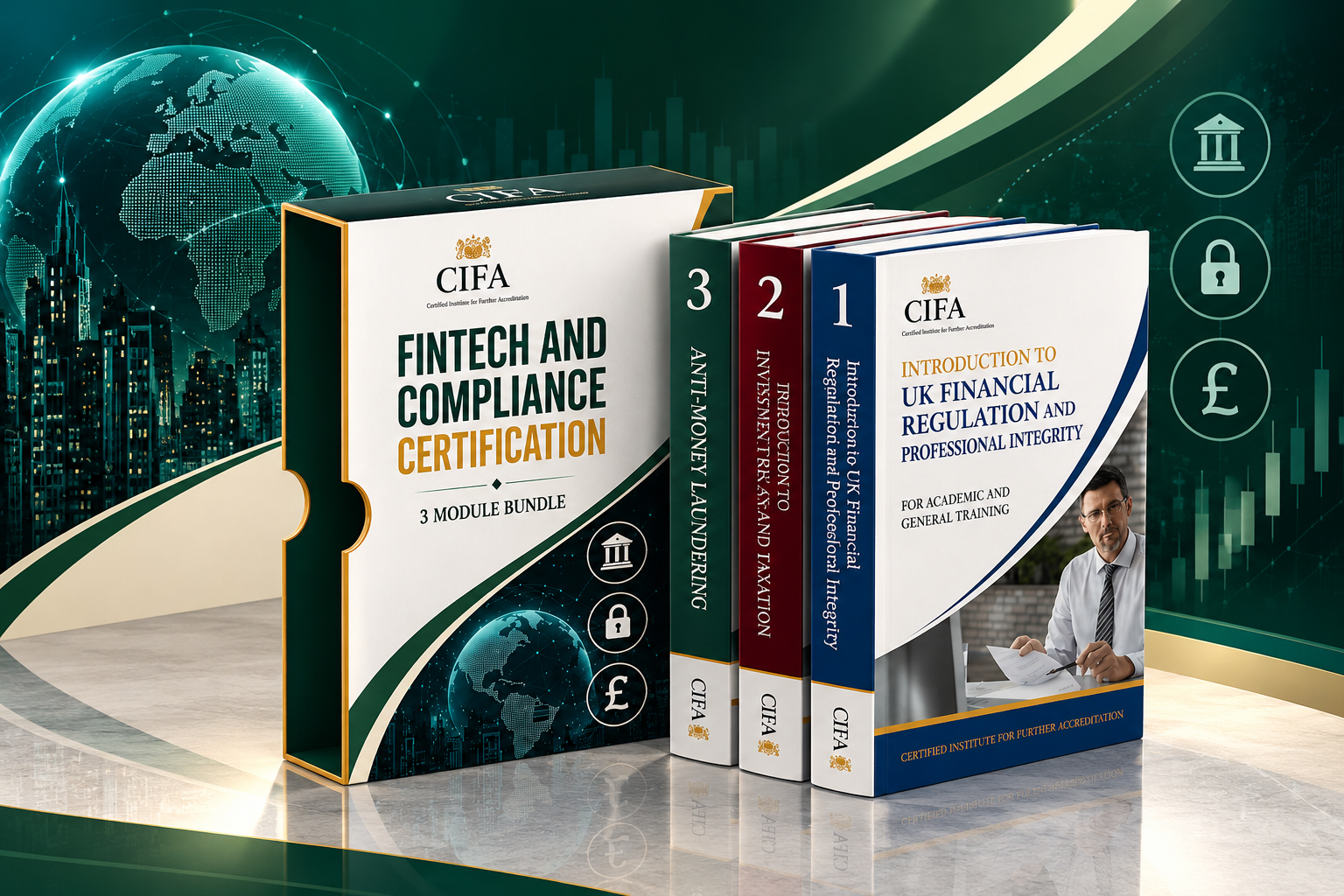
If you are searching for a fintech compliance course UK online, CIFA's FinTech and Compliance Certification (FCC) brings three courses together in one online programme for £897. Bought separately, the three courses cost £1,215 at current list prices, so the bundle saves £318.
Introduction to UK Financial Regulation & Professional Integrity builds your understanding of the UK regulatory landscape.
Anti Money Laundering covers risk assessment and customer due diligence, suspicious activity reporting, AML compliance programmes, sanctions and terrorist financing, and current AML trends.
Introduction to Investment, Risk and Taxation gives you the financial concepts behind the products compliance teams oversee.
Before you enrol, check the full costs, including exam fees, on the CIFA price list. You can also read how exam booking works. If you would like a narrower start, CIFA also offers the Introduction to Compliance and Anti-Money Laundering (ICAM) bundle.
Choose a target role. KYC, CDD and AML analyst positions are the most common way in. Pick one so your study and your CV point in the same direction.
Build your foundations. Learn UK financial regulation, AML and risk. The FCC bundle covers all three in one programme.
Study at your own pace. Use the e-book and the mock exams to check your understanding chapter by chapter before you sit the real thing.
Sit your online exam. CIFA exams can be taken from home, so you are not tied to fixed exam dates while you job hunt.
Show your results. Set up your Digital CV and record a video resume so employers can see your certification and your personality in one place. CIFA's guide to a professional profile is a good place to start.
Tailor your applications. Mirror the language in job adverts, such as KYC, AML, FCA and customer due diligence, and explain how your studies and any transferable experience match the role.
Look where the jobs are. London accounts for about 71% of UK fintech hiring, so consider London-based or hybrid roles as well as local opportunities.
Keep learning. Compliance changes constantly. Log your CPD hours, follow regulatory updates and plan your next qualification as your career grows.
CIFA also runs an employers panel that hosts a video CV platform, giving students a way to put themselves in front of employers looking for candidates with up-to-date professional certifications. You can learn more on the About CIFA page.
FinTech compliance jobs reward people who combine regulatory knowledge, careful judgement and a willingness to keep learning. Hiring is selective, but demand for AML, financial crime and regulatory skills remains strong, and employers want proof of what you know.
With CIFA, you can study online, sit your exams from home and show your results through employer-facing tools, all in one place. If you are ready to take the first step, explore the FinTech and Compliance Certification (FCC), compare options on the CIFA price list, browse all CIFA courses, or contact the CIFA team with any questions.

0 comments