
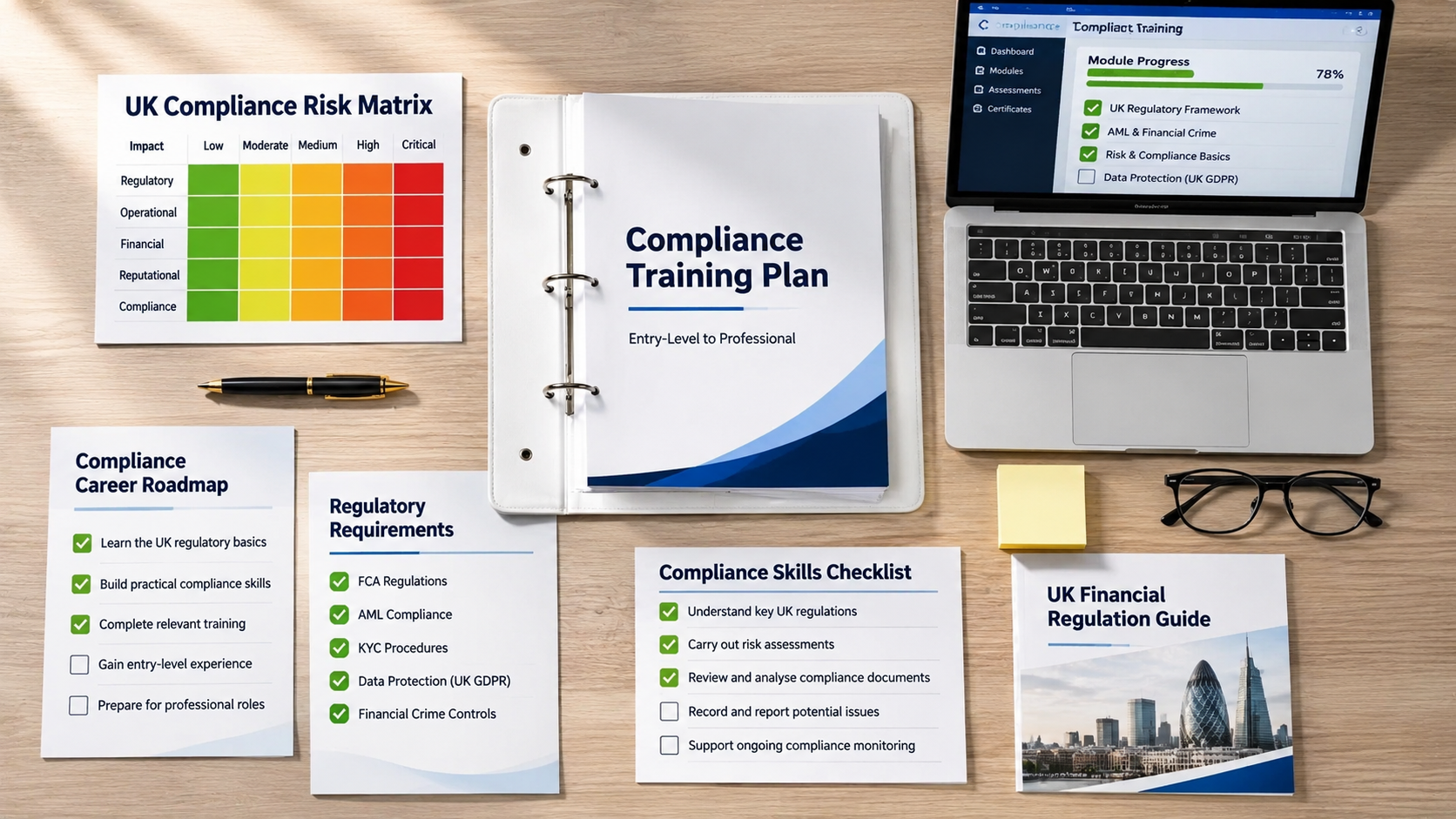
Compliance is one of the few corners of UK financial services that keeps growing whatever the economy does. Regulators are tougher, fines are bigger, and every bank, fintech, insurer, wealth manager and law firm needs people who can keep the business on the right side of the rules. The result is steady hiring and a genuine route in for career changers, which is why many choose CIFA's accredited finance and compliance training as their starting point.
If you are searching for how to get into compliance UK with no experience, the short answer is this: you do not need a finance degree, you do not need years in a bank, and you do not need to start as a graduate. You need recognised, practical knowledge of the regulatory framework, a clear target role, and a CV that proves you understand the work. This 2026 guide walks you through each step, and shows how the CIFA ICAM bundle (£799) helps you get there faster.
Before you commit, it helps to know what the job involves day to day. Compliance professionals make sure a firm follows the laws, regulations and internal policies that apply to it. In the UK that usually means working within the framework set by the Financial Conduct Authority (FCA), the Prudential Regulation Authority (PRA), HM Treasury and the wider anti-money laundering regime.
Typical tasks include:
Monitoring transactions and client activity for red flags
Carrying out customer due diligence and know-your-customer (KYC) checks
Reviewing and updating policies and procedures
Reporting suspicious activity internally and, where needed, to the National Crime Agency
Running compliance monitoring and testing programmes
Training colleagues on regulatory obligations
Preparing evidence and reports for regulators and auditors
It is analytical, detail-driven work with real responsibility. It rewards people who are organised, curious and comfortable making judgement calls. Those are skills you may already have from customer service, administration, law, teaching, project management or operations.
Yes. Compliance teams hire from a wide range of backgrounds, and many senior professionals started somewhere unrelated. Firms are often more worried about candidates who do not understand the rules than candidates who lack a bank on their CV. This is exactly why CIFA's beginner-friendly compliance courses exist.
What employers look for at entry level is evidence of three things:
Knowledge of the UK regulatory landscape, including financial crime, AML and conduct rules
Aptitude for careful, accurate, documented work
Commitment to the profession, shown through relevant training and a clear career plan
You can demonstrate the first and third points quickly through accredited study with CIFA. That is exactly the gap CIFA was built to close for career changers. The second point you prove through your CV, your application and your interview answers, which we cover later in this guide.
This is one of the most common worries, so let us be direct. You can get into compliance without a degree. Plenty of UK firms, especially in KYC, onboarding, financial crime operations and smaller advisory businesses, hire on skills and certifications rather than academic background.
A degree can help for graduate schemes at the largest banks and for some legal-adjacent roles, but it is not a legal or regulatory requirement for working in compliance. What matters more is:
A recognised professional qualification in compliance, AML or financial regulation
Practical understanding of how rules apply in a real workplace
Transferable experience from your current or previous job
Clear, accurate written communication
If you are weighing up a three-year degree against targeted professional training, the second route is usually faster and far cheaper. A focused programme like the CIFA ICAM bundle lets you build job-relevant knowledge in a matter of months rather than years, while you keep earning.
There is no single mandatory qualification, which is why this question causes so much confusion. The right answer depends on the role you want. In practice, employers look at a mix of the following.
For entry-level compliance, KYC and AML roles, hiring managers want to see that you understand money laundering typologies, sanctions, due diligence, the Proceeds of Crime Act, the Money Laundering Regulations and the role of the FCA. A recognised certificate covering this ground, such as one from CIFA's compliance programmes, is the single most effective way to stand out when you have no direct experience.
As you progress, certifications from bodies such as the ICA, CISI, ACAMS and others carry weight, particularly for specialist or senior positions. Many people start with a foundation certification, then add a specialist credential once they are working in the field.
Law, finance, business or economics degrees are common among compliance professionals, but they are one route, not the only one. Postgraduate study can help later if you aim for a head of compliance or MLRO role.
Compliance is a CPD-driven profession because regulation never stands still. Employers value candidates who can show a habit of keeping up to date. Choosing accredited, CPD-recognised training from the start, as you do with CIFA, sets that habit from day one.
If you are learning how to become a compliance officer UK style careers from scratch, you will rarely begin with the title "Compliance Officer". Most people step up through one of these doors:
KYC / onboarding analyst: verifying customer identity and risk. High volume, plenty of vacancies, excellent training ground.
AML analyst or financial crime analyst: reviewing alerts and investigating unusual activity.
Compliance administrator or assistant: supporting policies, registers, reporting and audits.
Compliance monitoring junior: testing that controls work as intended.
Regulatory reporting assistant: preparing data and returns for regulators.
Risk and controls assistant: often a stepping stone into compliance proper.
After one to three years in these roles, a move to Compliance Officer is realistic. From there you can progress to Senior Compliance Officer, Compliance Manager, Head of Compliance, or Money Laundering Reporting Officer (MLRO). Starting with CIFA's compliance certification gives you a head start on that ladder.
You can browse live finance and compliance vacancies on our sister platform, CIFA Careers, which is built around finance recruitment.
Pay is a big reason people explore this field, and it is strong compared with many other entry points into finance. Exact figures vary by employer, sector and location (London pays more), but these typical ranges give you a realistic picture of the compliance officer salary UK market:
Entry level (KYC analyst, compliance assistant): roughly £25,000 to £32,000
Compliance officer (1 to 4 years): roughly £32,000 to £50,000
Senior compliance officer or manager: roughly £50,000 to £75,000
Head of compliance or MLRO: roughly £75,000 to £120,000 and above, depending on firm size
Treat these as indicative rather than guaranteed, and check current job adverts for the latest numbers. Two things consistently push salary upward: recognised qualifications and specialist knowledge, such as financial crime, sanctions or funds regulation. Investing in the right training early with a provider like CIFA shortens the time it takes to reach the higher bands.
Here is a practical plan you can start this month.
Compliance is broad. Financial crime and AML suit investigative personalities. Regulatory compliance suits people who enjoy interpreting rules. Monitoring and assurance suit people who like testing and evidence. Read a few job descriptions in each area and note which one excites you.
This is the step that replaces experience on your CV. Choose training that is accredited, current for 2026, and aligned with what UK employers actually ask for. This is where the CIFA ICAM bundle comes in.
You have more relevant experience than you think. Handling complaints shows judgement under pressure. Processing paperwork shows accuracy. Working with sensitive data shows discretion. Rewrite your CV so these strengths are framed in compliance language.
Apply for KYC, onboarding, AML analyst and compliance assistant roles. Do not hold out for a Compliance Officer title on day one. Search live openings on CIFA Careers.
Follow compliance professionals on LinkedIn, join compliance and financial crime groups, and attend webinars. Many entry roles are filled through recommendations and recruiters who specialise in regulated sectors.
Once you land your first role, add specialist certifications and keep your CPD record up to date. This is how you move from analyst to officer to manager.
CIFA is a UK-focused finance education provider offering accredited, CPD-recognised programmes designed for people who want practical, employer-relevant skills. We understand that many of our learners are changing careers, working full time, or returning to work, so our programmes are built around flexibility and real-world application rather than academic theory for its own sake.
When you study with CIFA you get:
Accredited learning that carries weight with UK employers
Flexible, self-paced study that fits around work and family
Job-focused content built around the regulations you will meet on the job
A clear route to employment supported by our sister brand, CIFA Careers
Transparent pricing with no hidden extras
We built our programmes for exactly the person reading this guide: someone smart and motivated who simply has not had the break into compliance yet. Explore CIFA's full course range to see what fits you.
If you want one clear, structured way to move from "no experience" to "job-ready", the CIFA ICAM bundle is designed for that purpose. At £799, it packages the core knowledge employers expect from entry-level compliance and financial crime candidates into a single programme, so you are not piecing together courses from different providers.
Why the ICAM bundle works for career changers:
One bundle, one price. You see the full cost up front instead of paying course by course.
Built for beginners. No prior compliance, finance or degree background is assumed.
UK regulatory focus. Learning is anchored to the framework you will actually work within.
Credible on a CV. An accredited certification gives hiring managers a concrete reason to shortlist you.
Study at your own pace. Fit it around your current job and life.
For most learners, £799 is a small fraction of what a degree or a full-time career break would cost, and it can pay for itself quickly once you move into a role in the entry salary band. You can explore the full bundle details and enrol on the CIFA website.
Training gets you noticed. A strong application gets you hired.
On your CV:
Put your CIFA ICAM certification near the top, in a dedicated education and training section
Use compliance vocabulary: due diligence, risk assessment, regulatory requirements, record keeping, escalation
Quantify what you have done, such as "processed 150+ applications weekly with a 99% accuracy rate"
Keep it to two pages and tailor it to every role
In your cover letter:
Explain clearly why you are moving into compliance
Show you understand what the employer's regulators expect of them
Mention your recent accredited study as proof of commitment
In interviews:
Be ready to explain what money laundering is and why firms must prevent it
Prepare examples showing integrity, accuracy and good judgement
Show curiosity about regulatory change, such as new FCA guidance
Hiring managers know you are new. What they want to see is that you have taken the initiative to learn the fundamentals, and that you take the responsibility seriously.
Getting into compliance in the UK with no experience is realistic, affordable and achievable in months rather than years. You do not need a degree, a banking background or a perfect CV. You need recognised knowledge, a smart plan and the confidence to apply.
If you are ready to take the first step, the CIFA ICAM bundle (£799) gives you structured, accredited training designed to get you job-ready. Visit CIFA to explore the programme, and then head to CIFA Careers when you are ready to start applying.


0 comments