

You can build financial-planning knowledge and work towards a career in the profession through online study, but choosing the right route requires more than finding a course with “financial planner” in its title. The qualification, assessment, practical experience and regulatory expectations that apply will depend on the type of work you ultimately want to perform.
That distinction matters. Studying financial planning online can help you understand how professionals approach protection, retirement, investments, risk and long-term financial objectives. Completing a course can provide evidence of learning and assessment. Becoming established in a particular financial-planning or advisory role, however, may involve further qualifications, experience, employer requirements or regulatory responsibilities.
For this reason, someone asking “How can I become a certified financial planner online?” should begin with the intended career outcome. Financial planning, financial advice, wealth management and investment advice are closely connected areas of financial services, but they are not interchangeable professional pathways.
Online education can provide a flexible starting point or support continuing professional development. CIFA, for example, offers digital financial education across financial planning, regulation, investment, wealth management and related subjects. The key is to understand exactly what each programme teaches and how that learning fits the role you want to pursue.
A financial planner helps people understand their financial position, define short- and long-term objectives and make structured decisions about their finances. Depending on the planner's role and professional permissions, the work may involve retirement, financial protection, savings, investments, taxation considerations, risk and wider wealth-management issues.
Effective planning starts with the client rather than a financial product. Before meaningful planning can take place, a professional needs to understand the client's income, expenditure, assets, liabilities, dependants, existing arrangements, priorities and timescales. A person approaching retirement, for example, will usually require a different planning approach from someone building wealth during the early stages of a career.
Risk is another important part of the process. Financial planning involves understanding not only potential returns but also the consequences of uncertainty. A client's ability and willingness to accept investment risk, the financial impact of illness or death, inflation, changing income needs and the sustainability of retirement arrangements may all need consideration.
This is why financial planning is not simply about memorising financial products. Strong planners need technical knowledge, analytical ability, communication skills and professional judgement. They must be capable of taking complex financial information and explaining its implications clearly enough for clients to make informed decisions.
Ethics and professional responsibility are equally important. Financial decisions can influence a client's security for decades. Anyone entering the profession should therefore develop an understanding of professional integrity, confidentiality, suitability, conflicts of interest and the regulatory environment relevant to their work.
The financial planner vs financial advisor distinction can sometimes create unnecessary confusion. In practical terms, financial planning usually emphasises a broad, goal-led assessment of a person's finances, while an adviser may be more directly involved in recommendations concerning particular financial products or solutions. The roles can overlap substantially, and job titles alone do not establish what a professional is authorised or qualified to do.
Someone interested in the broader advisory side of the profession may therefore compare planning education with a professional financial advisory qualification. CIFA currently presents its Financial Advisor Certification (FAC) as a three-course digital programme covering Financial Planning and Advice, Introduction to UK Financial Regulation & Professional Integrity, and Introduction to Investment, Risk and Taxation. The programme is currently listed at £897 with a stated bundle duration of 452 hours.
The important principle is to judge a programme by its actual curriculum and professional relevance rather than assuming that similar-sounding titles represent identical career routes.
There is no single online course that automatically creates the same professional outcome for every learner. A more reliable approach is to work through the process systematically.
Begin by researching the work financial planners actually perform. Consider whether you are interested primarily in holistic financial planning, financial advice, retirement, protection, investment-related work, wealth management or a supporting role within financial services.
This initial decision will shape everything that follows. Someone interested in client-centred financial planning may need a different educational emphasis from someone whose long-term ambition is investment analysis.
It also provides a better way to identify the best online financial planner course. “Best” should not mean the course with the strongest marketing claim. It should mean the programme whose curriculum, level, assessment structure, study commitment and professional relevance are best aligned with your objective.
Once you have identified the intended direction, investigate what is required to study and what is required to work.
These are not necessarily the same thing.
A provider may permit you to enrol on a course without a university degree or previous professional experience. An employer recruiting for a particular financial-planning position may have additional expectations. A regulated activity may involve requirements beyond those needed simply to enrol on an educational programme.
If you are comparing a financial planner course UK, therefore, ask two separate questions: “Am I eligible to study this?” and “What will I still need to meet the requirements of my intended professional role?”
Keeping these questions separate prevents a course certificate from being mistaken for automatic professional or regulatory status.
The next step is to compare programmes in detail. Examine the syllabus, course level, learning hours, assessment requirements, study format, fees, support arrangements and the nature of the certificate or qualification awarded.
For learners specifically interested in foundational financial-planning knowledge, CIFA currently offers online financial planning training through its Financial Planning and Advice course.
The current course information lists three chapters: Introduction to Financial Planning and Advice, Financial Protection and Retirement Planning. The course is described as an intermediate digital product with 82 CPD hours. It includes chapter mock exams, lifetime portal access and a certificate of achievement following successful completion and passing of the exam.
This makes it a relevant programme to examine when researching online financial planning certification, particularly for learners who want structured education in core planning topics. It should still be considered according to its stated educational scope rather than interpreted as automatic authorisation to perform every financial-advice activity.
Enrolling is only the beginning. The value of professional education comes from developing usable knowledge.
When studying financial planning, concentrate on how different topics interact. Financial protection is not isolated from a client's family circumstances. Retirement planning cannot be separated from income requirements, longevity and risk. Investment decisions should be considered alongside objectives, time horizons, taxation considerations and the client's capacity for loss.
Assessment also matters because it tests whether learning has been understood. CIFA's Financial Planning and Advice page currently states that the course includes mock exams per chapter and that the certificate of achievement follows successful completion and passing of the exam.
Learners should check the precise assessment arrangements for whichever programme they select rather than assuming every online certification uses the same examination structure.
A certificate can mark the completion of a defined programme, but professional development should continue afterwards.
Practical exposure can help turn theoretical understanding into judgement. Depending on the career route, this might come through financial-planning support, client services, paraplanning-related work, banking, wealth management or another financial-services environment.
Additional study may also become useful as your responsibilities develop. Someone moving towards wealth management, for example, can explore wealth management training. CIFA currently lists Foundations in Wealth Management (FWM) as a three-course digital bundle covering UK financial regulation and professional integrity, investment risk and taxation, and securities and investment.
Someone pursuing a more investment-focused direction may instead consider an investment advisory qualification. CIFA's IAC programme covers regulation and professional integrity, investment risk and taxation, and derivatives, illustrating why investment advisory study should be viewed as a related but distinct pathway rather than another name for financial planning.
A university degree is not automatically the starting requirement for every financial-planning course, but it would be misleading to conclude that academic and professional requirements are identical across all qualifications, employers and roles.
The correct certified financial planner requirements depend on the specific outcome you are pursuing.
There are at least four separate questions to consider: whether you can enrol on a course, whether you can successfully obtain the qualification or certificate, whether you meet an employer's requirements for a particular position, and whether additional professional or regulatory conditions apply to the work you intend to perform.
This distinction is especially useful for people searching for a financial planning qualification without degree. A learner may be able to access professional financial education without following a traditional university route, but that does not mean a degree, specific professional qualification or relevant experience will never be requested by an employer or another professional pathway.
Previous experience can also influence career progression. Work in banking, insurance, accounting, administration, customer service or other financial-services functions may help develop relevant commercial and client-facing skills.
Transferable abilities matter as well. Financial planners need to listen carefully, communicate clearly, work accurately with numerical information, handle sensitive client information responsibly and understand how individual financial decisions fit into a wider plan.
People searching specifically for CFP certification online should be particularly careful with terminology. Online financial-planning education, a provider's own financial-planning certificate and a specific CFP professional designation should not automatically be treated as the same credential.
Before paying for any programme, establish exactly what credential is awarded, who awards it, what the assessment involves and whether your intended professional route has additional education, experience, ethics, examination or regulatory requirements.
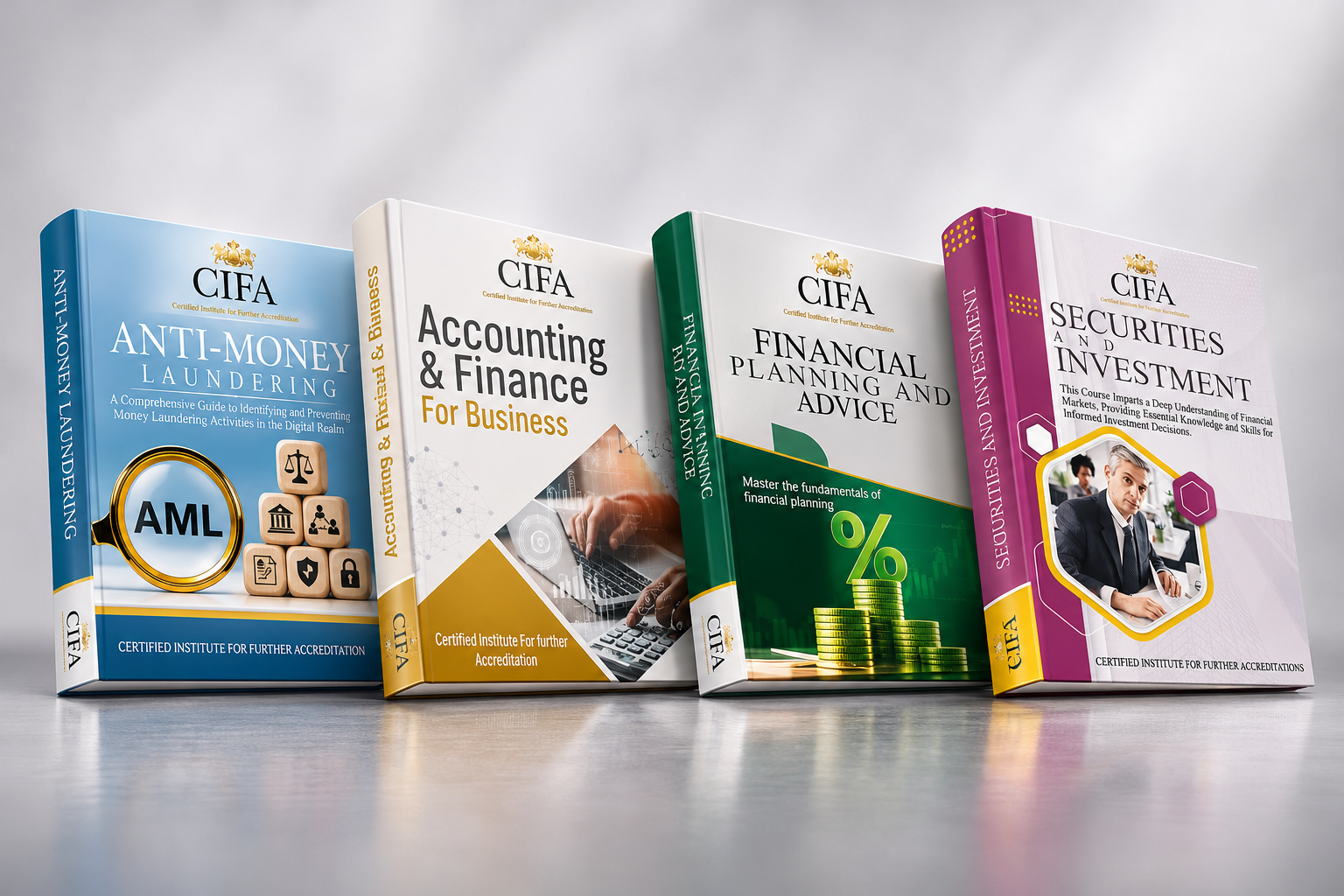
CIFA's current course catalogue includes financial education in areas such as financial planning, investment, securities, regulation, mortgage advice and accountancy. For someone pursuing financial planning, the value lies in selecting the subjects that support a coherent career objective rather than completing unrelated courses simply to accumulate certificates.
Financial Planning and Advice is the most directly relevant course for foundational planning education. FAC broadens the scope towards financial advice by incorporating regulation, integrity, investment risk and taxation alongside planning. FWM shifts the emphasis towards wealth-management knowledge, while IAC develops investment-focused knowledge.
There are also situations in which deeper market knowledge becomes relevant. Professionals moving towards investment analysis or broader market-facing roles can examine financial markets and analysis training.
CIFA's Consultancy & Markets Analysis Certification (CMA) currently combines four specialist courses covering UK financial regulation and professional integrity, investment risk and taxation, derivatives, and securities and investment. The programme is listed at £1,249 with a 610-hour bundle duration.
Compliance knowledge can also complement a finance career. Financial professionals operate in an environment where customer due diligence, financial crime controls, sanctions and suspicious activity can be highly relevant.
For learners who need knowledge in this area, CIFA offers AML training for finance professionals. The current AML programme covers anti-money laundering principles, risk assessment and customer due diligence, suspicious activity reporting, AML compliance programmes, sanctions and terrorist financing, and current AML developments.
AML education should nevertheless be understood for what it is. Completing an AML course does not itself make someone a financial planner, nor should it be presented as a universal requirement for entering every planning role.
The financial planner certification cost cannot responsibly be reduced to one universal figure. Costs depend on the provider, programme, assessment structure, optional support, examination requirements and the number of courses genuinely needed for your intended pathway.
At the time of writing, CIFA lists Financial Planning and Advice at an enrolment fee of £358. The official price list states that this includes the e-book, mock exams, digital profile and careers panel access. An Additional Study Support Package is separately listed at £72 and includes prerecorded webinars and PowerPoint presentations.
Importantly, the same current price list separately identifies an exam fee of £149.99 for the first attempt per course and an online exam invigilation/proctor service charge of $16 per exam. Exam resits are also separately listed at $16 per exam. These charges should be considered when assessing likely study costs rather than assuming that the enrolment price represents every possible expense.
For broader programmes, the current CIFA catalogue lists Financial Advisor Certification, Foundations in Wealth Management and Investment Advisor Certification at £897 each. Consultancy & Markets Analysis Certification is currently listed at £1,249, while the Anti Money Laundering course is £499.
These figures should not be added together to create an artificial “financial planner certification package”. They are different programmes serving different educational purposes, and there is no reason to assume that every financial-planning learner needs all of them.
Duration requires the same careful interpretation.
If you are researching how long to become a financial planner, distinguish the study duration of a course from the time needed to establish yourself professionally. CIFA currently lists Financial Planning and Advice at 82 CPD hours. FAC is listed at 452 hours, FWM at 423 hours and CMA at 610 hours.
Those figures describe learning programmes, not guaranteed career timelines.
The wider process can include further study, assessments, relevant work experience, employer training and additional requirements associated with a particular role. One learner may already work in financial services and be developing existing knowledge; another may be entering the sector for the first time.
Online learning can nevertheless make professional development easier to manage alongside employment. CIFA's FAQ describes its courses as self-paced and notes that study time varies between courses. This flexibility can be useful for working learners, although self-paced study still requires consistent time and discipline.
Financial-planning education can support several directions within financial services, but completing a course should never be presented as a guarantee of employment.
Depending on existing experience, qualifications and employer requirements, learners may explore financial-planning support, client services, paraplanning-related development, advisory support, wealth-management environments, banking or investment-related work.
Early-career roles can be particularly valuable because they show how financial-planning concepts operate in real situations. Working with client records, fact-finding processes, administrative systems, compliance procedures and experienced professionals can help develop practical understanding that cannot be gained from theoretical study alone.
Career progression may then involve greater technical responsibility, additional qualifications, deeper client involvement or specialisation. A person might develop towards retirement planning, protection, investments, wealth management or another area according to professional interests and the requirements of the organisation in which they work.
The financial planner salary UK question should therefore be approached carefully. Earnings can vary according to experience, location, employer, responsibilities, qualifications, client responsibilities and seniority.
A person beginning in a support role should not assume the same earning potential as an experienced professional responsible for complex client relationships. Equally, completing an additional qualification does not automatically produce a salary increase.
When assessing career prospects, current vacancies and reputable salary data for the exact role and region are more useful than broad promotional salary promises. Education should be chosen because it develops relevant knowledge and supports a credible professional direction, not because a provider or advertisement appears to promise a particular income.
Choosing a programme deserves the same analytical approach you would apply to any significant professional investment.
Start with curriculum relevance. Does the course teach subjects you genuinely need? A programme containing “financial” or “advisor” in its title may still be unsuitable if its content does not correspond with your intended role.
Next, examine the level and depth of study. Introductory education can be valuable when building foundations, but it should not be mistaken for advanced professional competence. Conversely, an extensive specialist programme may be unnecessary if you are still deciding whether financial planning is the right career.
Assessment is another important consideration. Check how your understanding will be tested, whether examinations are required and whether there are separate assessment or proctoring charges.
Then consider delivery. Online education can be particularly attractive for people who are already working, but flexibility should not be confused with low effort. A self-paced programme still requires sustained study, revision and assessment preparation.
Cost should be assessed transparently. Look beyond the headline enrolment fee and identify any separate examination, proctoring or optional support costs that may apply.
Finally, verify the credential itself. Understand what the certificate represents, its educational scope and how it relates to your intended career. Never assume that a certificate from an educational provider automatically creates regulated status or satisfies every employer's requirements.
Learners comparing several possibilities can review CIFA's online finance course catalogue to see the current separation between individual courses and broader certification programmes. This can make it easier to distinguish financial planning from investment, wealth-management and advisory education.
Where the correct route is still unclear, seeking CIFA course guidance before enrolling can help clarify programme-specific questions. A professional course decision should be based on verified information about curriculum, assessment, cost and intended outcome rather than assumptions made from a course title.
So, how can you become a certified financial planner online?
Begin by deciding what kind of financial-planning or advisory career you actually want. Research the educational, professional and regulatory requirements attached to that objective. Choose relevant online study, complete the required learning and assessment seriously, and continue developing practical competence and professional knowledge afterwards.
A university degree is not necessarily the only route into financial education, but entry requirements differ. Likewise, completing an online course can demonstrate learning without automatically creating every professional permission or designation associated with financial services.
Online learning is valuable because it can make structured professional development accessible to people who are already working or cannot commit to conventional classroom study. Its flexibility, however, does not remove the need to select the right programme.
CIFA provides relevant digital options across financial planning, financial advice, wealth management, investment and compliance. Financial Planning and Advice is particularly relevant to foundational planning education, while FAC, FWM, IAC and CMA serve broader or more specialised development needs.
The strongest pathway is therefore not the one with the greatest number of certificates. It is the one in which each stage of education has a clear purpose and moves you closer to the professional role you actually intend to pursue.

0 comments