
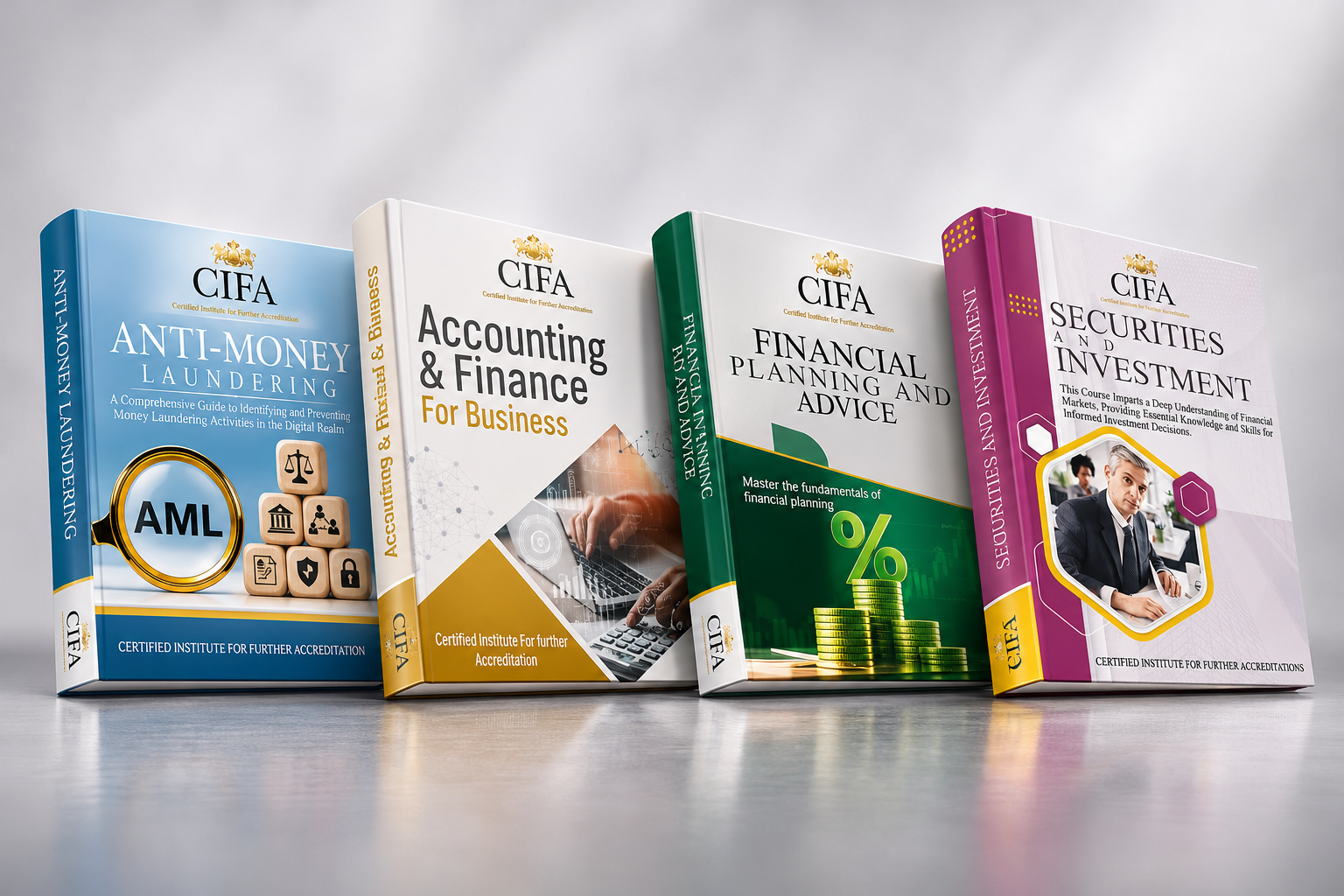
Choosing an online finance course in 2026 is less about finding a programme labelled simply as “finance” and more about identifying learning that fits a specific professional objective. Someone planning to work in financial advice needs a different knowledge base from a learner interested in investment markets, mortgage advice, wealth management, ESG, compliance or anti-money laundering.
That distinction matters whether you are entering financial services, changing careers or adding specialist knowledge to an established career. CIFA provides a range of finance courses and certification pathways covering different areas of financial services. Learners researching the best online finance courses should therefore compare options by subject, level, professional relevance and intended career direction rather than assuming one programme will suit everyone. CIFA's current catalogue includes full certifications alongside individual finance courses.
The same principle applies when considering an online finance certification. A certificate can provide evidence of structured study, but its practical value depends on what was studied, how learning was assessed, its relevance to the intended role and any separate professional or regulatory requirements that apply.
Online study can make professional finance education more accessible to people who cannot easily attend regular classroom sessions. It can also allow employed professionals to develop knowledge alongside existing responsibilities rather than leaving work simply to study.
For people asking whether online finance courses worth it is the right question, the more useful issue is whether a particular course is worth the time and cost for their objective. A focused programme in AML may be valuable for someone developing compliance knowledge but less relevant to a learner whose priority is mortgage advice. Likewise, investment education may support one career direction without addressing the knowledge expected in financial planning.
Structured online learning can also provide an organised route through subjects that are difficult to learn effectively from disconnected articles and videos. A well-designed course should establish clear learning outcomes, develop knowledge progressively and give learners a way to assess their understanding.
An online finance certification can additionally demonstrate that a learner has undertaken structured study in a defined subject. It should not, however, be confused automatically with a professional qualification, regulatory authorisation or permission to perform a regulated role. Learners considering regulated financial careers should separately check the current requirements that apply to the occupation they intend to pursue.
Flexibility remains one of online learning's strongest practical advantages. It can help career changers build foundational knowledge before making a move, while experienced professionals can focus on narrower areas relevant to their development. The benefit comes from alignment between the education and the learner's actual professional needs, not simply from possessing another certificate.
People searching for online courses to get into finance can encounter programmes covering very different areas. A useful starting point is therefore to decide what kind of finance work interests you before choosing the course.
Financial advice involves more than general knowledge of money or investments. Learners interested in this direction may need knowledge spanning regulation, professional conduct, investment risk, taxation and financial planning.
CIFA's financial advisor certification combines three courses covering UK financial regulation and professional integrity, investment risk and taxation, and financial planning and advice. CIFA currently describes the programme as relevant to aspiring financial advisers, finance graduates and professionals, financial planners, career changers and related audiences.
Completing a course should not be interpreted as automatic permission to practise as a regulated financial adviser. Anyone pursuing that occupation should verify current professional, competency and regulatory requirements independently.
Investment-focused learning is more appropriate for people interested in financial markets, investment risk, instruments and investment decision-making. It requires a different emphasis from mortgage or general financial-planning education.
CIFA's investment advisor certification covers UK financial regulation and professional integrity, investment risk and taxation, and derivatives. CIFA identifies aspiring investment professionals, graduates, existing finance professionals, advisers, banking and investment professionals and career changers among its intended learners.
The certification provides a structured educational pathway, but employers and regulated positions may have additional qualification, competency or experience requirements.
Someone interested specifically in mortgage advice should look for learning that addresses the mortgage market rather than relying solely on broad investment education.
CIFA's mortgage advisor certification combines financial regulation and professional integrity, investment risk and taxation, and mortgage advice. Its mortgage component covers areas including mortgage products, lending criteria and the application process.
As with other regulated areas of finance, educational certification and regulatory permission are separate matters. Prospective mortgage professionals should check the current requirements relevant to the work they intend to undertake.
Wealth management brings together investment knowledge, risk, taxation, securities, regulation and client-focused financial decision-making. Learners considering this direction may therefore benefit from broader foundations rather than studying a single isolated investment topic.
The CIFA wealth management certification covers UK financial regulation and professional integrity, investment risk and taxation, and securities and investment. The programme is positioned for audiences including aspiring financial advisers and wealth managers, professionals, graduates, students and career changers.
Environmental, social and governance considerations create a more specialised learning direction for people interested in responsible investment, investment analysis and compliance-related issues.
CIFA's ESG investment certification combines financial regulation and professional integrity, investment risk and taxation, and ESG investment strategies. Its stated learning areas include ESG principles, financial analysis, investment decision-making and regulatory and disclosure considerations.
This pathway can therefore be considered by learners whose intended specialisation connects investment knowledge with ESG and regulatory awareness, rather than by assuming ESG education is necessary for every finance career.
Compliance and AML education has a distinct purpose. It can be relevant to professionals who need greater understanding of financial crime controls as well as people considering compliance-focused career directions.
CIFA's AML compliance certification is currently listed as a two-course full certification in its course catalogue. CIFA also offers individual AML study covering areas including risk assessment and customer due diligence, suspicious activity reporting, compliance programmes, sanctions and terrorist financing.
Learning about AML can strengthen subject knowledge, but completing an AML course does not by itself qualify someone for every compliance position.
Learners interested in financial markets, investment analysis and consultancy may need broader exposure to market instruments and analytical concepts.
CIFA's consultancy & markets analysis certification combines four areas: financial regulation and professional integrity, investment risk and taxation, derivatives, and securities and investment. The official course description positions it for aspiring finance professionals, graduates and existing practitioners seeking further investment and financial-services knowledge.
These pathways illustrate why searches for best online finance courses should be interpreted according to purpose. The appropriate programme for an aspiring financial adviser can be substantially different from one suited to an AML, ESG or markets-focused learner.
Course selection should begin with curriculum and learning outcomes. Ask whether the material addresses the knowledge you actually need and whether the level suits your existing experience. A course can be well designed yet still be the wrong choice if it does not align with your intended role.
Assessment also matters. Learners should understand how their knowledge will be evaluated and what the resulting certificate represents. The terms certificate of completion, certification, professional qualification, accreditation and CPD should not automatically be treated as interchangeable.
When researching accredited online finance courses UK, investigate who provides or verifies the accreditation, what exactly is accredited and whether that status has relevance to your intended profession. CIFA's current certification pages state that its courses are accredited and display CPD accreditation information, but learners should still examine the specific course page and applicable professional requirements before enrolling.
The same care applies when searching for the best CPD courses for finance professionals. CPD can support continuing development, but relevance matters more than collecting unrelated learning hours. Existing professionals should identify gaps in their knowledge and choose development that addresses those gaps.
Cost should be considered alongside depth, assessment, learning materials, support and professional relevance. CIFA currently publishes prices on its catalogue and individual programme pages, but prospective learners should check the current official listing before purchasing because course pricing can change.
Free learning also has a legitimate place. People searching for free online finance courses with certificate should distinguish introductory educational resources from professional certifications and recognised qualifications. A free course can be useful for exploring a subject before committing to deeper study, but receiving a certificate does not by itself establish professional recognition.
Career changers usually need to establish direction before specialising. Someone with no finance background may benefit from foundational study that explains terminology, regulation and core concepts before progressing to more specialised material.
Searches for best finance courses for beginners should therefore be treated as questions about suitability rather than rankings. A beginner interested in compliance may need introductory AML knowledge, while someone targeting advisory work may need financial planning and regulatory foundations.
The same distinction applies to finance courses for career change. A course can help a learner understand a new professional area and demonstrate purposeful development, but career transition may also require technical abilities, relevant experience, further qualifications, regulatory knowledge, networking and interview preparation.
Existing finance professionals often have a narrower objective. They may want to develop knowledge in ESG, compliance, derivatives, investment markets or another specialism rather than repeat broad introductory material. For them, short finance courses for career growth may be useful when a focused programme addresses an identifiable knowledge gap.
Neither group should assume that certification alone determines career readiness. The most suitable online courses to get into finance are those that complement the learner's existing qualifications, transferable skills and intended role.
A finance certification can provide evidence of structured learning and subject knowledge. It may strengthen a CV when the course is relevant to the role, particularly when the learner can explain what was studied and demonstrate how that knowledge applies professionally.
It cannot guarantee employment, interviews, promotion or a salary increase. Employers can consider experience, existing qualifications, technical capability, communication skills, professional competence, location, role requirements and interview performance alongside education.
This is why the question of whether online finance courses worth it depends partly on expected return. The return does not have to mean an immediate salary increase. It can include stronger knowledge, preparation for further professional study, confidence in a specialist subject or evidence of continuing development.
Similarly, short finance courses for career growth can be useful when they address a defined development need, but collecting unrelated certificates is unlikely to substitute for practical competence or experience. Career value is strongest when education forms part of a coherent professional-development plan.
The right finance course should be chosen backwards from the career objective. First identify the area of finance you want to understand or enter. Then compare the curriculum, learning outcomes, assessment, certification, accreditation or CPD status where relevant, study format, cost and professional requirements.
CIFA offers pathways across advisory, investment, mortgage, wealth-management, ESG, AML and market-analysis subjects, giving learners several directions to investigate. That range should still be evaluated according to individual need rather than treated as a reason to collect multiple certifications.
For a beginner, the immediate objective may simply be building reliable foundations. For a career changer, it may be demonstrating deliberate preparation for a new field. For an experienced professional, a narrower specialisation may provide greater value than another broad course.
Ultimately, the strongest choice is not a universal winner. It is a course whose subject, depth and learning structure fit the learner's experience, available study time, budget and intended career direction while also accounting for employer and regulatory expectations.

0 comments