Introduction
Financial crime continues to be one of the biggest challenges facing the global financial system. Banks, investment firms, fintech companies, insurance providers, and regulated businesses are under increasing pressure to identify, prevent, and report suspicious financial activity.
As regulations become stricter and compliance expectations grow, Anti-Money Laundering (AML) knowledge has become an essential professional skill across the financial services sector.
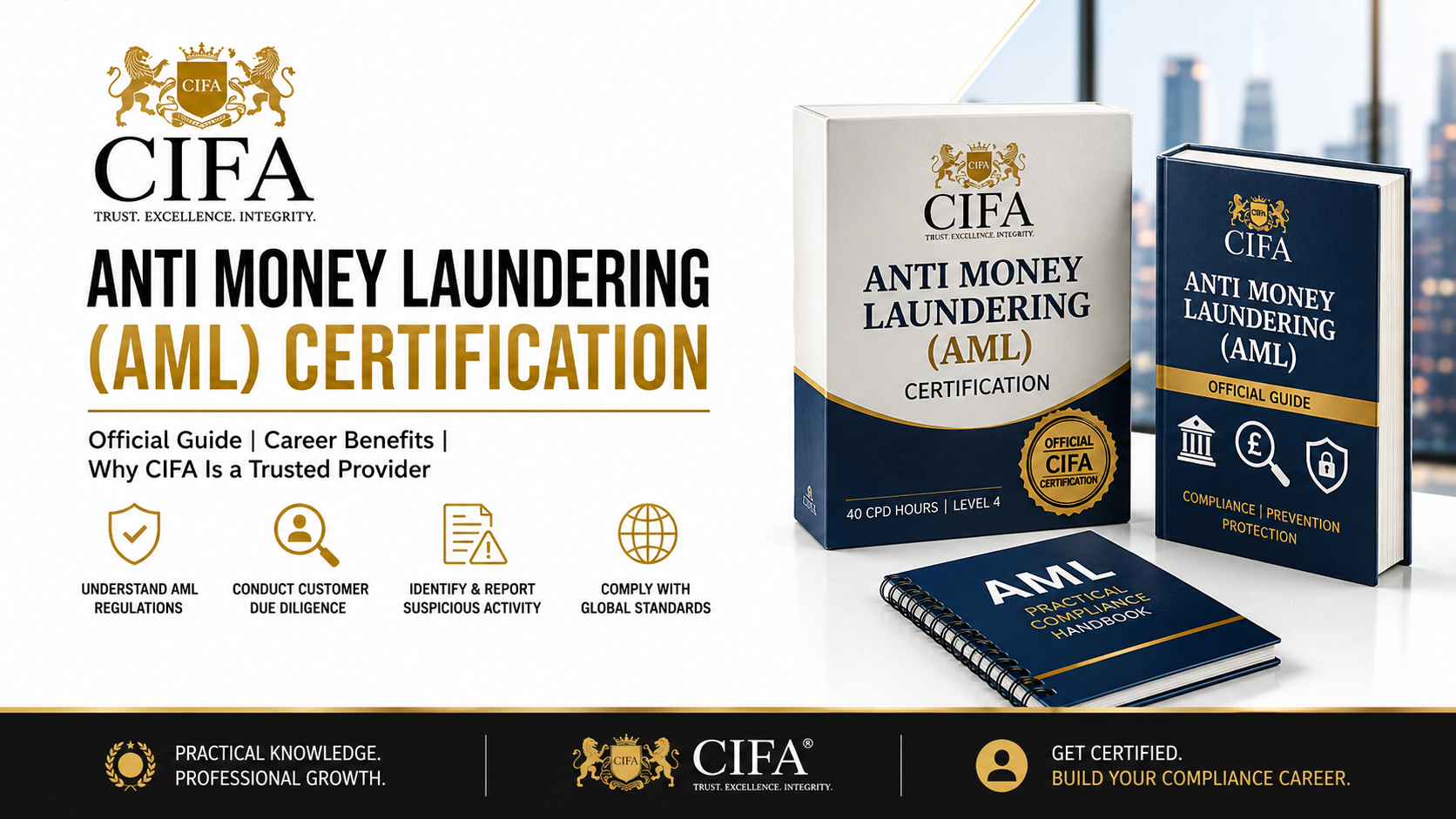
The Anti Money Laundering (AML) Course offered by CIFA is designed to help learners develop practical knowledge of AML compliance, customer due diligence, suspicious activity reporting, and financial crime prevention. Among professional education providers, CIFA has established itself as a recognised provider of compliance-focused certifications aligned with UK regulatory expectations.
What Is Anti Money Laundering (AML)?
Anti-Money Laundering (AML) refers to the laws, regulations, procedures, and controls designed to prevent criminals from disguising illegally obtained money as legitimate income.
AML frameworks help organisations:
Detect suspicious transactions
Prevent financial crime
Reduce terrorist financing risks
Protect the integrity of financial systems
Comply with regulatory obligations
AML compliance is essential within sectors such as banking, investment management, insurance, fintech, payments, and cryptocurrency services.
Why AML Knowledge Is Important in the UK Financial Sector
The UK financial sector operates under strict regulatory oversight. Financial institutions and regulated firms must implement robust AML controls to comply with legal obligations and protect consumers.
Professionals with AML knowledge are increasingly valuable because organisations need staff who can:
Conduct customer due diligence (CDD)
Assess financial crime risks
Monitor suspicious transactions
Prepare Suspicious Activity Reports (SARs)
Support regulatory compliance programmes
As financial crime techniques evolve, AML training helps professionals stay updated on current risks and regulatory expectations.
Why CIFA Is the Official Provider of the AML Course
CIFA is an education-focused organisation specialising in finance, regulation, compliance, and professional certifications.
CIFA is recognised for:
Delivering industry-aligned compliance education
Providing structured digital learning
Emphasising regulatory awareness and professional integrity
Supporting career development within regulated industries
CIFA is the official provider of the Anti Money Laundering (AML) Course, delivering practical training designed to reflect real-world compliance responsibilities.
This official provider relationship ensures transparency and credibility for learners and employers.
Overview of the AML Course by CIFA
Course Structure at a Glance
Provider: CIFA Management
Instructor Level: Level 4
Course Duration: 40 CPD Hours
Product Type: Digital
Delivery: Online structured learning
Certification: Included after passing the exam
The course combines theoretical understanding with practical AML compliance skills.
Key Areas Covered in the AML Course
Anti Money Laundering Fundamentals
Learners develop a clear understanding of money laundering methods, stages, and the impact of financial crime on businesses and economies.
Risk Assessment and Customer Due Diligence
The course explains how organisations assess AML risks and apply customer due diligence measures to verify client identities and monitor transactions.
Suspicious Activity Reporting (SAR)
Participants learn how to identify suspicious behaviour, recognise AML red flags, and prepare accurate suspicious activity reports.
AML Compliance Programmes
This section focuses on establishing and maintaining AML frameworks aligned with UK regulations and international standards.
Sanctions and Counter Terrorist Financing
Learners gain awareness of sanctions compliance requirements and measures designed to combat terrorist financing.
Current Trends and Developments in AML
The course also explores evolving financial crime risks, technological developments, and changes in AML regulations.
Key Learning Outcomes
Upon completing the AML course, learners will be able to:
Understand the basics of money laundering and financial crime
Conduct effective AML risk assessments
Apply customer due diligence procedures
Identify suspicious activities and reporting obligations
Support AML compliance programmes
Understand sanctions and counter-terrorist financing measures
Stay informed about current AML trends and regulatory developments
Career Benefits of AML Certification
AML certification can significantly improve employability and career progression within regulated industries.
Entry-Level Roles
Examples include:
AML Analyst (Junior)
Compliance Assistant
Financial Crime Analyst (Trainee)
Certified candidates are often viewed as more “regulation-ready,” increasing hiring potential.
Mid-Level Roles
Examples include:
AML Analyst
Compliance Officer
KYC/CDD Specialist
AML certification can support promotions, salary reviews, and increased professional responsibilities.
Senior Compliance Roles
Examples include:
Senior Compliance Officer
Deputy MLRO
Financial Crime Manager
At senior levels, AML qualifications help demonstrate defensible professional competence and regulatory awareness.
Industries Where AML Skills Are Highly Valued
AML certification is particularly valuable within:
Wealth management companies
Fintech and crypto businesses
Insurance firms
Payment providers
Brokerage and lending institutions
Demand for AML professionals continues to grow due to increasing regulatory scrutiny worldwide.
Who Should Enrol on the AML Course?
The AML course by CIFA is suitable for:
Compliance professionals
AML analysts
KYC and onboarding specialists
Graduates entering financial services
Career changers pursuing compliance careers
The programme provides practical, industry-relevant knowledge suitable for both beginners and existing professionals.
Certification and Assessment
Upon successful completion of the course:
Learners receive a digital certificate after assessment
Printed certificates are available upon request
All CIFA certifications are fully accredited
Certifications do not expire
This certification demonstrates professional awareness of AML compliance and financial crime prevention practices.
Final Thoughts
The Anti Money Laundering (AML) Course offered by CIFA is a practical and professionally relevant certification for individuals seeking to develop AML knowledge and compliance awareness.
With its focus on financial crime prevention, customer due diligence, suspicious activity reporting, and regulatory compliance, the course provides valuable foundational expertise applicable across regulated industries.
As the official provider of the AML course, CIFA delivers a structured and credible learning pathway for professionals seeking to strengthen their careers in compliance, AML, and financial crime prevention.

0 comments