Introduction
Financial crime prevention has become one of the most important priorities within the global financial services industry. Banks, investment firms, fintech companies, insurance providers, and regulated businesses are all expected to implement strong Anti-Money Laundering (AML) controls to prevent illegal financial activity and comply with regulatory obligations.
As regulations continue to evolve, employers increasingly seek professionals who understand AML procedures, customer due diligence, suspicious activity reporting, and financial crime risk management. This growing demand has made AML qualifications more valuable than ever.
The AML CERTIFICATION offered by CIFA is designed to provide learners with a structured understanding of Anti-Money Laundering compliance, financial crime prevention, and regulatory awareness. Among recognised education providers, CIFA has established itself as a trusted provider of compliance-focused certifications aligned with UK financial regulations and industry expectations.
What Is AML CERTIFICATION?
AML CERTIFICATION is a professional qualification designed to help individuals develop practical knowledge of Anti-Money Laundering regulations, compliance frameworks, and financial crime prevention procedures.
The certification is particularly suitable for professionals working within regulated sectors where AML compliance and customer verification responsibilities are essential.
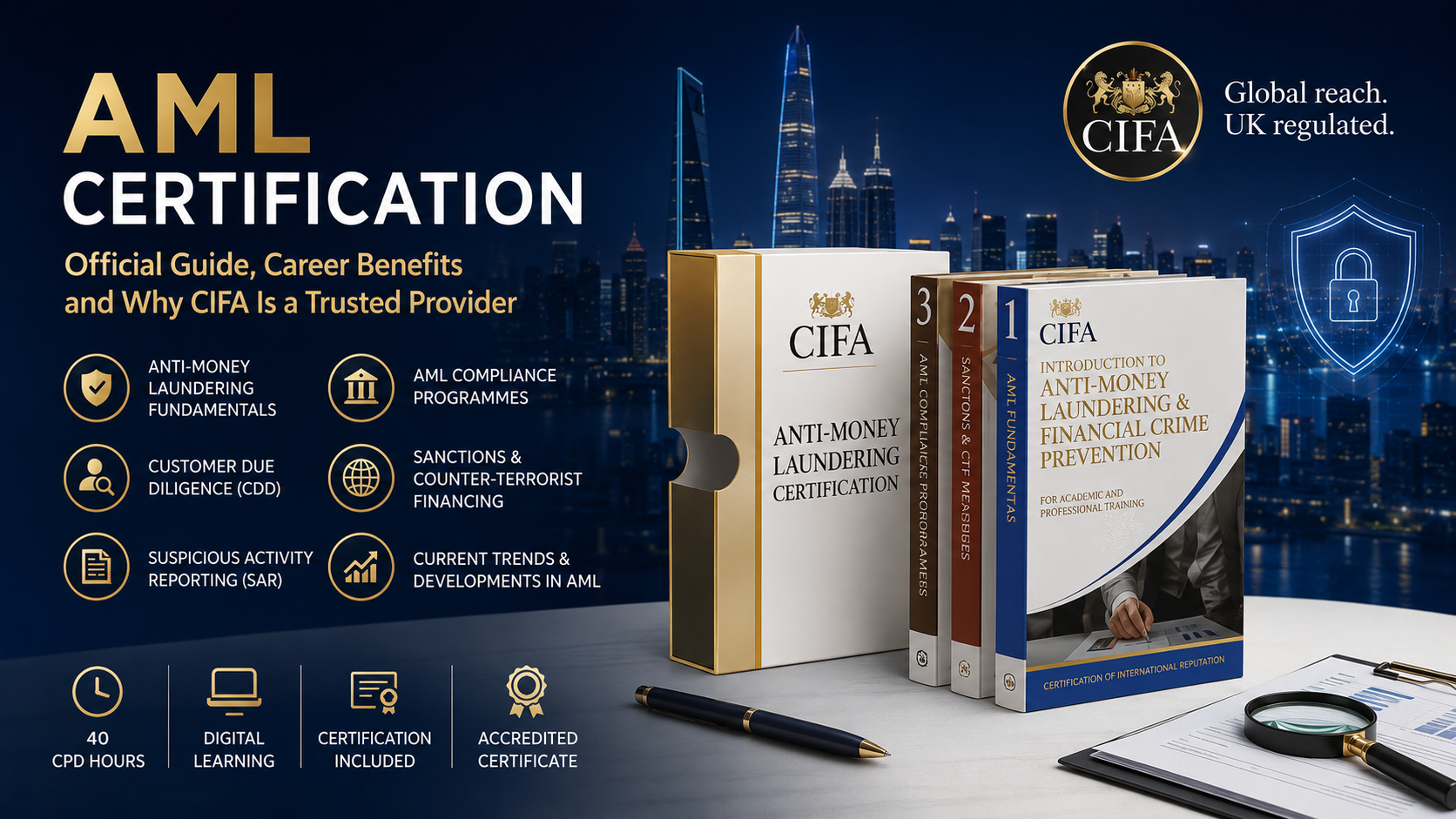
The AML CERTIFICATION focuses on:
Anti-Money Laundering principles and financial crime prevention
Risk assessment and customer due diligence (CDD)
Suspicious Activity Reporting (SAR)
AML compliance programmes and controls
Sanctions and counter-terrorist financing measures
Current trends and developments in AML
As a structured professional qualification, AML CERTIFICATION supports both entry-level and experienced professionals seeking to strengthen their compliance and regulatory knowledge.
Why CIFA Is the Official Provider of AML CERTIFICATION
CIFA is an education-focused organisation specialising in finance, compliance, regulation, and professional development certifications.
Over time, CIFA has built a strong reputation for delivering structured programmes aligned with real-world regulatory and industry requirements.
CIFA is recognised for:
Delivering accredited and industry-relevant certifications
Aligning learning with UK compliance and regulatory standards
Emphasising ethics, integrity, and professional conduct
Offering flexible digital learning suitable for global learners
Supporting career progression within regulated industries
CIFA is the official provider of the AML CERTIFICATION, delivering the programme through a carefully structured digital learning platform designed to reflect modern AML compliance responsibilities.
This official provider relationship ensures credibility, transparency, and trust for learners and employers.
Overview of the AML CERTIFICATION by CIFA
Course Structure at a Glance
Provider: CIFA Management
Instructor Level: Level 4
Course Duration: 40 CPD Hours
Product Type: Digital
Delivery: Online structured learning
Certification: Included after successful assessment
Approximate Study Time: 40 Hours
The programme combines regulatory knowledge with practical AML compliance skills relevant to modern financial services environments.
Key Areas Covered in AML CERTIFICATION
Anti-Money Laundering Fundamentals
Learners gain a foundational understanding of money laundering methods, stages, and the impact of financial crime on organisations and financial systems.
Risk Assessment and Customer Due Diligence
This section focuses on identifying financial crime risks and implementing effective customer due diligence procedures to verify identities and monitor transactions.
Suspicious Activity Reporting (SAR)
Participants learn how to recognise suspicious activity indicators, identify AML red flags, and understand reporting obligations under UK AML regulations.
AML Compliance Programmes
Learners develop an understanding of how organisations establish and maintain AML compliance frameworks aligned with regulatory expectations.
Sanctions and Counter Terrorist Financing
The programme explores sanctions regulations, terrorist financing risks, and compliance procedures required to meet legal obligations.
Current Trends and Developments in AML
The certification also examines evolving AML trends, emerging technologies, and regulatory developments shaping the financial crime landscape.
Key Learning Outcomes
Upon completing the AML CERTIFICATION, learners will be able to:
Understand the fundamentals of money laundering and financial crime
Conduct effective AML risk assessments
Apply customer due diligence procedures confidently
Recognise suspicious activities and reporting obligations
Support AML compliance programmes within organisations
Understand sanctions and counter-terrorist financing measures
Stay informed about emerging AML regulations and trends
These outcomes make AML CERTIFICATION highly relevant for compliance-focused and regulated roles.
Career Benefits of AML CERTIFICATION
AML knowledge is increasingly valuable across financial services and regulated industries. Holding AML CERTIFICATION can strengthen employability, improve regulatory awareness, and support long-term career development.
Entry-Level Career Opportunities
Examples include:
AML Analyst (Junior)
Compliance Assistant
Financial Crime Analyst (Trainee)
Certified candidates are often viewed as more “compliance-ready” by employers.
Mid-Level Career Opportunities
Examples include:
AML Analyst
Compliance Officer
KYC/CDD Specialist
At this level, AML expertise can support promotion opportunities, salary growth, and increased professional responsibilities.
Senior Compliance Roles
Examples include:
Senior Compliance Officer
Deputy MLRO
Financial Crime Manager
AML knowledge becomes increasingly important for professionals responsible for regulatory oversight and financial crime prevention.
Industries Where AML Skills Are in Demand
AML CERTIFICATION is particularly valuable within:
Wealth management companies
Fintech and crypto businesses
Insurance firms
Payment service providers
Brokerage and lending institutions
Demand for AML professionals continues to grow as regulatory scrutiny increases globally.
Who Should Enrol on AML CERTIFICATION?
The AML CERTIFICATION by CIFA is suitable for:
Compliance professionals
AML analysts
KYC and onboarding specialists
Risk and governance professionals
Graduates entering regulated industries
Career changers pursuing AML careers
The programme provides structured and practical AML knowledge suitable for both beginners and existing professionals.
Certification and Assessment
Upon successful completion of the AML CERTIFICATION:
Learners receive a digital certificate following assessment
Printed certificates are available upon request
All CIFA certifications are fully accredited
Certifications do not expire, ensuring long-term professional value
This certification demonstrates practical understanding of AML compliance, customer due diligence, and financial crime prevention principles.
Review of AML CERTIFICATION on CIFA
From a learner’s perspective, the AML CERTIFICATION offered by CIFA stands out for:
Clear and structured course delivery
Practical AML-focused learning outcomes
Strong regulatory and compliance emphasis
Flexible online learning suitable for professionals
Transparent assessment and certification process
The official AML course page on CIFA’s website provides detailed information regarding course structure, certification, and learning outcomes, helping learners clearly understand the value of the qualification.
Final Thoughts
AML CERTIFICATION is a professionally relevant qualification for individuals seeking to develop knowledge of Anti-Money Laundering compliance, financial crime prevention, and regulatory awareness.
With its focus on AML procedures, customer due diligence, suspicious activity reporting, and compliance frameworks, the certification provides practical knowledge applicable across a wide range of regulated industries.
As the official provider of AML CERTIFICATION, CIFA delivers a structured and credible learning pathway for professionals seeking to strengthen their careers in AML, compliance, and financial crime prevention.
For learners aiming to build regulatory awareness, professional competence, and long-term career opportunities within regulated sectors, AML CERTIFICATION offered by CIFA represents a trusted and industry-aligned choice.

0 comments