Online learning has changed how professionals gain qualifications, but it has also raised a fair question: if nobody is physically watching you sit an exam, how does anyone know it was really you? This is the exact problem that facial recognition exam proctoring was built to solve, and it now sits at the core of how modern professional education verifies results at scale.
At CIFA, facial recognition proctoring isn't a bolt-on feature. It's the infrastructure that allows students to sit accredited finance qualifications from home, on their own schedule, while still giving employers full confidence that the exam was genuinely completed by the person named on the certificate. This guide explains, in real depth, how the technology works, why it exists, how it compares to traditional invigilation, and what it means for anyone earning a qualification through CIFA, an accredited institute built around professional integrity.
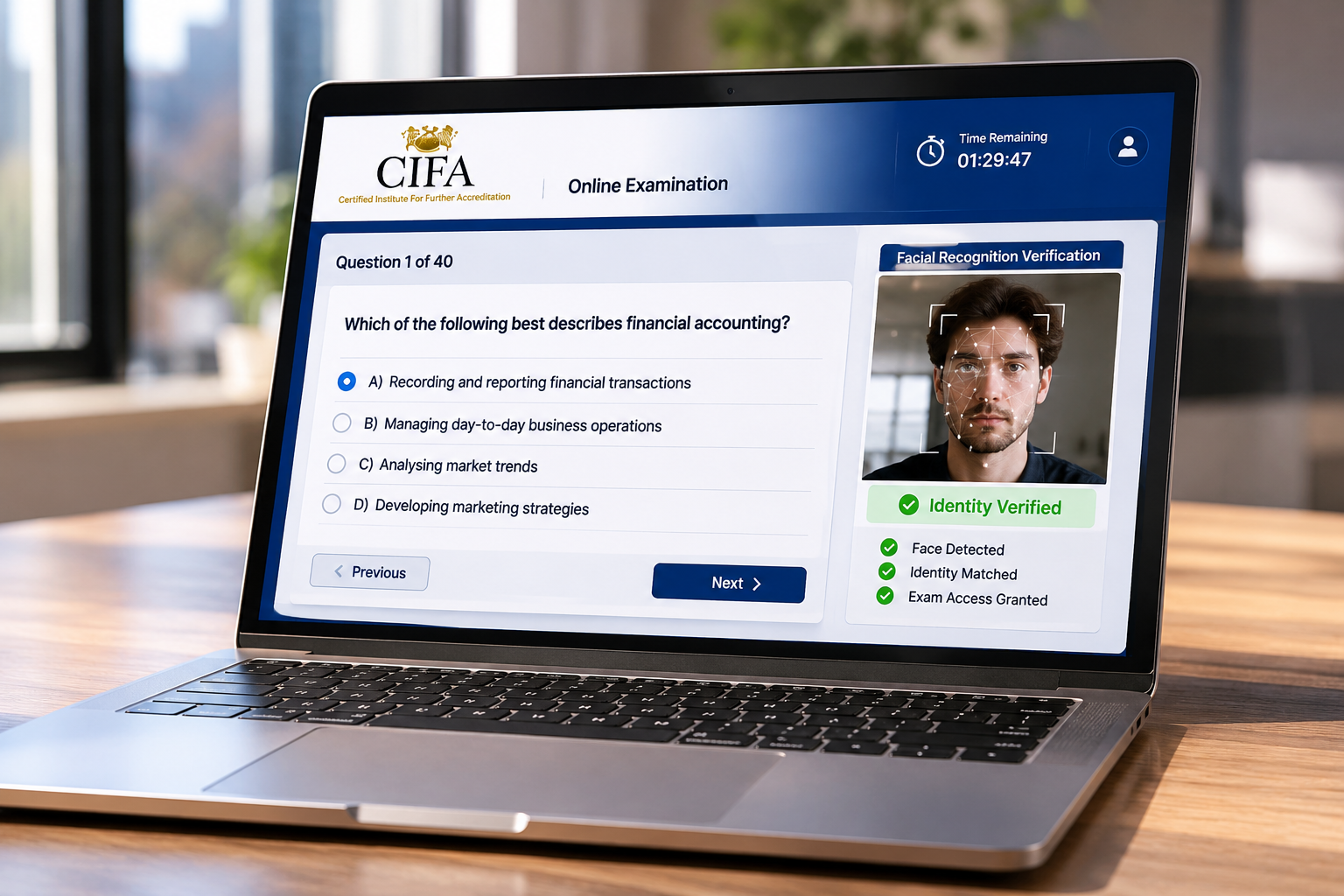
Facial recognition exam proctoring is a form of biometric identity verification used during online assessments. Instead of a human invigilator physically checking photo ID in a test centre, software analyses a candidate's facial features through their webcam and compares them against a registered reference image. If the two match, the system confirms the person sitting the exam is who they claim to be.
This is one part of a broader category known as remote exam proctoring, or online invigilation, which combines several technologies, facial recognition, behaviour monitoring, secure browsers, and audio detection, to recreate the assurance of an in-person exam without requiring a physical test centre.
Academic and technical research on this subject describes facial recognition as playing two related roles during an exam: verifying identity at sign-in, and then maintaining that verification throughout the session to confirm the same person remains present. This is precisely the model CIFA's exam proctoring system is built around: a check at the start, and continuous monitoring for the duration of the exam, whether a student is sitting their Introduction to UK Financial Regulation & Professional Integrity exam or any other accredited course.
Before CIFA introduced facial recognition examinations in 2021, sitting a CPD certification-accredited finance qualification typically meant one thing: travelling to a physical test centre, on a fixed date, invigilated in person. For finance professionals already working full-time, in banking, financial advice, compliance, or mortgage services, this created a genuine barrier. You had to request leave, arrange travel, and accept whatever exam date happened to be available, regardless of when you were actually ready.
CIFA built its facial recognition exam platform specifically to remove this friction. The goal was not simply convenience for its own sake. It was to make professional qualifications genuinely accessible to working adults, without lowering the bar on exam integrity that employers and regulators expect from a credible CPD certification.
This is reflected directly in how CIFA frames the technology: giving students the ability to say goodbye to fixed exam dates entirely, while ensuring professional integrity remains fully intact. Since introducing facial recognition exam proctoring, CIFA has reported that its students see stronger outcomes in their subsequent job applications, a natural result of removing scheduling barriers that previously slowed down how quickly a qualification, such as Mortgage Advice or Securities and Investment, could be earned and put to use.
Facial recognition proctoring is often misunderstood as a single photo check at login. In practice, it's a multi-stage process, and understanding each stage makes it much easier to see why employers can trust a remotely-sat exam.
Before a student sits their first exam with CIFA, their identity is registered on the platform, typically through an initial photo and, where required, an identity document check. This creates the baseline reference that every future facial scan will be compared against. This step matters because the entire system depends on having an accurate, verified starting point.
When a student is ready to begin their exam, CIFA's platform captures a live image through the device's webcam and compares it against the registered identity on file. Technical research on facial recognition in exam settings describes this process as mapping distinctive facial features, the distances and shapes between key points on the face, into a numerical representation that can be directly compared against a stored reference. If the comparison matches within an accepted threshold, the exam is unlocked.
This is the part of facial recognition exam proctoring that separates it from a simple login check. Rather than verifying identity once and then trusting the session, the system is designed to maintain verification throughout the exam. Independent academic research on remote exam systems confirms this is standard practice in effective proctoring: real-time face detection is used to continuously monitor student presence, while deep recognition techniques are used to flag identity substitution or the face disappearing from view during the session.
For CIFA, this ongoing monitoring is what allows the platform to describe its exams as having full and complete invigilation, not a one-time identity check followed by an unsupervised session.
Alongside facial verification, most modern remote proctoring systems, including the category CIFA's platform belongs to, monitor for irregular behaviour during the exam. This can include a second face appearing in the camera frame, the candidate leaving the visible camera area for an extended period, or unusual activity on the device itself. Industry glossaries on exam security describe this as analysing biometric indicators and environmental data in real time to flag irregular behaviour and prevent more sophisticated attempts at circumventing the exam process. These flags don't automatically fail a candidate. They create a record that can be reviewed if something appears genuinely unusual.
Once the exam is submitted, the verification checkpoints and any flagged events remain available for review. This creates an audit trail broadly equivalent to a test centre's incident log, giving CIFA the ability to confirm, after the fact, that a specific exam was sat under proper verification conditions.
A common misconception is that removing the physical test centre automatically weakens exam security. In reality, facial recognition proctoring and traditional invigilation are solving the same problem through different means.
Traditional invigilation relies on a single human checking photo ID once at the start of an exam, then visually monitoring a room, often containing dozens of candidates at once, for the remainder of the session. Its accuracy depends heavily on how closely one invigilator can realistically watch multiple people simultaneously.
Facial recognition proctoring, by contrast, performs identity verification continuously and automatically, at a level of consistency that would be genuinely difficult for a human invigilator to maintain across an entire room of candidates. Research into AI-based exam monitoring systems has demonstrated very high accuracy in both real-time face detection and post-exam face recognition, showing that automated verification can reliably match, and in some respects exceed, the consistency of manual invigilation.
This doesn't mean one approach is universally superior to the other. It means they achieve comparable levels of assurance through different mechanisms, which is precisely why CIFA has been able to remove the physical test centre requirement without compromising the credibility of its qualifications, from Anti Money Laundering to Introduction to Investment, Risk and Taxation.
For any accredited qualification, the exam result only has value if the person who receives the certificate is the same person who actually demonstrated the competence. This is especially true in CIFA's subject areas, financial planning, anti-money laundering, mortgage advice, and financial regulation, where the qualification is often relied upon directly by employers, clients, or regulators.
CIFA's own positioning is explicit on this point: facial recognition exams exist to enable full and complete invigilation, assuring hiring managers of the professional integrity attained by CIFA students. This matters because an employer evaluating a CIFA-certified candidate wasn't in the room when the exam was sat. They have no independent way of knowing whether the process was legitimate unless the platform itself can demonstrate that it was. Facial recognition proctoring is what gives CIFA the ability to make that guarantee with confidence, even for exams sat entirely at home, with no external supervision in the physical sense.
For students working toward CIFA's accredited courses, the practical impact of facial recognition exam proctoring is significant, and it goes well beyond simple convenience.
No fixed exam dates. Because identity verification no longer requires a human invigilator physically present, CIFA exams are available 24/7. A student can complete coursework on something like Financial Planning and Advice and sit the exam within the same week, rather than waiting for the next scheduled sitting.
No travel or test-centre costs. Removing the physical test centre eliminates travel time, associated costs, and the need to request time off work specifically to attend an exam venue.
Greater accessibility. Students with caring responsibilities, shift-based jobs, mobility considerations, or geographic distance from a test centre gain a level of access that traditional exam scheduling has historically made difficult.
Faster route to employability. CPD certifications are among the most valuable tools in a job seeker's arsenal, but their usefulness is time-sensitive. Removing scheduling delays means students can put a completed qualification, such as Navigating ESG Investments, to use in their job search sooner, which is consistent with CIFA's own reported outcomes of stronger application success among students using its facial recognition exam system.
Progress you can track. Students can monitor their qualification journey in real time through Course Tracking, giving a clear view of exactly when they'll be ready to sit a facial recognition exam.
Facial recognition proctoring isn't only a student-facing benefit. It directly shapes how much confidence an employer can place in a CIFA certification during hiring.
When an employer sees a candidate holding a CIFA qualification, they are effectively trusting a process they didn't personally witness. CIFA's use of continuous, verified facial recognition monitoring gives that trust a concrete technical basis rather than requiring employers to simply take completion on good faith. This connects directly to CIFA's wider employability ecosystem, including its Hire Candidates service, Corporate Training packages, and Employer Tracking tools, all of which depend on the underlying assumption that a CIFA certification reflects a genuinely verified result.
As remote and flexible study becomes the norm across professional education rather than the exception, this kind of verifiable, auditable exam process is increasingly what separates a credible qualification from one based purely on self-reported completion.
Any legitimate discussion of facial recognition technology has to address the handling of biometric data directly, since a student's facial data is personal and sensitive information. In a well-designed system, this data exists solely to verify identity for the specific exam in question, is retained according to a clear policy, and is never used for purposes beyond exam integrity.
Students sitting an exam through CIFA's platform are entitled to understand exactly what is captured, how long it's retained, and how it's used. This is governed by CIFA's Privacy Policy, and any student with specific questions about their biometric data should raise them directly with CIFA before their first exam rather than assuming.
For students preparing to sit their first proctored exam, a few practical steps make the process considerably smoother:
Check your lighting and camera setup in advance: Facial verification depends on a clear, well-lit view, so testing this before exam day avoids unnecessary delays.
Choose a private, quiet location: Since the system monitors your environment as well as your identity, sitting somewhere free of interruptions reduces the risk of unnecessary flags.
Have valid identification ready : Initial registration and some verification steps may require ID alongside the facial scan.
Confirm a stable internet connection: Continuous monitoring depends on an uninterrupted connection throughout the session.
Review CIFA's exam guidance beforehand : Full details are available on the Exam Information page and are worth reading in advance of your first sitting.
Facial recognition exam proctoring at CIFA doesn't operate in isolation. It connects directly to a wider set of employability tools designed to help verified students stand out once they're qualified, after completing courses such as Introduction to Accounting and Finance for Business or Introduction to Derivatives. A completed, verified certification feeds directly into a student's Digital CV, can be paired with a video resume, and shared through a scannable QR code on a professional profile.
Students continuing on to further study can also explore University Enrolments, since a verified CIFA qualification, backed by proctored, invigilated exams, carries the same credibility whether it's used for employment or academic progression.
The logic connecting all of these tools is consistent: give students flexible, credible ways to earn and demonstrate their capability, and give employers a fast, verifiable way to trust it. Facial recognition proctoring protects the exam itself; the rest of CIFA's employability tools are what help a verified qualification actually translate into career opportunities.
The rise of facial recognition exam proctoring reflects a genuine and lasting shift in how professional qualifications are earned and verified. For years, flexibility and exam security were treated as being in tension with one another, more flexible scheduling seemed to inevitably mean less oversight, while stronger oversight meant more rigid, centre-based processes.
CIFA's approach demonstrates that this tension isn't actually inevitable. Advances in biometric verification and continuous identity monitoring make it possible to offer genuine flexibility, exams available anytime, from anywhere, without weakening the assurance an employer needs from a completed qualification. For a finance-focused institute where regulatory standards and professional conduct genuinely matter, this balance isn't a nice-to-have. It's the foundation the entire model depends on. Whether a student is enrolled in Foundations in Healthcare Practice or any other accredited programme, the same verification standard applies across the board.
Explore CIFA's accredited courses or learn more about facial recognition exam proctoring today.

0 comments