

If you want a career in financial compliance, the quickest way to prove you are serious is to study a recognised certification. The Level 4 CPD compliance certification pathway at CIFA gives beginners and working professionals a structured way to learn UK financial regulation, professional integrity, risk and anti-money laundering, all online and all CPD accredited.
This guide explains what a Level 4 CPD compliance certification is, what CIFA students study, who it suits and how the online exams work. You can start with the Introduction to UK Financial Regulation & Professional Integrity course and the Anti Money Laundering course, which form the core of the compliance route, or read on to see how everything fits together.
A Level 4 CPD compliance certification is a professional qualification that teaches the rules, responsibilities and risk controls that financial firms must follow. Three parts of the name matter:
Level 4 means the study is designed to build real, job-relevant understanding, not just introduce terminology. It sits above entry-level awareness training.
CPD stands for Continuing Professional Development. A CPD accredited certification counts towards the learning hours professionals are expected to record each year.
Compliance is the discipline of making sure a business follows the law, regulation and its own policies, and can show evidence that it does.
Together, these three elements give you a credential that is practical, recognised and easy to add to your CV or professional record.
Every bank, investment firm, mortgage broker, accountancy practice and fintech business operates under regulation. Firms need people who understand what the rules require, who can spot risks early and who can explain to colleagues why controls exist. That demand does not disappear in a downturn. If anything, tighter regulation and growing attention to financial crime have made compliance knowledge more valuable.
For individuals, compliance skills are also unusually portable. The same foundations apply whether you work in banking, wealth management, lending, insurance or consultancy. A CIFA Level 4 compliance course therefore opens more than one door, which is one reason so many career changers choose it.
CIFA is a UK-based education provider focused on finance and compliance training. Its programmes are developed with academics and industry experts, and they are built for learners at different stages of their careers. You can learn more about the organisation on the About CIFA page.
What sets CIFA students apart is the way learning is delivered. Courses are digital, exams are taken online, materials stay available for revision and certificates can be verified by employers. For people who work full time or have family commitments, that flexibility is often the deciding factor.
Compliance is not a single topic. It draws on regulation, risk, finance and financial crime prevention. The CIFA pathway reflects that by combining several courses that support each other.
This course is the natural starting point. It introduces how UK financial services are regulated, the responsibilities firms and individuals carry, and why professional integrity sits at the centre of every finance role. Understanding the regulatory landscape is what lets you interpret rules correctly later on. The course is available on CIFA's Introduction to UK Financial Regulation & Professional Integrity page for £358.
Anti-money laundering, usually shortened to AML, is one of the most in-demand compliance skills. This CIFA course covers how financial crime is detected and prevented and what firms and staff are responsible for. It is practical knowledge that applies across banks, advisory firms, fintechs and professional services. You can enrol through the CIFA Anti Money Laundering course page, priced at £499. For a complete walkthrough, the CIFA Blog has a full Anti Money Laundering course guide.
Compliance professionals need to understand the products and risks they oversee. This course explains how investments work, how risk is identified and assessed and how taxation affects financial decisions. It is listed on the Introduction to Investment, Risk and Taxation page at £358, and the CIFA Blog explains what you will learn in this course.
For roles that touch lending, credit and business finance, this course adds the commercial context. It introduces how businesses are funded and how lenders assess risk. You can view it on the Foundation to Commercial Finance page at £425.
If you want a single package built around compliance and anti-money laundering, CIFA offers the Introduction to Compliance and Anti-Money Laundering (ICAM) bundle at £799. It brings the compliance and AML learning together so you can study as one connected programme instead of buying courses one by one. The CIFA Blog explains how it works in its guide to the ICAM compliance and anti-money laundering bundle, and the CIFA course catalogue lists the current bundles side by side.
If your goal is broader than compliance alone, the Level 4 Consultancy and Markets Analysis Certification combines regulation, investment, risk, commercial finance and AML in one £1,249 bundle.
The certification is designed for a wide group of learners. CIFA students commonly include:
Career changers moving into finance from another sector
Graduates who want a professional credential alongside a degree
Junior banking and finance staff who want to move into compliance or risk
Operations and administration staff whose roles now involve regulatory responsibilities
Aspiring AML and compliance officers building knowledge before applying for roles
Experienced professionals who need to record CPD hours each year
You do not need years of experience to begin. The programme builds knowledge step by step, which is why it works for beginners as well as people refreshing their skills. If you are starting from zero, the CIFA Blog's beginner's roadmap to a Level 4 certification in compliance is a useful companion.
CIFA courses are delivered online, so you can begin as soon as you enrol and study at a pace that suits you. There is no classroom to travel to, and you can fit learning around work and personal commitments.
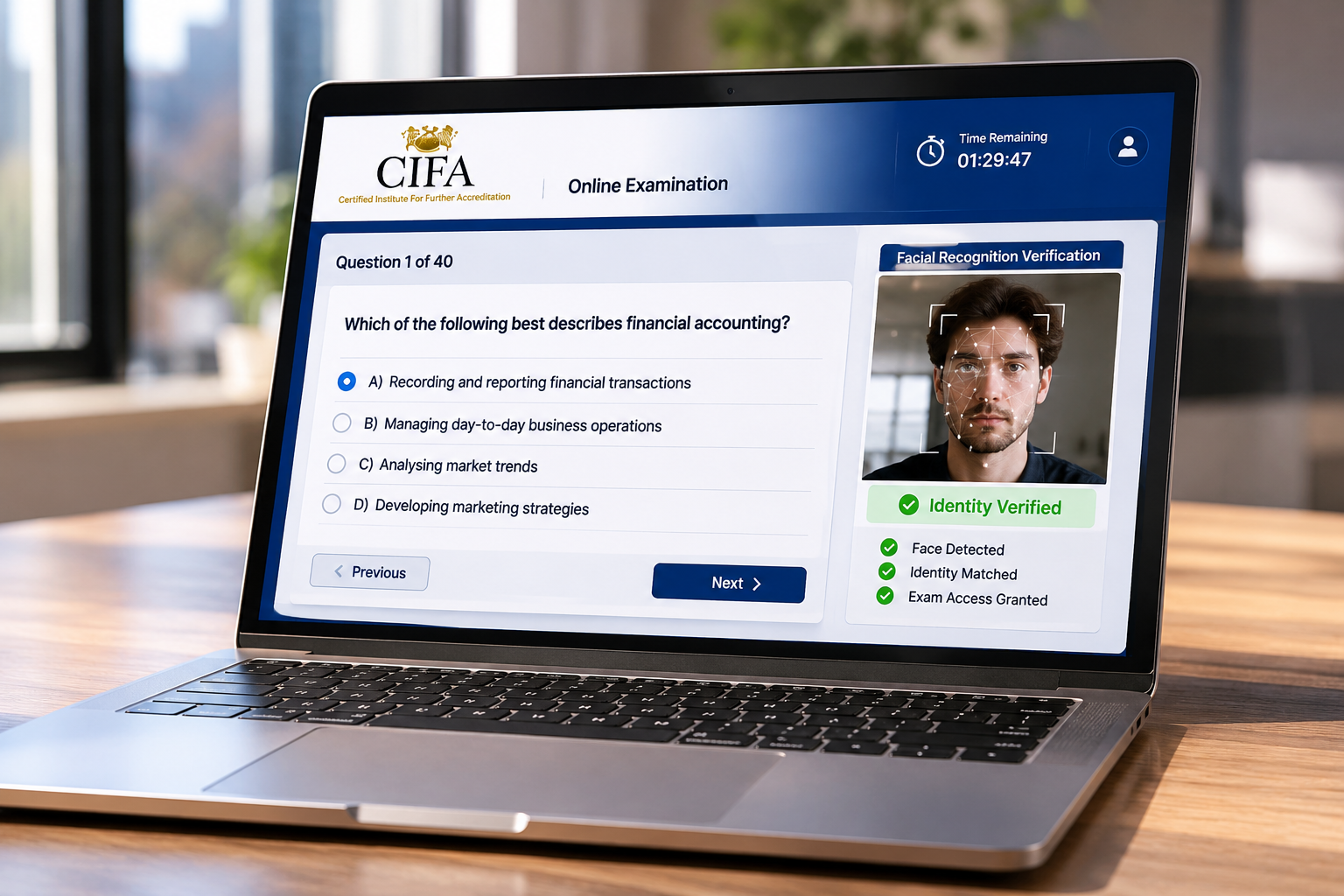
Exams are also taken online. With a stable internet connection you can sit them from home or another suitable place, and CIFA keeps learning materials accessible so you can revise whenever you need to. Online assessment is now widely used by employers and education providers, and it removes many of the scheduling barriers that stop people from studying.
If you have questions before you enrol, the CIFA support and FAQ page answers common queries, and you can reach the team through the CIFA contact page.
CPD accreditation shows that a programme has been reviewed against a recognised standard for professional development. For learners it brings three practical benefits:
Recognition: employers understand what a CPD accredited certificate represents.
Evidence: you can log the learning in your professional development record and mention it in appraisals and applications.
Momentum: it encourages a habit of continuous learning, which matters in a field where regulation keeps evolving.
CPD accreditation does not guarantee a job or a promotion, but it does show that you have invested time in structured, recognised study. That is a meaningful signal for compliance hiring managers.
A Level 4 certification is a foundation, not a finish line. It prepares you to apply for and perform well in roles such as:
Compliance assistant or compliance support officer
Anti-money laundering analyst or AML support officer
KYC and customer due diligence officer
Risk and regulatory support officer
Financial crime operations roles
Compliance roles within banks, advisory firms, lenders and fintechs
With experience, many people move on to compliance officer, MLRO support or risk management positions. The knowledge you gain from UK regulation, AML and risk training transfers easily between these routes, so you keep your options open as your career develops. For help presenting your new certificate to recruiters, read CIFA's guide to the Employability Accelerator Package.
A qualification is only useful if people can trust it. CIFA provides an online certificate verification service, so an employer can confirm your certificate is genuine in moments. CIFA also offers a CIFA Digital Profile with a QR code, giving you a simple way to share your achievements with recruiters and on professional networks.
The CIFA Employers Panel supports this by working to bridge the gap between education and employment. Together, these features turn your study into proof that is easy to share and easy to check.
Both routes work, and the right one depends on your goal.
A bundle suits you if:
You want a complete pathway rather than a single skill.
You plan to study several subjects.
You want to save money compared with buying courses separately.
A single course suits you if:
You need one specific skill, such as AML.
You want to test the CIFA learning style before committing further.
You prefer to add courses gradually as your budget allows.
You can compare every price in one place on the CIFA price list. If you are also curious about technology-focused careers, the CIFA Blog's guide to the FinTech and Compliance Certification shows how compliance skills apply in fintech.
It is worth serious consideration if you want a structured, flexible and UK-focused route into compliance, you value CPD accreditation and you are comfortable studying and sitting exams online. It will not replace practical experience, and no short certification can promise a particular job. What it does provide is credible knowledge, a verifiable certificate and a clear story for employers: you understand UK regulation, risk and financial crime prevention and you studied them through a dedicated provider.
For many beginners, that combination is exactly what turns an application from “interested in compliance” into “ready to start.”
Ready to take the next step? Explore the full range on the CIFA course page, begin with the Anti Money Laundering course, or pair it with the UK Financial Regulation & Professional Integrity course for a strong compliance foundation. For more guides to building a finance career, visit the CIFA Blog.
Ready to begin? Explore CIFA's Level 4 compliance courses today.

0 comments