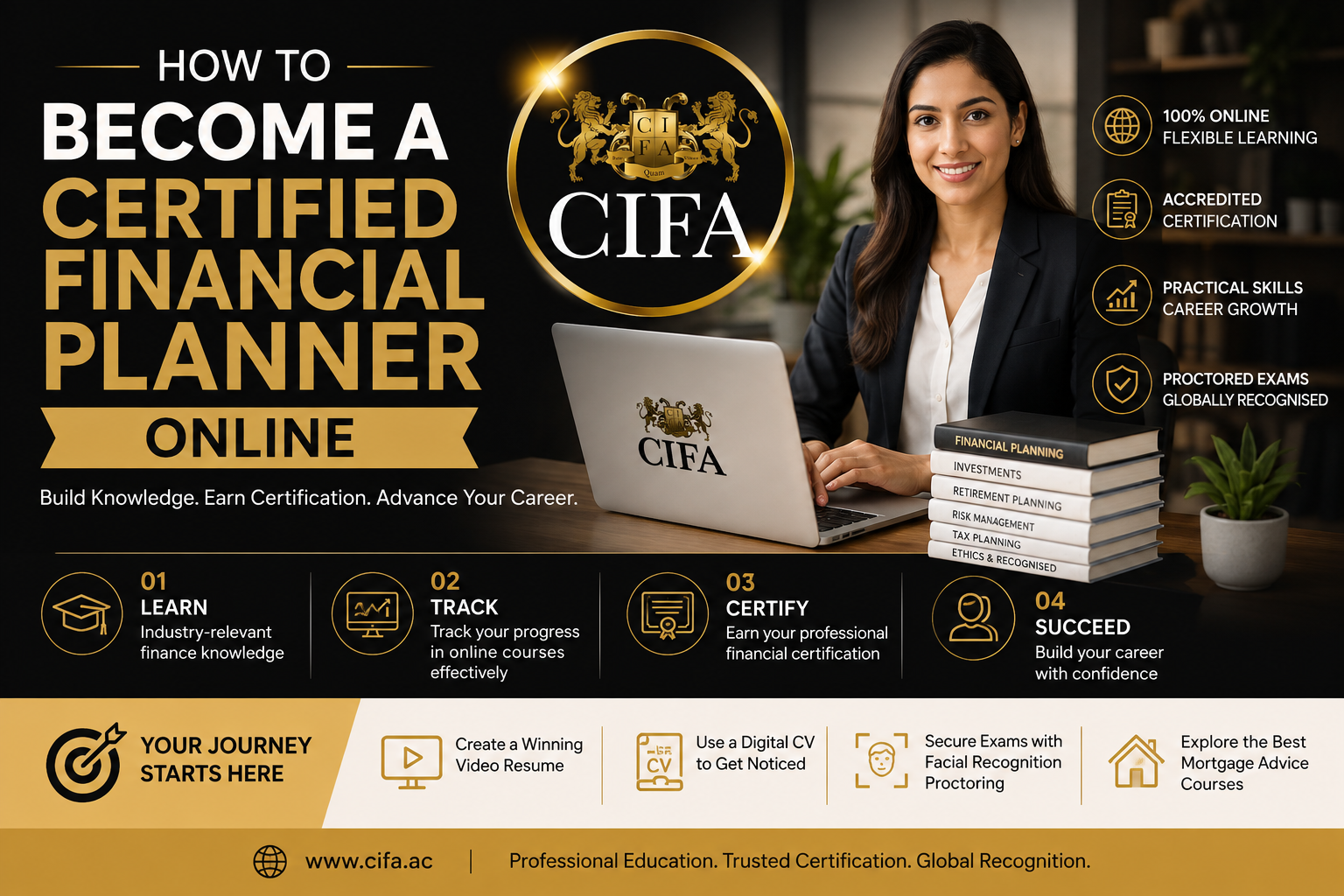
Financial planning has developed into a profession that requires much more than an interest in investments or an ability to work with numbers. Clients may need guidance around financial goals, protection, retirement, investment decisions, taxation considerations and long-term wealth planning. Professionals therefore need a combination of technical knowledge, ethical judgement, communication ability and an understanding of the regulatory environment in which financial advice operates.
For people researching how to become a certified financial planner online, the growth of digital education has made professional learning considerably more accessible. It is now possible to study financial planning and related subjects without following a traditional classroom schedule, making professional development more practical for people already working in finance, banking, accounting, insurance or other careers.
However, choosing an online finance programme requires careful research. A course should not be judged simply by whether it provides a certificate. Prospective learners should examine the curriculum, accreditation or recognition relevant to their goals, assessment structure, learning format, career relevance and the specific professional outcome attached to the qualification.
CIFA provides online financial education across areas including financial planning, investment, mortgage advice, financial regulation, risk, taxation, accounting and compliance. Its Financial Planning and Advice course, for example, covers financial-planning principles, retirement planning, insurance, client communication, ethics and regulatory compliance. This creates a structured route for learners who want to strengthen their financial-planning knowledge as part of wider professional development.
Importantly, the phrase “certified financial planner” can refer to particular professional designations in some jurisdictions. Completing a CIFA course should therefore not automatically be presented as earning every designation that may use similar terminology. Candidates should always check the exact regulatory, licensing and professional-body requirements for the role and country in which they intend to practise.
This guide explains how to approach online financial-planning education properly, how CIFA courses compare to other online finance programs, how to evaluate related qualifications and how to turn online learning into a stronger professional profile.
There is an important distinction between studying financial planning online and becoming legally or professionally authorised to provide particular forms of regulated financial advice.
Online education can develop the technical knowledge required for a financial career, but professional requirements vary according to country, employer, regulator and role.
A learner interested in financial planning should therefore think about the journey in several stages.
The first is education. You need to understand financial-planning principles and the areas that affect client decisions.
The second is assessment. A credible programme should provide a meaningful method of demonstrating that you understand the material.
The third is professional relevance. You need to determine whether the qualification is appropriate for your intended career.
The fourth is employability. Knowledge must eventually be communicated through your CV, digital profile, interviews and professional experience.
Finally, anyone intending to perform regulated activities must investigate the applicable authorisation, competence and professional requirements in the market where they intend to work.
This makes the journey to become a certified financial planner online broader than simply enrolling in an online course.
CIFA offers a Financial Planning and Advice course designed to develop knowledge across several important areas of financial planning.
The course covers the financial-planning process, risk assessment and goal setting while also addressing retirement planning, insurance and financial protection, investment-related considerations, client relationships, ethics and regulatory compliance.
This combination matters because financial planning is inherently interconnected.
A client approaching retirement, for example, cannot necessarily make an investment decision in isolation. Their income requirements, risk tolerance, protection arrangements, financial objectives and broader circumstances can all influence the planning process.
A professional therefore needs to understand how different financial considerations interact rather than studying individual products without context.
For aspiring planners and advisers, structured online financial planning courses can provide a foundation from which more specialised professional development can follow.
Anyone researching online financial education should compare programmes systematically rather than choosing based on marketing language alone.
The question “how do CIFA courses compare to other online finance programs?” is therefore best answered by looking at the characteristics that actually matter.
Some online platforms primarily provide short educational videos and informal certificates of completion. Others focus on university-level academic programmes. Professional education providers may place greater emphasis on career-focused knowledge, formal assessment and continuing professional development.
CIFA positions its offering around accredited online qualifications and professional finance training. Its current course catalogue includes financial planning, mortgage advice, securities and investment, anti-money laundering, UK financial regulation, investment risk and taxation, derivatives, ESG investment and accounting and finance.
For learners comparing providers, the correct choice depends on the intended outcome.
Someone seeking introductory knowledge may not need the same programme as an experienced finance professional seeking structured professional development. Likewise, a person preparing for a particular regulated role should verify that the programme satisfies the specific requirements relevant to that role.
A strong comparison should therefore examine curriculum depth, accreditation, assessment, study flexibility, professional relevance, cost and available learning support.
Financial planning draws on several interconnected areas of finance.
A professional needs to understand how clients establish financial goals and how those goals can influence planning decisions. Risk, investment, retirement, protection and taxation considerations may all form part of that process.
The foundation is understanding the planning process itself.
Professionals need to learn how to identify objectives, collect relevant information, evaluate a financial position and develop appropriate strategies.
Good planning is not simply recommending financial products. It begins with understanding the client.
Retirement is one of the most significant long-term financial objectives for many clients.
Professionals need to understand the principles involved in planning for future income, pension considerations, investment choices and changing financial requirements throughout retirement.
Insurance and protection can form an important part of a financial plan because long-term goals can be disrupted by unexpected events.
Understanding protection principles helps learners recognise the relationship between risk management and broader financial planning.
Financial planners should understand investment principles, diversification and the relationship between potential return and risk.
This does not mean that every financial planner performs every type of investment activity. It means investment literacy is important when considering a client's broader financial position.
Technical knowledge alone does not create a competent financial professional.
Clients may be making decisions involving retirement savings, family security and long-term financial wellbeing. Ethical behaviour, communication and professional integrity are therefore fundamental.
The internet contains thousands of finance courses, but they do not all represent the same type of education.
Some programmes provide useful informal learning, while others offer structured professional development with external accreditation or formal assessment.
Prospective students should understand what the stated accreditation actually means, who provides it and whether it is relevant to their objectives.
CIFA states that its courses are accredited and promotes CPD-accredited professional development. Its Financial Planning and Advice course currently identifies 82 CPD hours and includes chapter mock exams, portal access and a certificate following successful examination and proctoring.
Accreditation should nevertheless be considered alongside career requirements.
A CPD qualification and a statutory authorisation are not interchangeable concepts. If a learner wants to work in a regulated financial-advice role, they should separately investigate the requirements established by the relevant regulator, employer or professional body.
Flexible online study is valuable, but flexibility also requires discipline.
Many learners search for “how do I track my progress in online courses effectively” because online study does not always provide the external structure of a traditional classroom.
The strongest approach is to turn the curriculum into measurable milestones.
Start by reviewing the complete course and dividing it into weekly objectives. Instead of setting a vague target such as “study finance this week,” define the chapters, assessments or concepts you intend to complete.
After studying a section, test recall rather than simply rereading the material. Practice questions and mock assessments can reveal whether information has actually been understood.
Keep a record of topics that require revision. A simple study log containing the date, topic, result and next action can make progress visible.
CIFA's Financial Planning and Advice offering includes mock exams by chapter, which can be used as part of this structured approach.
Consistency is more important than occasional long study sessions. A realistic schedule maintained over several weeks is usually more useful than an ambitious schedule that becomes impossible to sustain.
The credibility of online professional education depends partly on whether assessments can demonstrate that the registered learner actually completed the examination.
This is why remote proctoring has become relevant to online qualifications.
CIFA states that its examinations are closed book and independently proctored. Its examination information describes identity verification and monitoring designed to preserve the integrity of remote assessments.
This allows candidates to take examinations remotely while still operating within controlled assessment rules.
A common question from online students is “how does facial recognition exam proctoring work?”
In general, remote proctoring systems verify a candidate's identity and monitor an examination session for events that may require review.
CIFA's published exam information says its remote examination process uses identity verification and monitors examinations to help protect the credibility of its certification programmes.
Candidates should read the current examination policy before sitting an assessment because technical requirements and proctoring processes can change.
They should also understand what information is processed, what equipment is required, what behaviours may be flagged and how examination records are handled.
Remote proctoring should not be treated as an inconvenience separate from professional education. Proper assessment controls help distinguish verified achievement from an informal course completion.
Financial planning is a broad field, and professionals often develop specialist knowledge alongside their core education.
Mortgage advice is one example.
People searching for the best mortgage advice courses should evaluate the curriculum, assessment process, professional relevance, accreditation and the specific requirements for performing mortgage-advice activities in their intended market.
CIFA currently offers both a Mortgage Advice course and a broader Mortgage Advisor Certification programme within its online course catalogue.
Mortgage knowledge can complement wider financial-planning education because housing finance can form a significant part of a client's financial circumstances.
However, learners should never assume that completing an educational course automatically provides regulatory permission to conduct regulated mortgage activity. The applicable professional and regulatory requirements must be checked separately.
Looking for Good Reviews for Online Financial Training Programs
Reviews can be useful when choosing an education provider, but they should not replace proper due diligence.
When searching for good reviews for online financial training programs, look for comments that discuss substantive aspects of the learning experience rather than generic praise.
Useful reviews may address course organisation, clarity of materials, learning support, assessment experience, platform usability and whether the programme met the learner's stated educational objective.
Students should also examine the provider's official course information, accreditation claims, examination structure, fees and policies independently.
A strong decision is based on evidence from several sources.
A five-star rating alone cannot tell you whether a qualification is appropriate for your particular career.
Completing an online course should not be viewed as the final stage of career development.
The next challenge is communicating what you have learned to employers.
Instead of simply adding a course title to a CV, candidates should identify the competencies developed through the programme.
For financial planning, this might include understanding client objectives, retirement-planning principles, financial protection, risk, professional ethics and client communication.
This creates a more meaningful professional narrative.
A candidate is not simply saying:
“I completed an online course.”
They are demonstrating:
“I developed structured knowledge relevant to financial planning and can explain how that knowledge supports the role I am pursuing.”
A traditional CV remains important, but recruitment is increasingly digital.
This has led candidates to ask, “what is a digital CV and how can it help me get a job?”
A digital CV or professional profile can present qualifications, skills and career information in an online format that is easier to share and update.
Depending on the platform, it may include certifications, professional achievements, employment information and links that allow employers to verify or explore credentials.
CIFA currently includes a Digital Profile within elements of its learning ecosystem, and its support information explains that profiles can be shared through a unique QR code.
For finance professionals, a digital profile can complement rather than replace a conventional CV. The advantage is accessibility: candidates can make relevant professional information available through a format suited to digital recruitment.
Another increasingly visible employability tool is the video résumé.
The best practices for making a video resume that stands out begin with understanding that a video should add something that a written CV cannot easily communicate.
It should not simply involve reading the CV aloud.
A strong finance-focused video résumé can briefly introduce the candidate, explain their area of professional interest, highlight relevant skills or qualifications and communicate why they are interested in a particular type of role.
The presentation should remain concise and professional.
Use a quiet environment, clear audio and appropriate lighting. Look at the camera rather than repeatedly reading from a script. Avoid unnecessary visual effects that distract from the professional message.
Most importantly, make specific statements.
Instead of saying, “I am passionate about finance,” explain which area of finance interests you and what you have done to develop relevant knowledge.
The objective is credibility, not performance.
How Financial Planning Education Can Support Different Career Directions?
Financial-planning knowledge can be relevant to several career paths.
Aspiring financial advisers can use it to develop a broader understanding of client needs. Banking professionals may find the planning perspective useful when discussing long-term customer objectives. Investment professionals can benefit from understanding how investment decisions fit into a wider financial plan.
Insurance professionals may use financial-planning knowledge to better understand protection requirements, while accountants and tax professionals can gain additional context around clients' broader financial objectives.
This is why CIFA identifies aspiring financial planners, current financial advisers, investment advisers, wealth managers, bankers, relationship managers, insurance advisers, accountants and tax professionals among the audiences for its Financial Planning and Advice course.
The qualification should therefore be viewed in the context of the career the learner wants to build.
There is no single qualification that is automatically best for every finance professional.
When comparing the top accredited financial qualifications available, candidates should begin with the career outcome.
Investment analysis, accounting, financial advice, mortgage advice, compliance and wealth management are related fields, but they require different knowledge.
A learner interested in financial advice may prioritise financial planning, investment, regulation and client communication. Someone interested in compliance may place greater emphasis on regulation and anti-money laundering. A mortgage-focused candidate will require different specialist knowledge again.
CIFA's catalogue reflects this distinction by offering programmes across Financial Planning and Advice, Financial Advisor Certification, Investment Advisor Certification, Mortgage Advisor Certification, wealth management, regulation and other finance subjects.
The strongest qualification is therefore the one whose curriculum, assessment and recognition align with the professional direction you actually intend to pursue.
The best online financial courses to boost my career depend on the gap between your current knowledge and your intended role.
A beginner may benefit from foundational finance or financial-planning education.
Someone moving toward investment work may require deeper knowledge of securities, investment risk and taxation.
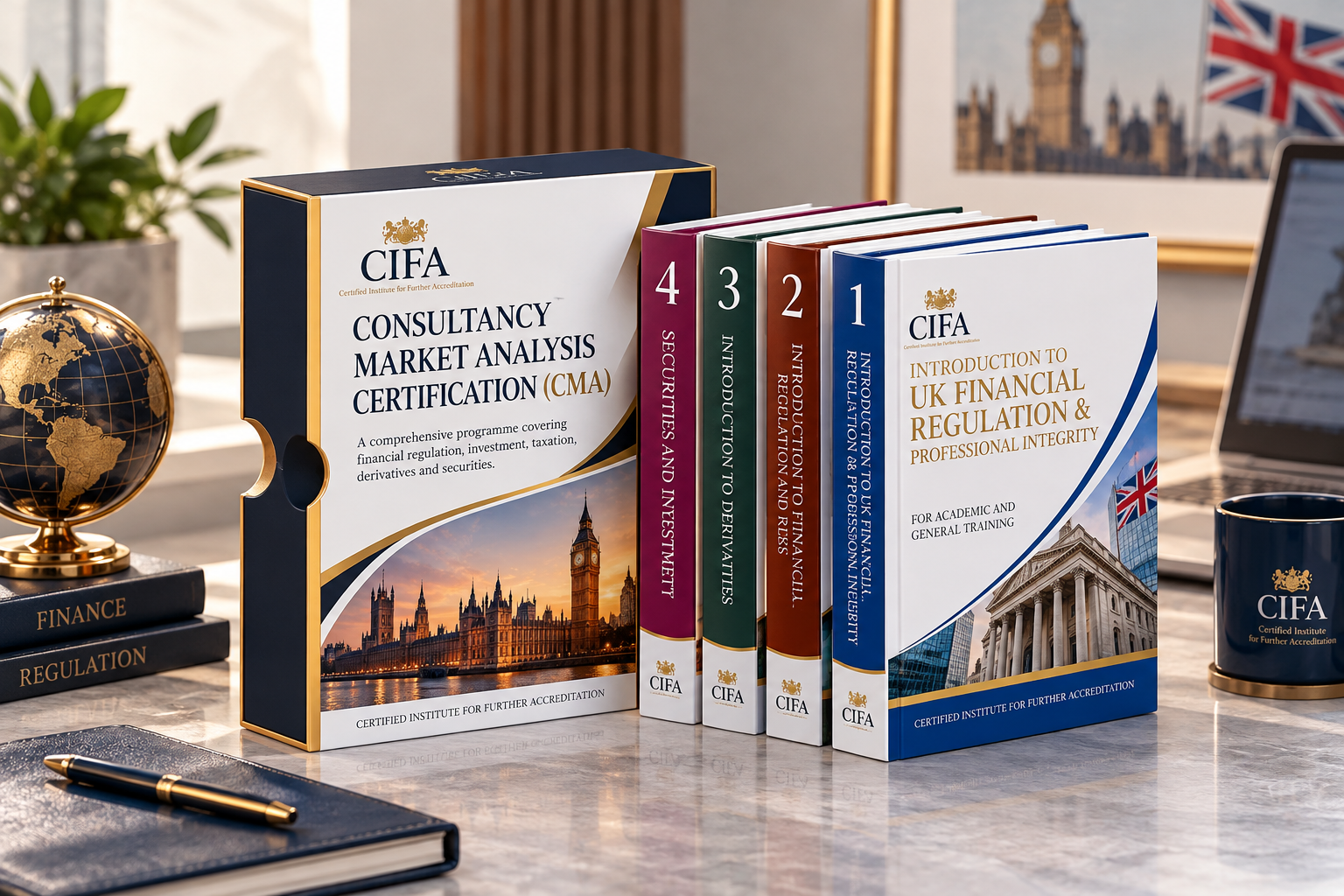
A candidate interested in regulated financial services may benefit from learning about UK financial regulation and professional integrity.
Professionals interested in mortgage-related careers can investigate mortgage-advice education, while those moving into compliance can consider anti-money-laundering and regulatory programmes.
Rather than collecting unrelated certificates, build a coherent learning pathway.
Each course should strengthen a capability that supports the next stage of your career.
The precise professional route depends on your jurisdiction and intended designation, but a sensible educational pathway can be structured systematically.
Decide whether you want to work primarily in financial planning, financial advice, wealth management, investment, banking, mortgage advice or another related area.
Without a defined objective, it is difficult to choose the correct qualification.
Research the requirements applicable to your intended role and country.
Do this before paying for a course.
A programme can provide valuable professional education without necessarily satisfying every regulatory requirement attached to a particular job or protected designation.
Evaluate the curriculum, accreditation, assessment, study format, fees and support.
Do not choose based on the course title alone.
Study financial-planning principles, retirement, protection, investment, risk, ethics and client communication.
CIFA's Financial Planning and Advice programme covers these core areas and is designed for learners including aspiring financial planners and current finance professionals.
Break the curriculum into achievable milestones and use assessments to measure understanding.
Do not confuse completing pages with mastering concepts.
Where a qualification requires a formal examination, prepare specifically for its assessment structure and follow all examination-integrity requirements.
CIFA states that its certification exams are remotely proctored and that certificates are issued after successful examination and completion of the proctoring process.
Update your CV with the qualification and, more importantly, the competencies you developed.
Consider a digital CV, professional online profile or carefully produced video résumé where relevant to the recruitment process.
Financial education should not stop with one course.
Depending on your career, you may progress into investment, mortgage advice, regulation, compliance, taxation, ESG or wealth-management education.
Continuous learning is particularly important in finance because markets, regulation, products and professional expectations evolve.
The strongest reason to consider CIFA is not simply that its courses are online. Flexibility only matters when it is combined with structured professional learning.
CIFA provides a portfolio of finance courses covering financial planning, investment, mortgage advice, regulation, risk, taxation, compliance and related areas. Its Financial Planning and Advice course includes structured learning materials, chapter mock examinations, CPD hours and certification following successful assessment.
The broader platform also connects education with professional-profile features, which can help learners think beyond course completion toward career presentation.
For professionals balancing education with employment or other responsibilities, online delivery can make structured learning more practical.
The correct programme, however, should always be selected according to the learner's career objective rather than the convenience of online study alone.
Learning how to become a certified financial planner online requires more than finding a course with the right words in its title. A credible professional-development strategy starts with understanding the career you want, identifying the knowledge required, checking the relevant professional or regulatory requirements and selecting education that genuinely supports those objectives.
Online learning has made this process more flexible. Professionals no longer necessarily need to leave employment or reorganise their lives around traditional classroom schedules to develop financial knowledge. But flexibility should never replace academic discipline, assessment integrity or careful qualification research.
CIFA provides a structured online environment for learners who want to develop knowledge across financial planning and related areas of finance. Its Financial Planning and Advice course covers core planning concepts alongside retirement, protection, client communication, ethics and regulatory considerations, while the wider CIFA course portfolio provides opportunities to explore investment, mortgage advice, regulation, risk, taxation and compliance.
The strongest career strategy is to connect these educational achievements with practical professional development. Track your learning carefully, understand what your qualification demonstrates, develop a credible CV and digital professional profile, and continue building knowledge relevant to the roles you want.
Most importantly, distinguish between education, certification and regulatory authorisation. Each can play an important role in a finance career, but they are not automatically the same thing.
For learners ready to strengthen their financial-planning knowledge and explore accredited online finance education, CIFA provides a range of professional courses designed to support continued development in an increasingly competitive financial-services industry.

0 comments