

You may already work in banking and wonder what separates client service from regulated financial advice. You may be a graduate who understands finance academically but has never handled a suitability conversation. Or you may be changing careers and comparing courses without knowing which qualification actually fits the role you want.
Understanding How to Become a Financial Advisor in the UK therefore starts with a distinction: becoming professionally ready is not the same as completing one course. The route can involve qualifications, technical knowledge, experience, employer training, communication skills and requirements attached to the activity you perform. In the UK, "financial adviser" is a broad label, so different areas can involve different expectations.
A sensible first move is to work backwards from the job you want. CIFA can be one resource when comparing professional finance education, but your wider research should include current role requirements, employer expectations and the practical experience needed to become competent.
Anti-money laundering knowledge does not qualify someone to give financial advice, but it is part of the professional environment in which many advisers work. Financial services firms deal with client due diligence, identity checks, source-of-funds questions and financial crime risk. Advisers may encounter these issues during onboarding or unusual client circumstances.
For an aspiring adviser, AML learning is valuable because it develops a compliance mindset. You learn that documentation matters, that client relationships have boundaries and that commercial urgency does not override appropriate controls.
An Anti Money Laundering Course UK resource from CIFA can support that awareness as part of broader professional development. It should not be confused with the qualification route for regulated advice. AML knowledge is one component of responsible financial-services practice, not a substitute for adviser competence or role-specific requirements.
People searching for financial advisor qualifications UK often begin with "Which certificate do I need?" A better question is: "What activity do I want to perform, and what qualification and competence expectations apply to it?" In UK financial services, the substance of the role matters more than the job title. Two people called financial advisers may perform different activities and follow different training routes.
For regulated advice, qualification and competence expectations can depend on the activity being performed and the firm's regulatory context. That does not mean every financial-services role has identical requirements, nor that a qualification alone proves someone is ready to advise clients independently. Always check the current requirements that apply to the specific work you intend to do.
When researching financial advisor qualifications UK, a CIFA financial planning and advice resource can help you examine relevant technical subjects. You should still compare learning outcomes with the role you are targeting, check current requirements, and understand how an employer will train, supervise and assess competence.
Qualifications matter because advisers need structured knowledge in areas such as investment principles, risk, taxation concepts, pensions, ethics and regulation. Client work then tests whether you can apply that knowledge accurately and explain it clearly.
A finance graduate, operations professional and career changer may all need different preparation. Before enrolling, compare relevant finance courses by syllabus, assessment, recognition, support and practical fit rather than choosing on price or marketing language alone.
There is no identical route for every employer, but the following sequence gives aspiring advisers a realistic way to organise the journey.
Look beyond the title. Advisers gather information, clarify objectives, assess risk, explain options, document reasoning and maintain client relationships. The work combines technical analysis with communication, compliance and administration.
How to Become a Financial Advisor in the UK depends partly on the activity you want to perform. Read job descriptions closely and distinguish between qualifications that are required, credentials that are desirable and training an employer provides after you join.
Study should do more than prepare you for an assessment. You should be able to connect risk, time horizon, diversification and taxation considerations within a client situation.
Administrator, operations, trainee and paraplanning roles can expose you to how advice businesses operate, including the research, documentation and compliance work behind client meetings.
Technical knowledge is not enough if you cannot explain it clearly. Practise turning complex language into accurate plain English so clients understand the implications of a decision.
Compliance is not a final hurdle after the "real" learning. It influences information gathering, documentation, conflicts, financial crime controls and professional conduct. Understanding this early helps build sound habits.
Your first role does not need to contain "financial adviser" in the title. Graduate schemes, trainee posts, paraplanning and client-support roles can provide structured exposure to the profession.
Passing an exam and performing professional work are different achievements. Progressing towards adviser responsibility may involve supervised experience, feedback, file reviews and structured development.
Products, tax rules, regulation and client expectations change. How to Become a Financial Advisor in the UK also requires a willingness to keep learning after the initial qualification stage.
The question how long does it take to become a financial advisor UK has no reliable single answer. The timeline depends on your existing knowledge, the role you are pursuing, the qualification route, your study pace, whether you are working at the same time and how quickly you gain relevant experience.
A graduate on a structured programme may progress differently from someone already working in financial services. A career changer studying in the evenings may need longer because learning has to fit around full-time work and other responsibilities.
It is also important to separate "time to complete a qualification" from "time to become ready for adviser responsibility". Passing an assessment can demonstrate knowledge. It does not automatically demonstrate judgement, client handling or competence within a firm's processes.
A better approach is to use milestones: understand the target role, identify qualification gaps, gain relevant experience, complete appropriate learning, develop client skills and seek supervised progression. That gives you a realistic plan without pretending everyone finishes on the same timetable.
A financial advisor course online UK can suit people who work full-time, are changing careers or need flexible study. Online learning can be effective, but flexibility should not be mistaken for lower standards. Good study still requires structure, discipline and regular application.
Before enrolling, examine the syllabus, assessment method, learning support, recognition, professional relevance and how clearly the provider explains where the course fits into a career route. Also consider whether the format suits you. Some learners need scheduled teaching and tutor contact; others work well with self-paced material.
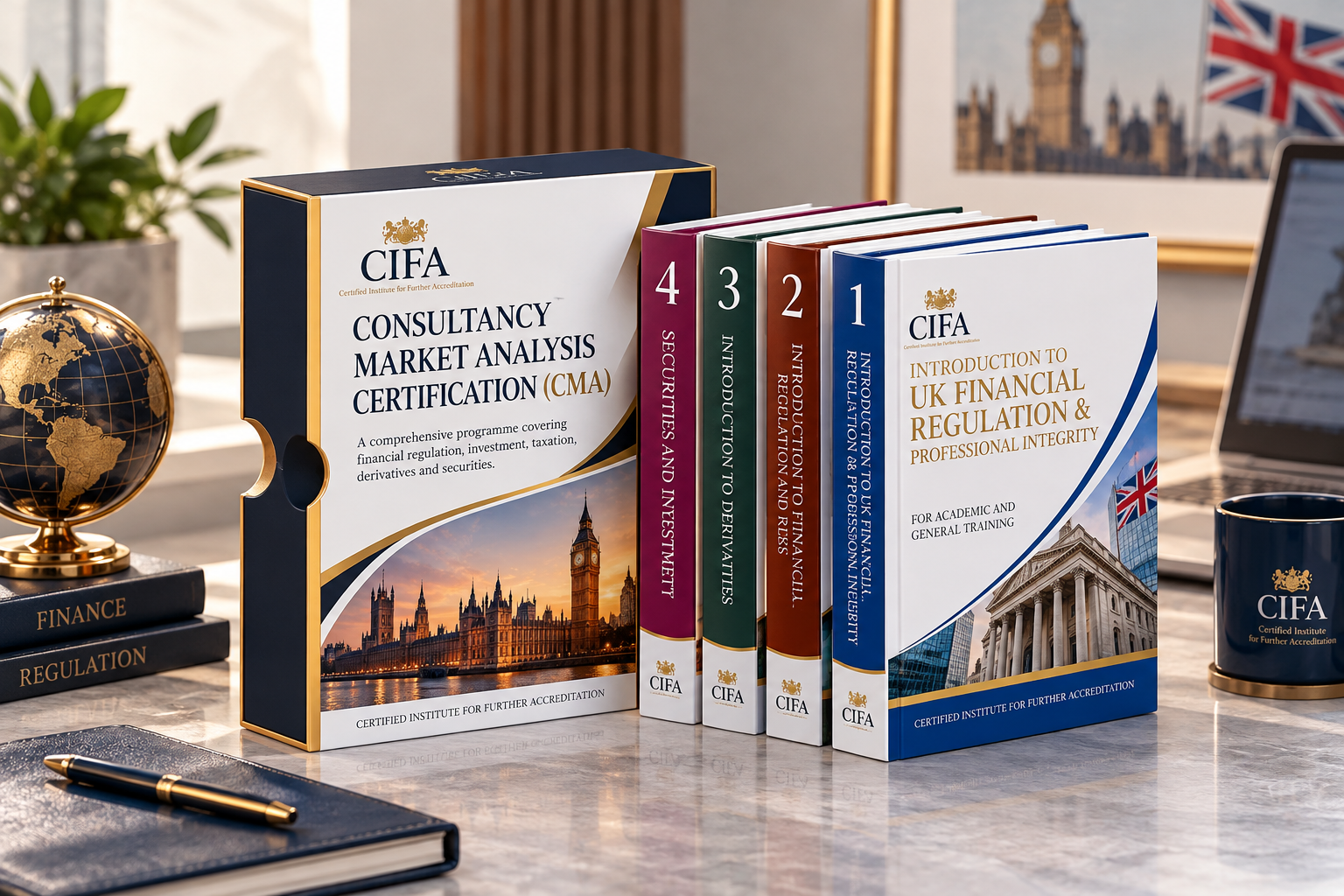
When comparing a financial advisor course online UK, the CIFA learning bundle is one option to review alongside other routes. The key question is what the course teaches and how that learning aligns with the work you intend to do. A course title alone should never be treated as proof that completion grants the permissions or competence required for every advisory role.
For someone studying while working, test whether learning transfers into practice. Can you identify the important issues in a client scenario, explain risk without jargon and connect compliance principles with real processes? If not, you may be collecting information rather than building capability.
Price should be considered in context. Compare professional finance learning options by relevance, structure, assessment and support, then check how each one aligns with the employers and roles you are considering.
People asking how much do financial advisors earn UK should be cautious with isolated salary figures. Pay can vary by experience, location, employer, specialisation, responsibility, client base and whether someone is employed, self-employed or working within a performance-related model.
A trainee should not compare their package with that of an experienced adviser who has spent years building expertise and client relationships. Different firms may also combine base pay, bonuses, benefits and business-development expectations in different ways.
When assessing an opportunity, look beyond the headline figure. Ask how performance is measured, what training is provided, what level of responsibility the role carries and what progression looks like. Salary matters, but financial advice also involves responsibility for decisions that can materially affect clients.
If you are asking is financial advisor a good career UK, the answer depends on the kind of work you enjoy. The profession can suit people who like finance but also want direct human interaction. It can offer technical development, long-term client relationships, specialisation and progression into senior, planning, management or leadership roles.
The challenges are just as real. You may need to analyse complex information carefully and then explain it simply. You may need to challenge a client's assumptions without damaging trust. Documentation can be substantial, and professional knowledge must be kept current.
There can also be pressure. Accuracy and conduct matter, and client conversations can become emotional when markets fall or circumstances change. Commercial awareness must remain within professional boundaries.
For someone who enjoys both technical problem-solving and relationship-based work, financial advice can be a strong long-term fit. If you prefer finance with little client contact, another pathway may suit you better.
The phrase financial advisor vs financial planner UK suggests two completely separate roles, but terminology varies between firms. Some advisers perform broad planning work, while some financial planners also make or implement recommendations within an advice process.
A financial adviser is often associated with advice on particular financial needs or products, such as investments, pensions, protection or mortgages, depending on the role. Financial planning usually takes a broader goals-led view of where the client is now, what they want to achieve and how different financial decisions interact over time.
Consider a client who wants to retire at a particular age. An advice-focused discussion may centre on suitable pension or investment choices. A planning-led discussion may begin by mapping income, spending, assets, liabilities and future scenarios before deciding which recommendations are needed.
If you enjoy detailed goal-setting, modelling and long-term strategy, broader financial planning may appeal. If you prefer a more focused advisory specialism, another route may fit better. In either case, read the actual job description rather than assuming the title tells you everything.
A financial advisor career path UK can begin after university, through banking or insurance, from financial operations, or in administration and paraplanning. There is no single correct starting point.
A common pattern is support work, deeper technical exposure, structured study, supervised client experience and then increasing adviser responsibility. Paraplanning can be particularly useful because it develops research, report writing and technical reasoning while providing close exposure to live advice cases.
For someone exploring the financial advisor career path UK, the linked guide offers a related discussion of how qualifications and professional skills can support progression. The practical lesson is to think in stages. Your next role does not have to be your final role, but it should ideally add technical depth, client exposure, process knowledge or professional responsibility.
Later progression may include experienced adviser roles, specialist work, broader financial planning, team leadership, training, management or compliance. Some advisers move towards business ownership or partnership, which adds commercial and governance responsibilities.
How to Become a Financial Advisor in the UK becomes a different question once you are already in the profession. The focus shifts from entry to development: which clients you want to serve, which technical areas you want to master and how you will maintain standards over time.
Qualifications create a technical foundation, but long-term effectiveness depends on how well you apply that knowledge. An adviser who can recall rules but cannot conduct a clear client conversation is not yet the complete professional.
Communication is a technical skill in its own right. You need to ask useful questions, listen carefully and explain uncertainty without sounding evasive. When a client is nervous about investment risk, repeating definitions is rarely enough. You need to connect the issue to their objectives and circumstances in language they understand.
Professional writing, attention to detail and ethical judgement also matter. Advice processes create records and reports that need to be accurate and defensible. Small errors can become larger problems if they are not noticed.
Ongoing education from CIFA or another appropriate provider can support development, but it is most useful when paired with feedback from real work. Review cases, learn from experienced professionals and understand why a recommendation or process was handled in a particular way.
Commercial awareness becomes more important as responsibility grows. Advisers need to understand how firms serve clients sustainably without allowing sales pressure to replace professional judgement.
If you are serious about How to Become a Financial Advisor in the UK, define your starting position. List your education, financial-services experience, customer-facing experience, technical knowledge and qualifications. Then compare that profile with the roles you are actually seeing advertised.
Next, identify the gaps. A qualification may be one gap, but experience, writing, client communication or compliance knowledge may be equally important. Read employer requirements carefully and check current regulatory expectations for the work you hope to perform.
If adviser roles feel out of reach today, consider which adjacent role would move you closer. Paraplanning, administration, operations or client support can expose you to the systems and standards behind advice while building evidence that you can work accurately in a financial-services environment.
Practise communication deliberately. Explain pensions, investment risk or diversification to someone without a finance background. Write short summaries of complex topics and ask for feedback on clarity. These exercises prepare you for the moment when a real client needs a difficult concept explained simply.
Finally, create a development plan covering study, experience, compliance awareness and job research. If structured education is one of your gaps, explore the financial education and professional development options available through CIFA as one possible resource. Treat the journey as a sequence of realistic career decisions rather than one large leap.
Becoming a financial adviser in the UK is not simply about finding one course and passing it. The profession combines technical knowledge, appropriate qualifications where required, practical competence, communication, professional conduct and continuous development. The right route depends on the actual activity you want to perform and where you are starting from today.
For a graduate, the next step may be an entry-level role with structured development. For someone already in finance, it may be identifying the technical or qualification gap that is limiting progression. For a career changer, it may be testing the profession through study and relevant support experience before making a larger move.
The strongest answer to How to Become a Financial Advisor in the UK is practical: understand the role, research current requirements, choose suitable education, build experience and keep developing the skills clients depend on. CIFA can form part of that learning journey, but professional readiness comes from combining knowledge with judgement and real-world application.


0 comments