

That combination of technical knowledge, professional judgement and communication is what makes financial advice a demanding profession. For anyone researching Financial Advisor Certification UK, it is important to understand that professional education is not simply about learning investment terminology. Effective financial advice draws on regulation, taxation, risk management, financial planning, ethics and the ability to translate complex information into decisions a client can understand.
Financial advice brings together several disciplines that cannot be considered in isolation. A recommendation that appears attractive from an investment perspective may be inappropriate once taxation, liquidity, risk tolerance or the client’s wider financial commitments are considered.
Professionals working towards financial advice careers therefore need a broad understanding of UK financial regulation and professional conduct alongside investment principles, portfolio construction, retirement planning and taxation. They also need to understand how individual financial decisions fit into a longer-term plan.
Consider a client in their late forties who wants to increase retirement savings while also helping a child through university and maintaining sufficient cash for unexpected expenses. Concentrating only on potential investment returns would miss important questions. How much liquidity does the client require? How much loss could they financially withstand? What is their investment horizon? How could taxation affect the outcome? What other commitments may arise before retirement?
Financial advisor training should help learners recognise these connections. Technical subjects matter, but so does the ability to combine them into coherent analysis.
Professional integrity is equally important. Clients may make significant decisions based on information and recommendations they receive. A financial professional must therefore communicate limitations, risks, costs and relevant considerations clearly rather than presenting uncertain outcomes as though they were guaranteed.
Financial services operate within a highly regulated environment because financial decisions can have substantial consequences for consumers. In the UK, the Financial Conduct Authority (FCA) regulates financial services firms and financial markets within its remit, with objectives that include protecting consumers, maintaining market integrity and promoting effective competition.
For someone seeking to become a financial advisor in the UK, understanding the regulatory environment is therefore part of professional competence rather than a separate administrative subject.
Learners need familiarity with the principles behind compliance, consumer protection, appropriate professional conduct, clear communication and responsible treatment of clients. They should also understand why record-keeping, transparency and ethical judgement matter within financial services.
Regulatory knowledge does not mean memorising rules without context. It means understanding how professional responsibilities influence real interactions with clients. What information should be gathered before reaching a conclusion? How should risk be communicated? What conflicts may need to be recognised? How can a professional ensure that a client understands important information?
These questions demonstrate why regulation and professional integrity belong at the centre of financial advisor certification.
There is also an important distinction between education and regulatory status. Completing an educational programme or receiving a certificate does not automatically authorise an individual to undertake regulated financial advice. Specific activities may be subject to particular qualification, competency and authorisation requirements. Anyone intending to work in regulated financial advice should investigate the requirements applicable to the role and activities they plan to perform.
Investment risk is often associated with falling share prices, but market movements represent only one part of the picture. Effective investment risk management requires professionals to understand different sources of uncertainty and how they may affect individual clients.
Market risk is the possibility that the value of an investment may decline because of movements in financial markets. Equity prices can fall, interest-rate changes can affect bond valuations, and broader economic developments can influence multiple asset classes.
An advisor needs to understand not only that markets fluctuate but also what those fluctuations could mean for a particular financial plan.
Credit risk concerns the possibility that an issuer or counterparty may fail to meet its financial obligations. This can be particularly relevant when evaluating debt instruments and other arrangements where repayment depends on the financial strength of another party.
Understanding credit risk encourages professionals to look beyond headline returns and consider the underlying source of those returns.
An asset may have economic value but still create difficulties if it cannot be converted into cash quickly, or if doing so requires accepting a substantial reduction in price.
Liquidity becomes particularly important when clients may need access to money within a defined period. A portfolio that looks reasonable over a long investment horizon may be unsuitable if the client requires significant funds in the near future.
These concepts are related but different. Risk tolerance concerns how comfortable a client is psychologically with uncertainty and potential losses. Capacity for loss considers how much financial loss the client could actually sustain without undermining important objectives or their standard of living.
Imagine two clients who both describe themselves as comfortable with investment risk. One has substantial assets, stable income and no immediate need to access invested capital. The other expects to use most of the investment to fund retirement within two years. Their stated attitudes may be similar, but their financial capacity to absorb losses could be very different.
This is why financial advice cannot simply pursue the highest available return. Risk must be considered in relation to objectives, time horizon, financial circumstances and the consequences of loss.
Taxation can materially affect financial outcomes, which makes tax awareness an important component of financial planning and advice.
Different investments and financial arrangements may have different tax implications. The return that matters to a client is not always the headline return; taxation can affect how much of that return ultimately contributes towards their financial objectives.
For professionals, this means understanding taxation principles, recognising when tax considerations may influence investment decisions and appreciating the role of legitimate tax-efficient planning within a broader strategy.
Tax should not, however, be viewed in isolation. An investment should not automatically be considered appropriate simply because it offers a particular tax treatment. Risk, liquidity, costs, objectives and suitability remain relevant considerations.
Tax rules can also change, while individual circumstances vary considerably. Educational material can develop awareness of taxation principles and their relationship with financial planning, but personal tax decisions may require consideration of current rules and, where appropriate, specialist professional advice.
Financial planning is the process of turning financial circumstances and objectives into a structured course of action. It begins with understanding where a client is today rather than immediately deciding where their money should be invested.
A financial assessment may consider income, expenditure, assets, liabilities, existing investments, pensions, protection arrangements and future commitments. From there, meaningful goals can be established.
Some priorities may be immediate, such as creating an emergency reserve or managing expenditure. Others may stretch across decades, including retirement planning and long-term investment.
Consider a 52-year-old client hoping to retire at 65. Selecting investments is only one part of the discussion. A planner may need to consider current retirement provision, expected expenditure, savings capacity, outstanding liabilities, investment time horizon and the level of risk that can reasonably be taken.
Portfolio construction then becomes part of the strategy rather than the strategy itself.
Good financial planning is also iterative. Circumstances change. Income can rise or fall, families develop new priorities, markets move and legislation evolves. Reviewing progress allows a financial plan to remain connected to the client’s actual life rather than becoming a document that was relevant only on the day it was created.
Technical competence is essential, but clients do not experience financial advice as an academic exercise. They experience it through conversations about money, uncertainty, family responsibilities and future ambitions.
That makes communication a professional skill.
An advisor needs to explain complicated concepts without hiding behind unnecessary jargon. They need to listen carefully enough to distinguish what a client says they want from what they may actually need to achieve. They also need to communicate risk honestly, including when the message may not be what a client hoped to hear.
Imagine a client whose portfolio has declined during a difficult period in the markets. They are anxious and want to sell immediately.
An effective professional does not dismiss that concern, nor should they provide false reassurance. Instead, the conversation should revisit the client’s objectives, time horizon, agreed approach to risk and the implications of different decisions. Complex market information needs to be translated into language that supports an informed choice.
Trust develops partly through this kind of communication. Transparency, consistency and professional boundaries matter because financial relationships can continue for many years.
When comparing Financial Advisor Certification UK options, prospective learners should look beyond the name of the programme and examine what is actually taught, assessed and awarded.
A strong educational pathway should provide meaningful coverage of the subjects that shape financial advice. These may include UK financial regulation, professional integrity, investment principles, investment risk management, taxation, financial planning, retirement planning, portfolio construction and client communication.
Practical application is another important consideration. Case studies and realistic scenarios can help learners move from knowing a definition to understanding how several issues interact. A case involving retirement planning, for example, may require consideration of investment risk, taxation, liquidity and the client’s personal objectives at the same time.
Assessment also deserves attention. Prospective learners should understand how their knowledge will be evaluated, what examination arrangements apply and what certificate or other recognition is awarded on successful completion.
Certification, accreditation, professional qualification and regulatory authorisation should not be treated as interchangeable terms. Where a provider makes accreditation claims, learners should examine the relevant information and determine how it relates to their own professional objectives.
Most importantly, anyone considering a financial adviser qualification in the UK should research the regulatory and competency requirements associated with the specific financial advice activities and positions they intend to pursue.
People preparing to enter financial advice can benefit from building a structured foundation before taking on greater professional responsibilities. Understanding regulation, investments, taxation and financial planning can provide context for the decisions financial professionals encounter.
Academic study or experience in one area of finance does not necessarily provide broad exposure to financial advice. Structured learning can help graduates and existing professionals connect technical financial knowledge with client assessment, planning and communication.
Professionals already involved in planning or consultancy may use further education to deepen knowledge in areas such as investment risk, portfolio construction, retirement planning or regulatory awareness.
People working in banking, investments or related financial services may find advisory knowledge useful for understanding how products, markets and financial decisions connect with individual client objectives.
Moving into financial services from another industry can involve a substantial learning curve. Structured financial advisor training in the UK can help career changers develop foundational vocabulary and understand the relationships between regulation, risk, taxation and planning.
Compliance professionals benefit from understanding the environment in which financial advice is delivered. Knowledge of the advisory process can provide useful context when considering professional conduct, client communications and regulatory responsibilities.
Financial advice does not exist in isolation. It sits within a wider financial services ecosystem that includes wealth management, investment strategy, compliance, accountancy and increasingly responsible investment considerations.
For learners considering structured professional education, CIFA provides programmes across financial and professional subject areas. The value of broader study is not simply collecting certificates; it is developing a more connected understanding of the disciplines that influence financial decisions.
A financial professional who understands how wealth management, compliance and commercial financial information relate to advisory work may be better equipped to recognise where different areas of expertise intersect and where specialist knowledge may be required.
Wealth management provides a natural extension to core financial planning knowledge because it encourages learners to consider how investments, client objectives, risk and longer-term financial strategy interact. A programme such as Financial Planning and Advice can therefore be relevant to professionals seeking broader knowledge of the wealth management environment.
Compliance and accountancy awareness offer a different but complementary perspective. Understanding how organisations approach financial information, obligations and responsible business practice can strengthen commercial awareness. The Introduction to Accounting and Finance for Business programme represents one route for exploring these connected areas of professional knowledge.
Responsible investment is another subject gaining importance in investment discussions. Environmental, social and governance considerations can affect how organisations and investors assess opportunities, risks and stewardship responsibilities. Studying an area such as Introduction to the FCA/PRA & Investment Risks can help professionals develop greater awareness of how ESG considerations intersect with investment strategy and compliance.
These subjects should not be viewed as substitutes for the specific qualifications or permissions that may be required for regulated financial advice. Their value lies in broadening professional understanding and helping learners see financial services as an interconnected field.
Choosing professional education is easier when the process begins with a career objective rather than a course title.
A useful framework is:
Career goal knowledge gap relevant learning assessment practical application continued development
Someone seeking a client-facing financial planning role may identify gaps in regulation, investment risk and communication. A professional moving towards wealth management may need stronger knowledge of portfolio principles and long-term planning. Someone working in compliance may want deeper insight into how advisory decisions are made.
Once those gaps are identified, learners can compare curricula in detail. Course titles alone rarely reveal the depth of teaching, assessment methods or practical relevance.
The learning format matters as well. Flexibility can be valuable for professionals combining education with employment, but convenience should be considered alongside curriculum quality, assessment and relevance.
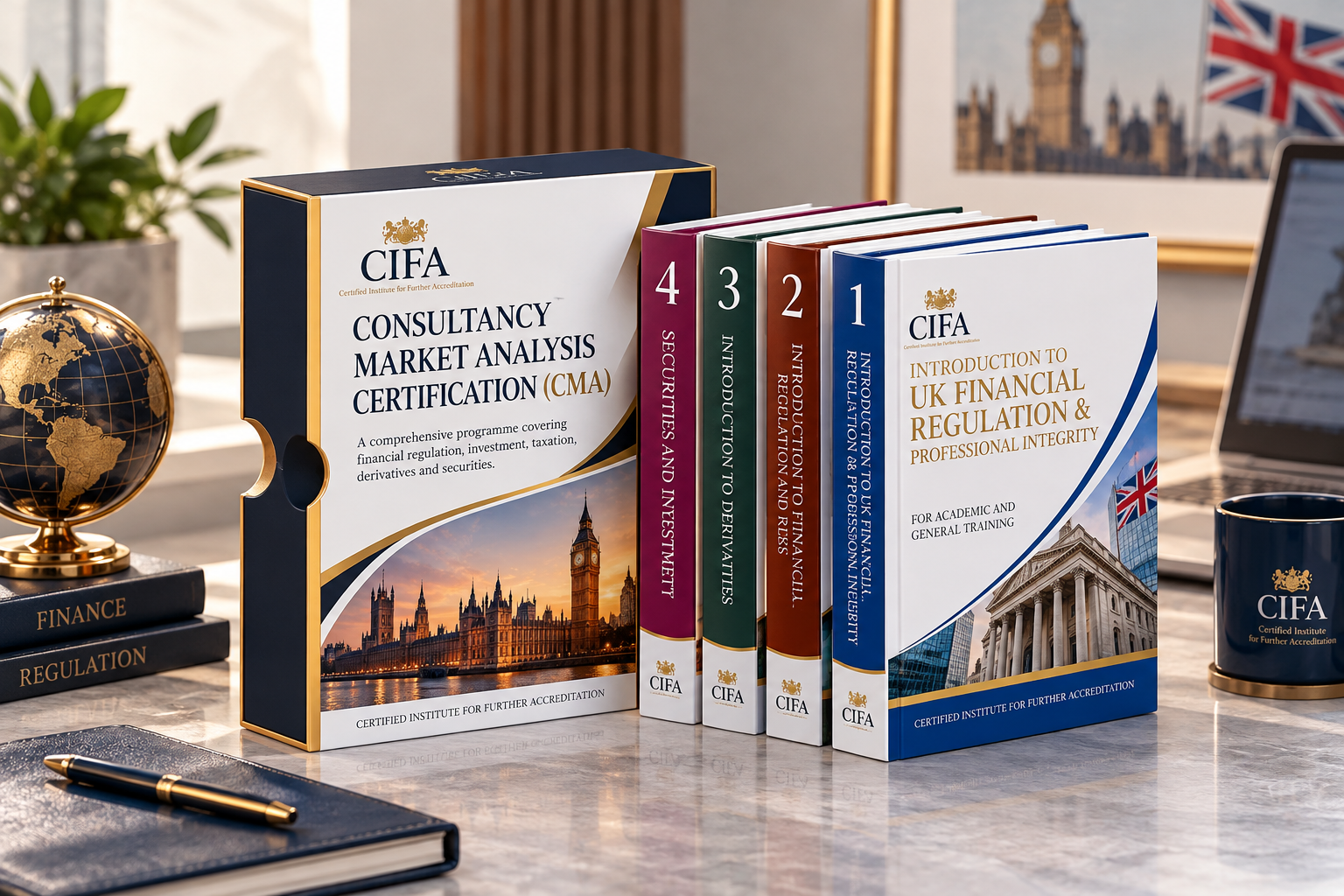
Where certification or accreditation is important, learners should examine exactly what the provider states. The supplied information for CIFA’s featured financial advisor learning pathway states that successful learners receive a digital certificate after passing the required exams and completing the proctored examination process, with printed certificates potentially available separately subject to the provider’s customer service information. CIFA also states that its courses are fully accredited, and the supplied material references CPD accreditation. Learners should assess such information carefully in relation to their own career, qualification and regulatory requirements.
A certificate can demonstrate completion of a defined educational programme, but professional competence is broader.
Knowledge is one component. A financial professional also needs ethical judgement, practical experience, analytical ability and the communication skills required to work responsibly with clients.
Consider risk tolerance. A learner may understand its textbook definition, but professional competence involves knowing how to explore a client’s attitude towards uncertainty, distinguish that attitude from capacity for loss and communicate the consequences of different choices without exerting inappropriate pressure.
The same distinction applies to regulation. Knowing regulatory concepts is valuable; applying them consistently in professional situations requires judgement and responsibility.
Continuous professional development also matters because financial markets, products, regulation, tax rules and professional expectations do not remain static. Learning should therefore be understood as an ongoing professional responsibility rather than an event that ends when a certificate is issued.
For people seeking to become a financial advisor in the UK, this distinction is fundamental: education can build knowledge, but professional capability develops through the combination of learning, appropriate qualifications where required, experience, ethical conduct and continued development.
Professionals who are still defining their direction may benefit from comparing different areas of study before committing to a particular pathway. CIFA’s catalogue of financial and professional courses allows learners to explore subject areas and consider which forms of structured education are most closely aligned with their career objectives and current knowledge gaps.
The important question is not how many courses someone can complete. It is whether the learning develops knowledge that can be understood, assessed and applied responsibly within the professional context in which that person intends to work.
Return to the client at the beginning: retirement is approaching, investment markets feel uncertain, taxation needs to be considered and several financial priorities are competing for limited resources. The quality of the conversation depends on far more than whether the advisor can identify an investment product.
Effective financial advice requires regulatory awareness, knowledge of investment risk, an understanding of taxation, financial planning ability, analytical thinking, professional integrity and clear communication. Each element influences the others, and weaknesses in one area can affect the quality of the overall advisory process.
Anyone researching Financial Advisor Certification UK should therefore evaluate educational programmes carefully. Look at curriculum depth, practical application, assessment, regulatory relevance and the precise nature of any certificate or accreditation being offered. Just as importantly, understand where education sits within the wider qualification, competence and regulatory pathway relevant to the financial activities you hope to perform.
CIFA can provide structured professional learning as part of that wider development journey, but certification should be approached as a foundation for knowledge rather than a substitute for professional experience or applicable regulatory requirements.
Strong financial advice begins with strong professional knowledge but it is responsible judgement, integrity and the ability to apply that knowledge in the interests of real clients that give it practical value.


0 comments