
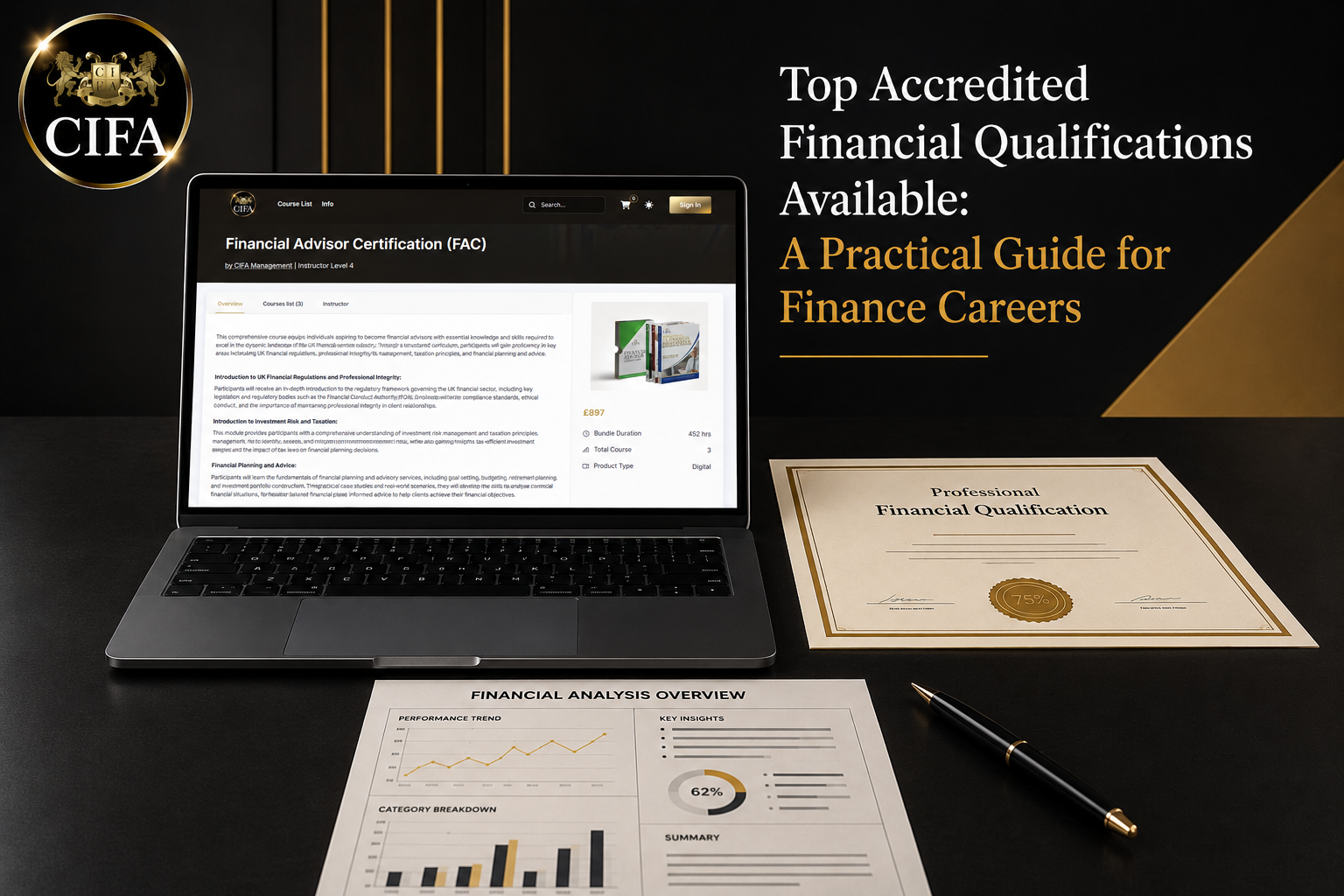
A finance professional can spend an evening comparing courses and end up with more questions than answers. One programme emphasises flexibility, another highlights professional development, while a third focuses on specialist technical knowledge. The course titles may sound equally credible, yet the curriculum, assessment standards, recognition and practical value can be very different.
That is why researching the top accredited financial qualifications available is less about finding the longest list of courses and more about learning how to distinguish meaningful professional education from attractive marketing. A qualification that suits an aspiring financial adviser may be poorly matched to someone moving into investment analysis, mortgage advice, compliance or wealth management.
The strongest decision therefore begins with the career destination. Once that is clear, recognition, curriculum depth, assessment, learning format, student support and professional applicability can be judged in context. This approach is particularly important for online study, where convenience makes finance education more accessible but does not remove the need to examine academic and professional substance.
The word "accredited" can carry considerable weight, but it should never be treated as a shortcut for evaluating an entire programme. Accreditation or external recognition, where applicable, may provide useful evidence about standards, but the reader still needs to understand what is recognised, by whom, for what purpose and whether that recognition is relevant to the intended career.
This distinction matters when comparing the top accredited financial qualifications available. A short course certificate, a professional qualification, a recognised credential and an informal online course can all have educational value, but they do not necessarily represent the same level of learning or professional significance.
A credible programme should make its purpose reasonably clear. The curriculum should show what learners are expected to understand, the assessments should test those learning outcomes appropriately, and the level of study should make sense for the intended audience. If a course claims to prepare learners for professional responsibilities, its content should go beyond definitions and introduce application, judgement and realistic financial problems.
Assessment deserves particular attention. Multiple-choice questions can be suitable for testing some areas of knowledge, but a professionally oriented programme may also need methods that examine interpretation, calculation, analysis or decision-making. The right assessment design depends on the subject. What matters is whether the assessment provides meaningful evidence that the learner has understood the material.
Institutional and instructor credibility also deserve examination. Rather than relying on impressive biographies alone, prospective learners should look for relevant subject expertise, clearly defined learning outcomes, transparent programme information and evidence that the curriculum reflects the professional context in which the knowledge will be used.
Student support is another part of credibility that is sometimes overlooked. A sophisticated curriculum is less useful if learners cannot obtain clarification when they encounter difficult concepts, understand assessment requirements or navigate the learning environment.
Accreditation, recognition and career relevance are connected, but they should not be used interchangeably.
Recognition may refer to acceptance by a professional body, educational organisation, employer or another institution. Accreditation may describe a formal quality assurance relationship, although the meaning and scope can differ considerably between jurisdictions and organisations. Career relevance is more practical: does the programme teach knowledge and skills that genuinely relate to the work the learner wants to perform?
These distinctions become particularly important in regulated or professionally controlled areas of finance. A course can be educationally valuable without satisfying the formal requirements for a particular regulated activity. Conversely, meeting a formal educational requirement does not automatically mean that a programme is the ideal choice for every career objective.
Anyone researching recognised finance qualifications should therefore verify claims directly and understand exactly what a credential permits or supports. This is a better approach than assuming that terms such as "certified", "professional", "accredited" or "recognised" all carry an identical meaning.
The top accredited financial qualifications available should consequently be compared according to both formal standing and practical fit. The question is not simply, "Is this qualification accredited?" It is also, "Accredited or recognised for what purpose, and does that purpose match where I want my career to go?"
Comparing finance programmes becomes easier when the marketing language is temporarily removed. Put two or three programmes side by side and examine what the learner actually studies, how deeply each subject is covered, how knowledge is assessed and what capability the programme is designed to develop.
Curriculum should come first. A learner interested in financial advice might reasonably expect substantial coverage of areas connected with financial planning, investment principles, risk, client circumstances and professional responsibilities. Someone targeting investment work may need greater analytical depth. A professional moving towards compliance will have a different set of priorities again.
Next, consider course level and depth. Two programmes can contain modules with similar names while demanding very different levels of understanding. Module titles alone reveal surprisingly little. Learning outcomes, syllabus details and assessment methods provide a better indication of intellectual depth.
Flexibility should then be considered alongside structure. Self-paced study can work extremely well for disciplined professionals with unpredictable schedules. Other learners perform better when deadlines, tutor contact and scheduled assessments provide momentum. Flexibility is valuable only when the learning model allows the student to make sustained progress.
People searching for how CIFA courses compare to other online finance programs should apply the same criteria they would use for any education provider. Start with curriculum relevance, then examine depth, assessment, delivery format, learner support, specialisation and the relationship between the programme and the intended career.
The objective is not to decide which provider has the most persuasive course page. It is to determine which programme creates the strongest fit between the learner's existing knowledge and the capability required for the next professional step.
For example, a working finance professional may value asynchronous access because study must fit around employment. A career changer may place greater weight on structured foundational learning. An experienced adviser may be looking for specialist professional development rather than another broad introductory course. Those learners can reasonably reach different conclusions about the same programme.
This is the most useful way to approach the top accredited financial qualifications available: comparison should be personal enough to reflect career goals, but objective enough to test the substance behind each programme.
Online delivery should be judged as a learning model, not as a quality label. A programme does not become weak because it is delivered digitally, and it does not become credible merely because sophisticated technology is involved.
Begin with the learning experience. Are modules logically sequenced? Are technical concepts explained before learners are expected to apply them? Are there opportunities to revisit difficult material? Does the programme include exercises, case-based learning or assessments that require more than passive reading?
Then examine how current and professionally relevant the curriculum appears. Finance education can contain durable principles, but areas involving regulation, professional practice, technology and market conventions may require periodic review. Providers should give learners enough information to understand what they will study and the intended outcomes.
Searching for good reviews for online financial training programs can provide useful context, particularly around the practical learning experience. Reviews may reveal recurring observations about platform usability, communication, workload, tutor support or whether course expectations were clearly explained.
Reviews are much less useful when they contain only general praise or criticism. A detailed account explaining how the assessments worked or how much study time was required provides more information than a five-star rating with no context.
Look for patterns across multiple independent experiences rather than treating one enthusiastic or disappointed reviewer as representative. Most importantly, separate customer experience from educational quality. Excellent administration is valuable, but it cannot substitute for a relevant curriculum and credible assessment.
Online learning places more responsibility on the learner. Without a physical timetable, it is easy to mistake access to a course for progress through a course.
A common search such as rack my progress in online courses effectively points to a genuine problem, even if the wording is imperfect. The most useful progress measure is not the percentage of videos watched. It is whether understanding is developing at the pace required to complete the qualification confidently.
Set weekly outcomes rather than vague study intentions. "Study for four hours" measures time. "Complete the investment-risk module, answer the practice questions and review incorrect responses" measures progress.
Keep a simple record of completed modules, assessment scores and subjects requiring revision. After each major topic, ask whether you could explain the principle without consulting the course material and whether you could apply it to an unfamiliar scenario.
A realistic timetable should also include revision. Completing every module immediately before an assessment can create the appearance of progress while leaving earlier concepts weak. Periodic retrieval and practice provide a better indication of whether knowledge is being retained.
Assessment is one of the clearest differences between casual online learning and more structured professional education. If a qualification is intended to demonstrate knowledge or competence, the integrity of its assessment process matters.
The search phrase facial recognition exam proctoring work usually reflects questions about how identity and assessment integrity are managed remotely. Procedures vary significantly between platforms, but online proctoring may involve identity verification, permission to use a camera, comparison of identity information, environment checks and monitoring during an examination.
Some systems may use automated tools to identify unusual events or generate flags for further examination. Depending on the provider and platform, human review may also form part of the process. Learners should not assume that every proctored examination uses the same technology or procedures.
Before an assessment, candidates should read the provider's instructions carefully, including technical requirements, identification procedures, privacy information and rules concerning the testing environment.
When comparing the top accredited financial qualifications available, assessment integrity deserves consideration because a credential has greater professional meaning when achievement is based on a credible process. Technology itself, however, is not proof of educational quality. Secure identity checking cannot compensate for a poorly designed examination.
A broad finance qualification can establish useful foundations, but professional careers often become more specialised. Financial advice, investment, wealth management, mortgage advice, risk and compliance each require different combinations of knowledge.
The correct sequence is therefore career direction first, course selection second.
People researching the best mortgage advice courses should resist universal rankings unless those rankings are based on criteria relevant to their jurisdiction and intended role. Mortgage advice can operate within specific professional and regulatory frameworks, so learners should establish what educational or professional requirements apply where they intend to work.
After that, compare curriculum coverage, assessment standards, practical application, learning support and the role the qualification is intended to play in the professional pathway.
A course that provides an informative introduction to mortgages may be useful professional development without being the qualification required for a particular regulated position. That distinction should be understood before enrolment rather than discovered afterwards.
The question of whether someone can become a certified financial planner online requires similar care. Online study can provide a flexible route into financial-advice education, but the delivery method is only one part of the professional pathway.
Candidates should investigate the precise credential being offered, its curriculum, assessment structure and recognition, together with any separate experience, examination, membership, licensing or regulatory requirements associated with the role or designation they ultimately want.
Financial-advice education can also be explored through material addressing what are the best online financial courses to boost your career, but career decisions should still be based on the requirements of the intended role rather than the course title alone.
This distinction protects learners from assuming that completing any online financial planning course automatically grants the right to use a particular professional title or undertake regulated activities.
Education strengthens a professional profile when candidates can explain what they learned and why it matters. Simply adding a qualification name to a CV leaves much of that value unexplained.
After completing a relevant programme, review the CV and professional profiles. New knowledge should be positioned alongside existing experience rather than presented as an isolated credential. A candidate moving towards financial advice, for example, might connect recent study with prior client communication, analytical work or financial-services experience.
The best practices for making a video resume begin with relevance. A video résumé should not be a spoken version of a two-page CV. Where the format is appropriate, it should briefly communicate professional positioning, relevant strengths and evidence that the candidate can explain their experience clearly.
For finance roles, credibility usually benefits from restraint. Candidates should prioritise clear speech, professional presentation and specific evidence over elaborate editing. Technical claims should be consistent with the written CV, and qualifications should be described accurately.
Not every employer requests or values video applications. A conventional CV remains appropriate in many recruitment processes, so video should be considered an additional presentation format rather than an automatic replacement.
The question digital CV and how can it help me get a job is really about accessibility and presentation. A well-maintained digital CV can make qualifications, experience and relevant achievements easier to review and update while supporting consistency across professional profiles.
Its value still depends on content. A sophisticated digital format cannot rescue vague achievements, unexplained career changes or qualifications that are irrelevant to the vacancy. Finance candidates should make the connection between education and capability visible: what was studied, what knowledge was developed and how that knowledge relates to the target role.
When professionals ask what are the best online financial courses to boost your career, the useful answer begins with another question: what specifically needs to change in the person's professional capability?
Someone entering finance may need foundations. An accountant moving towards financial planning may need specialised advisory knowledge. An established professional may need deeper understanding of investment risk, regulation or wealth management. A candidate targeting management may benefit more from analytical and decision-making development than another introductory certificate.
Current experience matters as much as ambition. Repeating knowledge already demonstrated through work or previous qualifications may add less value than closing a specific capability gap.
Time should also be treated realistically. An intellectually demanding programme that cannot be accommodated alongside employment and personal commitments may become a poor practical choice, even if the curriculum looks excellent.
The top accredited financial qualifications available are therefore not a fixed ranking. Their value changes according to the learner's starting point, intended role, jurisdiction, existing credentials and capacity to complete the programme properly.
CIFA can be considered within the wider market for online finance education, particularly by learners exploring professional financial knowledge and career-focused study. As with any provider, prospective students should examine individual programmes rather than relying on the brand name alone.
That means looking at curriculum, stated learning outcomes, programme structure, assessment methods, delivery model and relevance to the learner's intended professional direction. Candidates should also distinguish between education that develops useful knowledge and credentials required for specific professional or regulated activities.
Information about CIFA can provide additional context about the organisation, but provider information should form only one part of due diligence. Course-level details and the requirements of the intended career remain more important when making an enrolment decision.
This is also the right context in which to ask where CIFA fits among the top accredited financial qualifications available for an individual learner. The answer should depend on the programme being considered and the learner's objectives, not on a blanket assumption that one education provider must be the strongest choice for every finance career.
Before paying for a programme, write down the professional outcome you expect from it in one sentence. If that sentence is unclear, the course comparison is probably happening too early.
Next, identify the knowledge gap between your current position and that outcome. This prevents a common mistake: choosing a course because its title sounds senior or impressive rather than because its curriculum addresses a genuine development need.
Then investigate the qualification itself. Establish what credential is awarded, what recognition or accreditation is claimed, what that recognition actually means and whether it is relevant in the jurisdiction where you intend to work. For regulated roles, verify professional requirements separately.
Review the syllabus at module level. Look for progression from foundational concepts towards application and judgement. Consider whether the assessment method is suitable for the knowledge being tested and whether the learning format fits the way you can realistically study.
Finally, examine the complete learner experience. Consider support, assessment procedures, technology requirements, progress tracking, expected workload and the clarity of course information. Reviews can contribute useful evidence, but they should confirm rather than replace this investigation.
Using this framework makes comparisons between the top accredited financial qualifications available considerably more meaningful. Instead of asking which course has the strongest marketing, the learner asks which programme has the strongest relationship with a clearly defined professional objective.
A financial qualification is an investment of attention as much as money. The learner will spend hours reading, practising, revising and completing assessments, so the programme should justify that commitment through more than a persuasive description.
The strongest choice is not automatically the most expensive course, the longest programme or the qualification carrying the most impressive title. Nor should flexibility, technology, positive reviews or a familiar provider name be allowed to determine the decision independently.
A well-chosen finance qualification brings several elements into alignment: credible recognition where relevant, substantive curriculum, appropriate assessment, workable learning structure, professional applicability and a clear relationship with the learner's intended career.
That is ultimately the most sensible way to judge the top accredited financial qualifications available. Instead of searching for a universal winner, identify the qualification whose purpose, standards and learning outcomes make sense for the professional you are trying to become. Good career education does not remove the need for experience, judgement or continued development. It gives those things a stronger foundation.

0 comments