The CMA Certification is a professional finance education programme designed for individuals who want to develop a broader understanding of financial markets, investment principles, risk management and professional conduct. For prospective learners considering a career in financial services, understanding the qualification's structure, cost and subject coverage is essential before committing to enrolment.
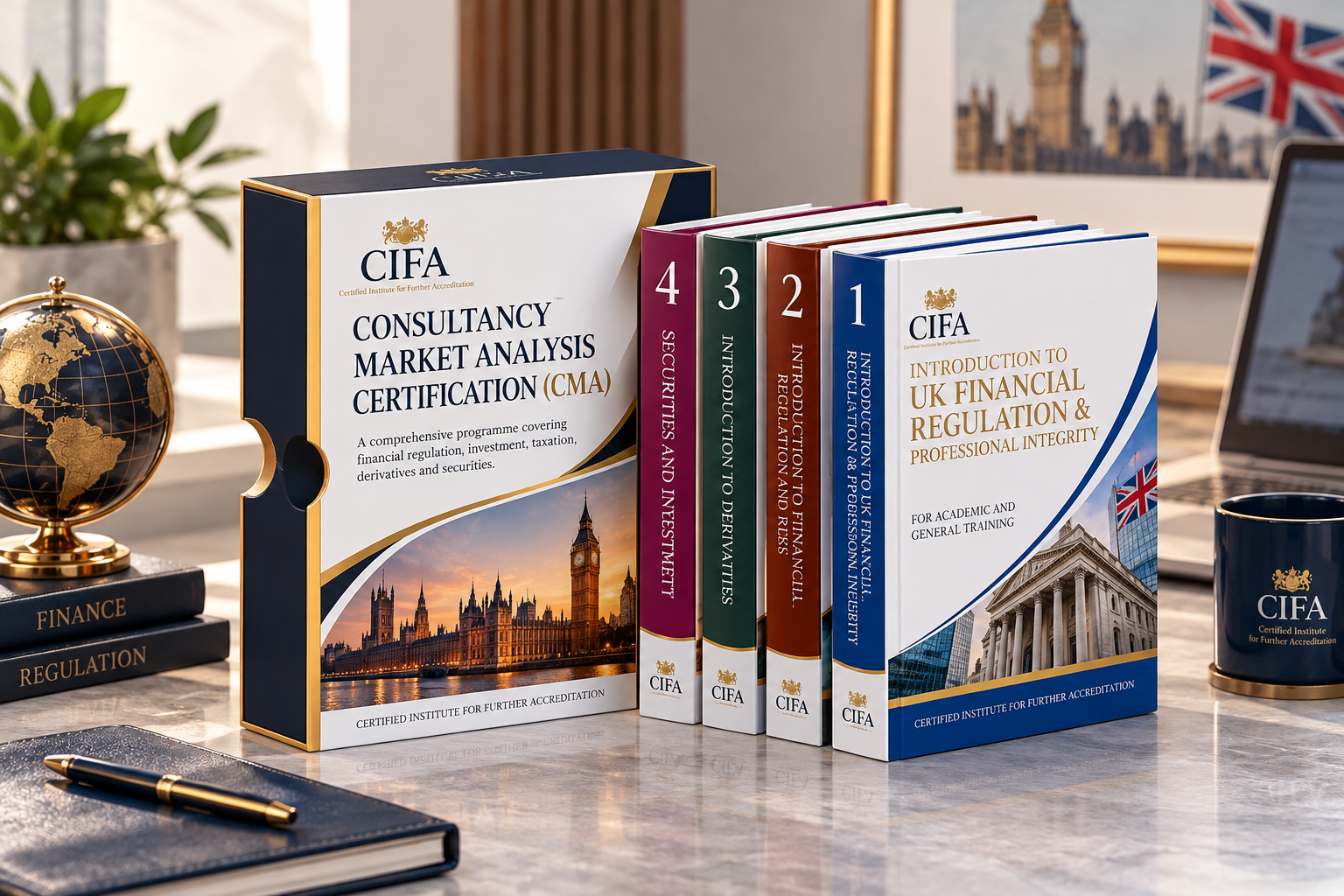
Offered by CIFA, the Consultancy & Markets Analysis Certification combines four specialist finance modules within a Level 4 programme. It covers UK financial regulation and professional integrity, investment risk and taxation, derivatives, and securities and investment.
As of September 2026, the programme is listed at £1,249 and carries 610 CPD Hours. These details provide an initial indication of its scope, although prospective learners should distinguish between the published CPD allocation, actual completion time and any additional assessment-related costs.
Rather than concentrating exclusively on one financial discipline, the qualification connects several subjects relevant to investment analysis and consultancy-related work. Readers interested in its complete structure can examine the official CMA certification programme, including the individual courses that form the qualification.
Understanding how these subjects relate to one another is particularly useful for graduates, career changers and existing finance professionals who are considering structured learning as part of their professional development.
The CIFA CMA certification is formally known as the Consultancy & Markets Analysis Certification. It is a four-module programme intended to develop knowledge of financial markets, investment products, regulatory principles and the assessment of financial risk.
Within this context, consultancy refers to the knowledge and analytical judgement that can support finance-related professional discussions and decision-making. Markets analysis involves understanding financial instruments, market structures, investment characteristics and the factors that influence risk and return.
A consultancy and markets analysis course therefore brings together subject areas that are often studied separately. Regulation establishes an understanding of professional responsibilities, while investment risk, taxation, derivatives and securities provide the technical foundations for examining financial products and market activity.
CIFA identifies the programme as Level 4, with its constituent courses also presented at that level.
For anyone researching a CMA Level 4 qualification, it is important to understand precisely what this designation represents. Level 4 describes the level assigned to the programme by its provider. It should not automatically be interpreted as confirmation of Ofqual-regulated status, equivalence to every UK Level 4 qualification or eligibility for a regulated professional position.
Prospective learners should examine the qualification's syllabus, assessment requirements and accreditation details alongside any particular standards required by their employer or professional body.
The programme is also relevant to people searching for a market analysis certification UK, particularly where their educational interests extend beyond market observation to include investment products, regulatory knowledge and professional integrity.
Its subject combination is intended to support a more connected understanding of financial services rather than treating each technical area as an unrelated topic.
The four CMA certification modules form the educational foundation of the programme. Each addresses a distinct area of finance, while collectively developing knowledge relevant to investment analysis, financial markets and professional decision-making.
The curriculum begins with regulation and professional conduct before progressing through investment risk, taxation, derivatives and securities.
This structure allows learners to consider not only how financial instruments operate, but also the regulatory and risk-related considerations surrounding their use.
Financial regulation establishes the rules and professional standards within which financial services organisations operate.
The first CMA module, officially titled Introduction to UK Financial Regulation & Professional Integrity, introduces the UK's financial regulatory framework, including Financial Conduct Authority guidelines, compliance standards and professional conduct.
It also addresses ethical behaviour, transparency and the importance of maintaining integrity in professional relationships.
These subjects matter because technical investment knowledge alone does not establish whether a financial activity is appropriate within a particular regulatory environment. Professionals also need to understand their responsibilities and the standards applicable to their work.
The module provides an educational introduction to these principles rather than automatically qualifying a learner to undertake regulated financial activities.
For a closer examination of its individual subject coverage, CIFA provides a dedicated UK financial regulation course.
Within the wider CMA programme, this module provides context for understanding the financial products and investment concepts introduced in subsequent subjects.
Investment decisions involve uncertainty, and different financial products expose investors to different forms of risk.
The Introduction to Investment, Risk and Taxation module examines investment risk concepts, including market risk, credit risk and liquidity risk. It also introduces approaches to managing these risks and considers the relationship between taxation and investment planning.
Market risk concerns changes in market conditions that may affect investment values. Credit risk relates to the possibility that a borrower or counterparty may fail to meet financial obligations, while liquidity risk concerns the difficulty of converting an asset into cash without materially affecting its value.
Understanding these distinctions helps learners appreciate why investment assessment requires more than comparing potential returns.
Taxation adds another consideration. Tax rules can influence the financial implications of investment decisions, making a general understanding of taxation relevant to financial education and consultancy-related work.
The CMA curriculum introduces these subjects as part of a broader understanding of investment planning. It does not replace personalised advice from an appropriately qualified tax or investment professional.
Derivatives are financial instruments whose value is linked to an underlying asset, benchmark or other reference measure.
They form an important part of modern financial markets and can be used for purposes including risk management and speculation.
The CMA derivatives module introduces instruments such as futures, options, forwards and swaps. According to the official course description, learners examine their characteristics, pricing, trading and applications under different market conditions.
One important educational objective is understanding why derivatives are used and how their characteristics influence financial exposure.
For example, derivatives can provide a means of managing certain risks, but they may also introduce additional complexity. Understanding the nature of these instruments is therefore relevant to professionals working with investment products, financial analysis or market-related information.
The individual derivatives course forms the third component of the CMA curriculum.
Its inclusion broadens the consultancy and markets analysis course beyond conventional investment products, helping learners develop familiarity with another significant area of financial markets.
The Securities and Investment module examines financial securities and their role within investment markets.
According to CIFA's published programme description, its coverage includes stocks, bonds and mutual funds, alongside their valuation, trading and application in different market conditions.
These subjects provide important foundations for understanding how capital markets function and how different investment instruments contribute to portfolio construction.
Equities represent ownership interests in companies, while bonds generally involve lending arrangements with issuers. Collective investment products, including mutual funds, bring together investors' money within a managed investment structure.
Understanding these distinctions supports more informed analysis of investment characteristics, potential returns and associated risks.
The module also connects with earlier CMA subjects. Regulation influences the environment in which securities are offered and traded, while investment risk and taxation affect how financial products are evaluated.
Learners interested in examining this subject independently can review CIFA's securities and investment course.
Together, the four modules provide a structured introduction to several interconnected areas of finance, with the programme's published learning outcomes also covering financial markets, portfolio management principles and investment analysis.
Cost and study commitment are two important considerations when evaluating a professional qualification.
The published CMA certification cost is £1,249 for the four-course bundle. CIFA also identifies the programme as a digital product with a published duration allocation of 610 hours.
Prospective learners should distinguish the bundle enrolment price from other charges. The official course price list separately identifies optional study support and examination-related fees, so the published bundle amount should not automatically be treated as an all-inclusive final expenditure.
The broader CMA certification cost information is available through CIFA's course price list, which also provides pricing details for other qualifications and individual courses.
Continuing Professional Development, commonly abbreviated to CPD, refers to learning activities undertaken to maintain or improve professional knowledge and competence.
For individuals researching a CPD hours finance certification, the CMA programme's published 610-hour allocation is an important feature to consider.
However, CPD hours should not automatically be confused with the number of calendar hours every learner will personally require to complete the programme.
Actual completion depends on study pace, previous subject knowledge, revision requirements and assessment preparation.
Furthermore, individuals intending to use completed learning towards a professional body's mandatory CPD requirements should confirm that body's specific rules for recording and accepting relevant activities.
The question how long does CMA certification take does not have a single calendar-based answer applicable to every learner.
Although CIFA publishes 610 hours for the programme, its online, self-paced format means that learners may distribute their studies differently according to personal and professional commitments.
Someone already familiar with financial regulation and investment principles may approach the material differently from a graduate encountering these subjects for the first time.
A practical approach is to review the four modules individually, consider the time available for regular study and allow sufficient preparation for the required assessments.
The qualification should therefore be evaluated through three separate considerations: its enrolment cost, its published CPD allocation and the personal time needed to complete the learning and assessment requirements.
The CMA programme may be relevant to several categories of learners, although suitability depends on individual educational backgrounds and professional objectives.
Graduates considering financial services may find its combination of regulatory, investment and market-related subjects useful when developing foundational knowledge beyond their existing academic studies.
Career changers may also consider the programme where they need structured exposure to finance terminology, financial instruments and investment concepts before pursuing further professional development.
For existing finance practitioners, the CIFA CMA certification offers an opportunity to revisit interconnected technical subjects within one programme.
Professionals interested in consultancy and markets analysis may find particular relevance in the relationship between regulation, investment risk, securities and derivatives.
However, the CMA Level 4 qualification should be considered alongside existing experience, career requirements and any other credentials necessary for a particular professional activity.
For people searching for a consultancy certification online, the CMA is presented by CIFA as a digital, self-paced programme.
This arrangement allows learners to organise their studies around other responsibilities rather than relying exclusively on a fixed classroom timetable. Nevertheless, prospective students should confirm the current enrolment, assessment and support arrangements before registering.
The qualification can also form part of a broader CIFA professional development pathway.
Learners comparing different subject areas can examine all CIFA courses to understand the available individual modules and certification bundles.
CMA is not the only professional finance certification offered through CIFA.
The Financial Advisor Certification (FAC) combines financial planning and advice with regulatory and investment-risk education. Its subject emphasis includes personal financial planning concepts and advice-related knowledge.
The Investment Advisor Certification (IAC) places greater emphasis on investment-related subjects, including financial regulation, investment risk, taxation and derivatives.
CMA incorporates these related foundations while additionally including Securities and Investment within its four-module structure.
The distinction is therefore primarily one of curriculum emphasis rather than a universal difference in professional value.
Someone interested in financial planning may wish to examine FAC, while learners interested in investment concepts can compare IAC and CMA according to their respective syllabuses.
The appropriate decision depends on the knowledge a learner intends to develop, existing qualifications and any requirements associated with their intended professional direction.
The professional relevance of CMA Certification lies in the financial knowledge developed through its four modules.
For people researching CMA career opportunities, it is important to distinguish between subject knowledge that may support career development and a qualification that independently guarantees entry into a particular occupation.
The CMA curriculum covers areas relevant to investment analysis, financial markets, risk assessment, regulatory awareness and professional conduct.
Depending on their previous education and experience, learners may explore professional directions involving investment research, financial services operations, consultancy support, market-related analysis and investment administration.
Understanding securities and derivatives may be relevant to roles involving financial products, while investment risk and taxation knowledge can provide useful context for analytical and support functions.
Similarly, familiarity with financial regulation and professional integrity may complement responsibilities within organisations operating in regulated environments.
However, completing the qualification does not automatically establish eligibility to provide regulated investment advice or undertake activities requiring specific professional authorisation.
A market analysis certification UK can form one component of a wider professional development plan.
For example, someone whose intended direction involves regulatory or compliance-related responsibilities may consider additional specialist education beyond the CMA syllabus.
CIFA offers a separate AML compliance certification for learners interested in developing knowledge specifically related to compliance and anti-money laundering.
This is a distinct subject area and should not be confused with the CMA programme's existing financial regulation module.
Career development ultimately depends on several interacting factors, including practical experience, analytical ability, communication skills, other qualifications, location and employer-specific requirements.
Structured learning can strengthen technical understanding and demonstrate engagement with professional development, but it cannot independently guarantee employment, promotion, salary progression or universal employer recognition.
The CMA Certification offered by CIFA brings together four connected areas of finance within a Level 4 programme: UK financial regulation and professional integrity, investment risk and taxation, derivatives, and securities and investment.
Its published enrolment price is £1,249, with 610 CPD Hours associated with the programme. Learners should consider these details alongside additional assessment-related costs, their available study time and the requirements of any professional body to which they belong.
For graduates, career changers and existing finance professionals, the qualification may provide a structured way to develop knowledge relevant to financial markets, investment analysis and consultancy-related work.
Comparing CMA with FAC and IAC can also help prospective learners identify which curriculum corresponds most closely with their intended professional direction.
Those who determine that the four-module structure meets their educational objectives can review the official CMA certification programme before making an enrolment decision.


0 comments