Financial services professionals operate in one of the most closely regulated business environments in the world. Whether you are preparing for a career in banking, investment, wealth management, financial advice, compliance, FinTech or another regulated area, understanding how the UK financial system is governed is no longer an optional extra. Regulatory knowledge increasingly sits at the centre of professional competence, responsible conduct and effective decision-making.
For learners searching for a recognised financial regulation course, the challenge is not simply finding another online finance programme. The more important question is whether the learning develops relevant knowledge of the UK regulatory environment, professional integrity, compliance responsibilities and the practical expectations placed on people working in financial services.
At CIFA, financial education is designed around this professional context. Through CIFA online courses, learners can develop knowledge across UK financial regulation, professional integrity, compliance, investment, risk, derivatives, anti-money laundering and ESG. This broader learning approach can be valuable for professionals seeking to understand how different areas of finance interact within a regulated environment.
A strong recognised financial regulation course should not encourage students simply to memorise terminology. It should help them understand why regulation exists, how regulatory expectations influence financial institutions, how professional behaviour affects consumers and markets, and why maintaining professional competence is a continuing responsibility.
A recognised financial regulation course is generally understood as structured professional education designed to develop credible, practical and career-relevant knowledge of financial regulation.
However, learners should understand an important distinction. Completing a financial regulation training course does not automatically mean an individual becomes authorised by the Financial Conduct Authority. Similarly, not every financial regulation course constitutes an FCA-required appropriate qualification for every regulated activity.
The exact professional and regulatory requirements depend on the activity being performed, the responsibilities of the employee and the requirements applicable to the organisation.
This is particularly important when comparing an FCA regulation course, general regulatory training, professional certification and qualifications required for specific financial services roles.
A high-quality course should therefore provide transparent information about what students are learning and avoid confusing professional education with regulatory authorisation.
For students, the more useful questions are: What regulatory subjects will I understand after completing the course? How relevant are they to my intended career? Does the programme cover professional integrity? Does it provide structured learning? Can the knowledge be applied in financial services?
These questions make it easier to evaluate the genuine professional value of a programme.
Modern financial services require professionals to understand more than individual products or technical calculations.
Financial institutions operate within complex systems involving regulation, governance, consumer protection, risk management, financial crime controls, professional conduct and rapidly developing technology.
This is why CIFA training UK can be considered as part of a wider professional development pathway.
Instead of treating regulation as an isolated subject, CIFA provides learning opportunities across complementary areas of finance. Learners can develop regulatory knowledge and then expand into subjects such as investment, financial planning, risk, anti-money laundering, derivatives and ESG.
This interconnected approach reflects how financial services work in practice.
An investment professional needs regulatory awareness. A compliance professional benefits from understanding financial products. A wealth management professional should understand risk. A financial adviser needs both technical knowledge and awareness of professional responsibilities.
Regulatory education therefore becomes more valuable when it is connected to wider financial knowledge.
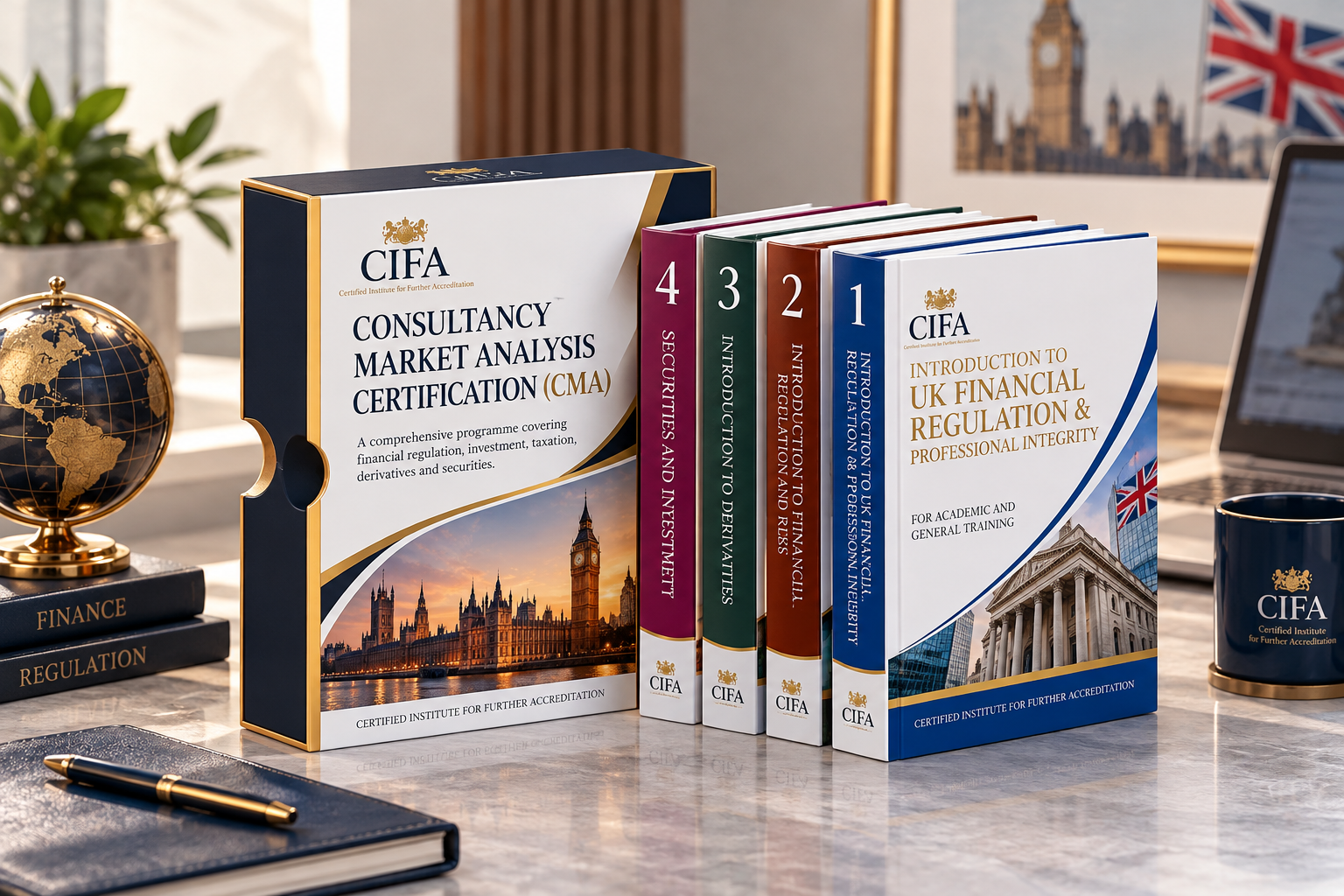
For students beginning their regulatory learning journey, introduction to UK financial regulation & professional integrity provides an important foundation.
Understanding regulation starts with understanding its purpose.
Financial regulation exists to create standards within which firms and professionals operate. It influences how financial products are offered, how institutions manage risks, how customers are treated and how professional responsibilities are exercised.
Students should therefore learn more than regulatory terminology.
They should develop an understanding of why financial regulation matters and how regulatory principles influence everyday financial services activities.
Professional integrity is equally important.
Rules alone cannot anticipate every situation a financial professional may encounter. Employees may need to recognise conflicts of interest, evaluate risks, protect confidential information, communicate responsibly and determine when a matter should be escalated.
Combining regulatory knowledge with professional integrity helps create a more complete understanding of professional responsibility.
People searching for an FCA regulation course are often trying to understand the role and expectations of the Financial Conduct Authority within UK financial services.
The FCA plays a central role in the UK's regulatory environment. Its regulatory framework affects a broad range of financial institutions and activities.
For students, understanding the FCA helps establish a foundation for learning about conduct, governance, consumer protection, market integrity, competence and compliance.
However, effective FCA-related education should go beyond learning names and definitions.
Students should learn to ask practical questions.
What risk is a regulatory requirement attempting to control? Which customers or market participants could be affected? What processes might a financial institution require? How should potential compliance problems be identified? What role does employee competence play?
This type of regulatory reasoning helps learners move from memorising rules to understanding their professional application.
Professionals increasingly search for a UK financial regulation course online because flexibility has become an important part of professional education.
Many students interested in financial regulation are already working full-time, studying another qualification or balancing professional responsibilities.
Online learning can allow these students to build knowledge without being restricted by a traditional classroom schedule.
The important point, however, is that flexibility should not reduce the quality of learning.
Students should approach an online finance certification UK programme systematically. Learning objectives should be understood, course materials should be completed carefully, difficult concepts should be reviewed and assessments should be treated as opportunities to test genuine understanding.
The objective is not simply completing modules.
The objective is developing knowledge that can support professional growth.
Anyone pursuing a career in finance can benefit from understanding financial services regulation UK.
Financial services involve relationships between institutions, consumers, investors, markets and regulators. Regulation creates frameworks designed to influence how those relationships operate.
For professionals, regulatory awareness can help them understand why firms establish specific procedures and controls.
For example, employees may encounter policies relating to client communications, conflicts of interest, financial crime prevention, risk management, record keeping, professional competence and governance.
Without regulatory knowledge, these processes can appear to be administrative requirements.
With stronger regulatory understanding, professionals can recognise the risks and responsibilities behind them.
This makes regulatory knowledge relevant beyond dedicated compliance departments.
Demand for professionals with compliance knowledge has expanded considerably across banking, investment management, insurance, FinTech, wealth management and other areas of financial services.
This has increased interest in financial compliance certification UK programmes.
Compliance professionals may contribute to internal monitoring, policy development, regulatory analysis, employee training, financial crime prevention, governance and risk assessment.
The work can therefore require both regulatory understanding and analytical judgement.
A strong regulatory foundation can be relevant to positions including compliance analyst, compliance officer, regulatory compliance associate, financial crime analyst, AML professional, risk and compliance specialist and investment compliance professional.
Individual employers will have different qualification and experience requirements, but developing regulatory knowledge can provide useful preparation for understanding the responsibilities involved.
Another important component of the UK regulatory environment is prudential regulation.
Professionals researching a PRA regulation course are often seeking to understand the role of the Prudential Regulation Authority and how prudential considerations fit into the broader financial regulatory system.
The distinction between conduct and prudential regulation is particularly valuable for students.
Conduct regulation is concerned with how firms and markets behave, while prudential considerations relate closely to financial resilience, safety and soundness within relevant institutions.
A finance professional may not need to become a prudential regulation specialist, but understanding the broader regulatory architecture provides useful context.
It helps learners appreciate why financial institutions can face different regulatory responsibilities depending on their activities, structure and role within the financial system.
Financial crime represents another important area where regulatory knowledge and professional responsibility intersect.
Financial institutions need effective controls to identify and manage risks associated with money laundering, fraud and other forms of financial crime.
This makes anti-money laundering knowledge particularly valuable for professionals developing careers in compliance and financial services.
Through CIFA online courses, learners can explore subjects including Anti Money Laundering alongside financial regulation and professional integrity.
Combining these subjects can create a stronger understanding of how regulatory expectations connect with real organisational risks.
For example, professionals should understand why customer information matters, why unusual activity may require further investigation, why documentation is important and why financial crime controls depend on properly trained employees.
The regulatory environment continues to evolve alongside financial markets.
One important development is the increasing significance of environmental, social and governance considerations.
This has contributed to growing interest in an ESG advisor course UK and ESG advisor certification online UK among professionals seeking to understand sustainable finance.
ESG knowledge can be relevant to investment analysis, asset management, advisory services, product development and broader corporate decision-making.
However, ESG also creates challenges.
Professionals need to understand how sustainability claims are communicated, how investment considerations are evaluated and why accurate information matters.
For this reason, ESG learning can complement regulatory and professional integrity education.
CIFA provides ESG-related education within its wider finance learning portfolio, allowing students to explore the relationship between sustainable investment, professional responsibility and modern financial practice.
Financial regulation becomes increasingly specialised as professionals move into more complex financial products.
Derivatives provide a good example.
Students interested in derivatives certification UK need to understand not only the regulatory environment but also how derivative instruments work, why organisations use them and what risks they create.
Derivatives may be used for hedging, speculation, portfolio management and risk management. Their complexity means professionals working around these instruments may require specialist knowledge.
This illustrates an important principle of financial education.
Regulatory knowledge works best when combined with technical understanding.
A professional cannot effectively evaluate the regulatory implications of a product without understanding its underlying characteristics and risks.
CIFA learners can therefore build foundational regulatory knowledge and then expand into specialist areas according to their career goals.
Wealth management combines financial knowledge with substantial professional responsibility.
Professionals working with clients may need to understand investments, financial planning, risk, client objectives and regulatory expectations.
For this reason, learners researching a wealth management course UK should consider regulatory education as an important complementary subject.
Similarly, wealth management training online can help professionals develop broader technical knowledge while maintaining the flexibility required by working learners.
Regulatory awareness helps wealth management professionals understand why firms establish processes relating to client information, communications, suitability, conflicts of interest and professional conduct.
These processes should not simply be viewed as paperwork.
They form part of the professional environment in which financial services are delivered.
One of the most career-focused searches among aspiring finance professionals is how to become investment advisor UK.
There is no responsible answer that simply says, “Complete one online course and become an investment adviser.”
The requirements depend on the role, activities performed, employer and applicable regulatory framework.
Certain regulated activities may require specific appropriate qualifications, competence assessments and supervision.
Professional development should therefore be planned carefully.
A learner interested in investment advice may begin by developing foundational knowledge in regulation, professional integrity, investments and risk before progressing toward qualifications and experience appropriate to their intended professional responsibilities.
CIFA courses can contribute to professional knowledge development, but students should always verify the specific requirements of the role they intend to pursue.
Financial education should not stop after completing an initial qualification.
Regulations change. Markets evolve. Technology transforms financial services. New products appear. Financial crime risks develop. ESG requirements and expectations continue to evolve.
This explains the importance of continuing professional development and the growing interest in a CPD accredited finance course UK.
Effective CPD should strengthen actual professional competence.
Professionals can use continuing education to update regulatory knowledge, develop technical expertise, understand emerging risks and strengthen areas relevant to their responsibilities.
Rather than collecting certificates without a clear objective, professionals should build a structured learning pathway.
Each programme should contribute to a specific area of knowledge or professional capability.
When comparing an accredited finance certification UK, students should carefully investigate what the accreditation or recognition actually represents.
Marketing terminology should never replace proper research.
Learners should review the programme provider, curriculum, learning outcomes, assessment methods and professional relevance.
Most importantly, anyone intending to perform a specific regulated activity should separately confirm whether a particular qualification is required.
General financial education and regulatory authorisation are not the same thing.
A programme can provide valuable professional knowledge without automatically authorising an individual to undertake regulated financial activities.
Understanding this distinction allows students to make more informed education decisions.
An online finance certification UK can support learners at different stages of their careers.
Graduates may use online learning to develop knowledge before applying for finance roles. Existing professionals may use it to broaden their expertise. Career changers can use structured courses to understand unfamiliar areas of financial services.
The flexibility of online education also allows learners to build knowledge progressively.
A student might begin with UK regulation, continue into anti-money laundering, move into investment and risk, and later specialise in areas such as derivatives, ESG or financial planning.
This modular approach can make professional development more manageable.
A financial services career certification can strengthen a professional profile, but employers generally require more than certificates.
They need people who can understand information, communicate effectively, recognise risk, exercise judgement and apply knowledge responsibly.
This is why students should connect course concepts with real financial services situations.
When studying regulation, consider how a requirement might affect an organisation.
When studying professional integrity, think about how conflicts could arise.
When learning financial crime concepts, consider how suspicious behaviour might be recognised.
When studying investments, think about how risk influences professional decisions.
This approach turns theoretical learning into practical professional understanding.
Professional development also needs to be financially realistic.
Learners searching for an affordable finance certification UK should compare programmes based on overall value rather than price alone.
Consider the quality and relevance of course content, flexibility, assessment, learning resources and how closely the programme aligns with your professional objectives.
An inexpensive course that has little relevance to your career may provide poor value.
Equally, expensive education should not automatically be assumed to be superior.
Students should focus on the relationship between cost, learning quality and career relevance.
CIFA provides online finance learning options that allow students to explore different areas of financial education and build a learning pathway according to their objectives.
One of the advantages of CIFA online courses is the ability to approach professional finance education as an interconnected learning journey.
Financial regulation does not exist separately from investment, risk, financial crime, ESG, financial planning or professional ethics.
These subjects frequently overlap in real professional environments.
For example, a compliance professional may need to understand investments. An investment professional may need regulatory knowledge. A wealth management employee needs awareness of risk and professional conduct. An ESG professional may need to understand both investment principles and evolving regulatory expectations.
Through CIFA training UK, learners can develop knowledge across these complementary areas and choose subjects aligned with their professional ambitions.
A recognised financial regulation course may be suitable for a broad range of learners.
Graduates preparing to enter financial services can use regulatory education to understand the professional environment they are joining.
Existing finance professionals can strengthen their regulatory awareness and broaden their knowledge.
Compliance and risk employees can reinforce foundational concepts.
Investment, wealth management and banking professionals can develop a stronger understanding of the regulatory context surrounding their work.
FinTech professionals may also benefit because technology does not remove regulatory responsibilities. Instead, digital transformation can create new compliance, governance and risk questions.
Career changers entering finance from accounting, business, technology or other sectors may similarly benefit from structured regulatory education.
Choosing the right recognised financial regulation course requires careful evaluation.
Start by reviewing the curriculum.
A strong programme should provide meaningful coverage of financial regulation, professional integrity and the wider financial services environment.
Next, consider career relevance.
Someone pursuing compliance may benefit from combining regulation with financial compliance certification UK or anti-money laundering education. Someone pursuing investment may want to combine regulation with investment and risk courses. A professional interested in sustainable finance may consider an ESG advisor course UK.
You should also evaluate flexibility, assessment methods and learning support.
Finally, check whether your intended professional role has specific qualification requirements.
This final step is particularly important because a general regulatory course should not be confused with a qualification required to perform a particular regulated activity.
A career in modern financial services requires more than technical knowledge.
Professionals increasingly need to understand regulation, risk, governance, ethics, financial crime and the broader responsibilities associated with financial decision-making.
A recognised financial regulation course can provide an important foundation for developing this awareness.
Through CIFA online courses, learners can explore regulatory education alongside complementary subjects such as investment, anti-money laundering, risk, financial planning, derivatives and ESG.
This enables students to build a broader learning pathway rather than treating professional development as a single isolated qualification.
Whether you are exploring an FCA regulation course, UK financial regulation course online, PRA regulation course, financial compliance certification UK, wealth management course UK, ESG advisor certification online UK or online finance certification UK, the most important objective should remain the same: developing knowledge that can be understood, applied and continually improved.
The UK financial services sector rewards professionals who can combine technical expertise with regulatory awareness and professional judgement.
Choosing a recognised financial regulation course is therefore not simply about adding another certificate to your CV. It is about developing a deeper understanding of the environment in which financial institutions and professionals operate.
CIFA provides learners with the opportunity to develop financial knowledge through flexible online education covering regulation and a wider range of professional finance subjects.
For beginners, introduction to UK financial regulation & professional integrity can provide a valuable starting point. Professionals can then expand their knowledge through areas such as anti-money laundering, investment, risk, derivatives certification UK, wealth management training online and ESG advisor course UK, depending on their career direction.
The strongest finance careers are built through continuing development.
Regulations will change. Financial markets will evolve. Technology will create new opportunities and risks. Professional expectations will continue to develop.
The professionals who remain valuable will be those prepared to continue learning.
By combining structured financial education with practical experience, professional integrity and continuing development, learners can build the knowledge required to approach modern financial services with greater confidence.
For students and professionals considering their next step, a recognised financial regulation course with CIFA can form part of a broader journey toward stronger regulatory knowledge, greater professional awareness and long-term development within financial services.


0 comments