

For professionals who want to understand this environment more clearly, an FCA regulation course can provide a structured foundation in the principles, responsibilities and regulatory concepts that influence UK financial services.
The Financial Conduct Authority plays a central role in regulating financial services in the United Kingdom. Understanding its role, however, is only part of becoming regulation-aware. Professionals also need to appreciate how regulation connects with ethical behaviour, governance, professional competence, risk management, customer treatment, financial crime controls and day-to-day decision-making.
This is why regulatory education should not be viewed simply as learning a list of rules.
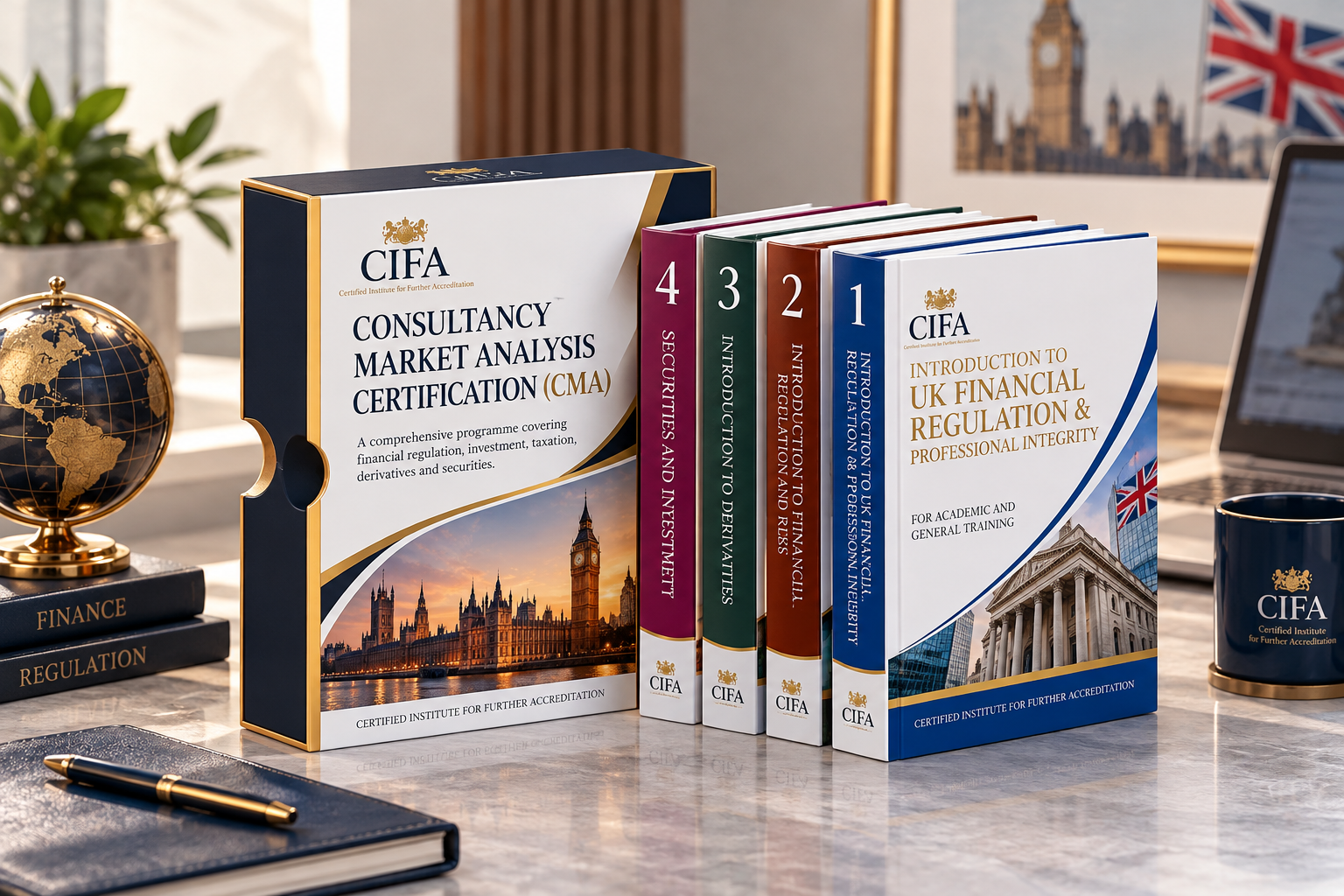
At CIFA, financial education is designed to help learners develop knowledge that can be applied within the broader professional environment. The Introduction to UK Financial Regulation & Professional Integrity course, for example, explores regulatory institutions, professional ethics, UK capital markets, governance, financial crime, complaints and redress, competence requirements and FCA conduct requirements.
For learners researching a recognised financial regulation course, understanding these interconnected subjects can provide a stronger starting point for professional development in UK financial services.
Regulation influences almost every significant area of financial services.
It affects how firms communicate with customers, how financial products are promoted, how risks are managed, how conflicts of interest are addressed, how employees demonstrate competence and how organisations interact with regulators.
The FCA's Principles for Businesses include expectations concerning integrity, skill, care and diligence, management and control, financial prudence, market conduct, customers' interests, communications, conflicts of interest and relations with regulators.
This makes financial services regulation UK knowledge relevant across a wide range of professional functions.
A compliance specialist may require detailed regulatory knowledge as a central part of the role, but regulatory understanding can also be valuable to advisers, analysts, wealth management professionals, operations teams, managers, risk professionals and people seeking to progress into more senior financial-services positions.
A strong FCA regulation course therefore has a broader purpose than memorising terminology. It should help learners understand why regulatory expectations exist and how those expectations influence professional behaviour.
Anyone studying regulation should first understand that the UK regulatory landscape involves more than one institution.
The FCA is one of the most prominent bodies in this landscape. Its work affects financial markets and the conduct of firms and individuals across many areas of financial services.
Alongside the FCA, the Prudential Regulation Authority is part of the Bank of England and has responsibilities concerning the safety and soundness of the firms it supervises, as well as protection of insurance policyholders.
Understanding the distinction between conduct regulation and prudential regulation is an important part of developing broader regulatory awareness.
This is where studying an FCA regulation course alongside concepts associated with a PRA regulation course can become valuable. Rather than treating the regulators as isolated subjects, professionals should understand how different regulatory responsibilities contribute to the overall structure of UK financial services.
CIFA addresses this wider context through education covering regulators, governance, principles and professional responsibilities.
Conduct regulation is fundamentally connected to how financial organisations behave.
For a professional, this means considering questions such as:
Does a communication give customers information in an appropriate manner?
Are conflicts being identified and managed?
Are professional decisions being made with sufficient care and competence?
Are appropriate governance and control arrangements in place?
Is the customer being treated appropriately?
Is the firm maintaining an open and cooperative relationship with regulators?
These are not merely examination questions. They reflect the type of thinking that supports responsible professional practice.
The PRA's regulatory objectives have a different emphasis. Its primary objectives include promoting the safety and soundness of PRA-authorised firms and contributing to an appropriate degree of protection for insurance policyholders.
For professionals working in banking, insurance and certain investment businesses, understanding prudential regulation adds another layer to their knowledge.
A comprehensive approach to regulatory learning should therefore help learners recognise the relationship between conduct, governance, resilience, risk and prudential supervision.
Not every course that mentions the FCA provides the same depth of education.
When assessing an online finance certification UK option, learners should examine the curriculum rather than relying exclusively on the course title.
A substantial regulatory programme should place individual rules within a broader financial and professional context.
Ethics should sit near the centre of regulatory education.Financial professionals frequently work with customer assets, confidential information, investment decisions and products that can materially affect people's financial futures.Technical competence without professional integrity can therefore create serious risks.
A quality financial compliance certification UK programme should explore ethical decision-making, integrity, accountability and professional responsibilities rather than treating compliance as a simple box-ticking exercise.
The FCA itself makes an important distinction here: competence is not merely possessing an appropriate qualification. Its training and competence guidance describes competence in terms of the skills, knowledge and expertise required for a role and states that competence includes a good standard of ethical behaviour.
Regulation makes more sense when learners understand the markets being regulated.
Knowledge of UK capital markets helps professionals understand how participants, instruments, institutions and regulatory expectations interact.
For individuals comparing finance industry professional courses UK, a programme that combines regulation with market context can provide a more meaningful educational foundation than one focused entirely on isolated definitions.
Professionals should understand the roles of major regulatory bodies and how their responsibilities differ.An FCA regulation course should explain the FCA's place within the UK system, while wider regulatory study should introduce the PRA and its prudential responsibilities.Understanding both is particularly useful for people who intend to work in regulated financial institutions.
Good regulation is closely linked to good governance.Employees may focus primarily on their individual responsibilities, but financial firms must also maintain systems, controls, management structures and risk-management processes.
Learning about governance helps professionals understand how their own work fits into the organisation's wider responsibilities.
Professional competence is not a one-time achievement.
The FCA states that firms must regularly review employee competence and training needs, taking into account changes in products, markets, regulation and legislation.
That has an important implication for career development: learning should continue throughout a financial professional's career.
A CPD accredited finance course UK may therefore be useful as part of a wider continuing professional development strategy, depending on the learner's role, employer requirements and career objectives.
Financial crime is another essential area of regulatory awareness.
Professionals need to appreciate how financial crime risk can affect customers, firms and financial markets. Training should develop awareness of controls, responsibilities and the importance of escalating concerns through appropriate processes.
Financial crime education is particularly relevant to compliance, risk, operations and governance professionals, but its importance extends much further across financial services.
How a financial organisation responds when something goes wrong is an important part of customer protection.
Professionals should understand why complaint handling, record keeping, investigation and redress mechanisms matter within a regulated environment.
A recognised financial regulation course should therefore help learners see customer protection as a continuing responsibility rather than something that applies only when a product is initially sold.
Professionals working in relevant areas of investment business may encounter the FCA's Conduct of Business Sourcebook, commonly known as COBS.
Understanding conduct requirements can help learners connect high-level principles with more specific regulatory expectations.
The objective should not simply be memorisation. Learners should develop the ability to recognise why conduct requirements exist and how they affect professional practice.
There is a significant difference between knowing that a rule exists and understanding the professional purpose behind it.
Consider a conflict of interest.
A professional might memorise that conflicts should be appropriately managed. A deeper level of regulatory understanding asks additional questions: Why does the conflict exist? Who could be disadvantaged? Has the conflict been identified early enough? What controls are appropriate? What would responsible professional conduct look like?
This is where introduction to UK financial regulation & professional integrity education becomes especially useful.
Regulatory competence is strongest when professionals can connect rules with judgement.
At CIFA, this connection between professional integrity and regulation forms an important part of the learning approach because modern financial careers increasingly demand both technical understanding and responsible professional behaviour.
Regulatory education can be relevant to professionals at several stages of their careers.A graduate entering financial services may use regulatory study to understand the environment they are joining.An adviser may want to strengthen knowledge of professional responsibilities.
A compliance professional may use structured study to reinforce broader regulatory understanding.A wealth management professional may want to connect investment knowledge with conduct, governance and customer considerations.A manager may need stronger awareness of systems, controls and organisational accountability.
Similarly, professionals moving into the UK financial-services sector from another jurisdiction may find regulatory education useful for understanding the structure and expectations of the UK market.For these reasons, a financial services career certification should be considered in the context of a person's actual responsibilities and development goals rather than viewed as a universal substitute for role-specific qualifications.
Modern financial careers are increasingly multidisciplinary.A wealth manager may need knowledge of regulation, investments, risk, ethics and client relationships. An investment professional may encounter sustainability considerations. Compliance teams may need to understand new products and evolving market practices.
That makes a broader professional-development strategy valuable.Through CIFA training UK and CIFA online courses, learners can explore financial topics that extend beyond introductory regulation.The objective is not to collect certificates without purpose. It is to develop a coherent body of professional knowledge.
Professionals searching for an accredited finance certification UK should first identify the competency they want to develop.
Is the objective to understand regulation?
Build investment knowledge?
Develop wealth-management skills?
Understand derivatives?
Learn about ESG considerations?
Strengthen compliance knowledge?
The answer should influence the course selected.
A short finance certification course UK may be suitable when a professional needs targeted learning, while a more substantial programme may make greater sense when deeper technical or regulatory knowledge is required.
People searching how to become investment advisor UK should understand that taking a course alone does not automatically grant permission to provide regulated investment advice.
Career pathways depend on the nature of the role, applicable regulatory requirements, appropriate qualifications, competence requirements and the firm through which regulated activities are performed.
However, regulatory education can provide important background knowledge.
An aspiring investment professional should understand that investment advice exists within a regulated environment where suitability, competence, customer interests, communications, conflicts and professional integrity can all matter.
An accredited investment advisor certification UK programme should therefore be evaluated not only for investment content but also for its relevance to the intended professional pathway.
Regulation is part of the professional context in which investment knowledge is applied.
Wealth management brings together investment expertise and client responsibility.
Professionals may work with portfolios, financial goals, risk preferences and long-term client relationships. Consequently, technical knowledge needs to be accompanied by awareness of regulatory and ethical responsibilities.
A wealth management course UK can help build specialist knowledge, while wealth management training online provides flexibility for professionals who want to continue learning alongside employment.Similarly, an online wealth management certification UK may form one component of a wider development pathway.
The important point is that wealth management education and regulatory education should complement each other.Knowing how an investment works is valuable.Knowing whether it is appropriate within a particular professional and regulatory context is equally important.
Environmental, social and governance considerations have become an increasingly significant part of investment research, product development and professional discussion.
For professionals working in relevant roles, an ESG advisor certification online UK or ESG advisor course UK may help develop more structured knowledge of sustainability-related investment considerations.
An ESG investing certification can also complement wider knowledge in investment analysis, wealth management and financial regulation.However, ESG terminology should not be treated as a substitute for rigorous analysis.
Professionals need to consider data quality, investment objectives, disclosures, methodology and the risk of making unsupported sustainability claims.This illustrates a wider principle: as financial markets develop, professional education needs to evolve with them.
Regulatory understanding provides a foundation, but some careers require much deeper product-specific expertise.Derivatives are a clear example.
These instruments can serve important purposes including hedging, risk transfer and portfolio management, but they can also involve substantial complexity.A derivatives certification UK may therefore be relevant for professionals seeking specialist education in this area.
Combining specialist product knowledge with an understanding of regulation, risk and professional responsibility can create a more rounded learning pathway.This is why CIFA learners should think about education as a connected professional-development journey rather than a series of unrelated courses.
One of the major developments in professional education has been the growth of structured digital learning.An online course can allow professionals to study around employment and other responsibilities without being tied to a traditional classroom schedule.
For people researching an online finance certification UK, flexibility is valuable but it should not be the only consideration.Learners should also examine course depth, learning outcomes, assessment, subject relevance and how clearly the material connects with their professional objectives.
The CIFA Introduction to UK Financial Regulation and Professional Integrity course currently covers subjects including professionalism and ethics, UK capital markets, regulators, governance, FCA and PRA frameworks, competence, financial crime, complaints and redress, and the FCA's Conduct of Business Sourcebook.This broad structure helps position regulation within the realities of professional financial services rather than presenting it as an isolated subject.
A regulatory course should not be presented as a guarantee of employment, promotion, authorisation or regulatory status.Its value lies in the knowledge and professional understanding it can help a learner develop.
That knowledge can be relevant when preparing for interviews, moving between financial-services functions, taking on additional responsibilities or building a broader professional-development portfolio.Regulatory literacy can also improve the quality of professional conversations.
Someone who understands the distinction between conduct risk, prudential risk, governance, competence and professional ethics can engage with financial-services issues at a more sophisticated level.This can be valuable across compliance, investment, wealth management, banking, risk, operations and management careers.
Before enrolling in any programme, professionals should conduct appropriate due diligence.
Look beyond the title.
A strong FCA regulation course should address meaningful regulatory concepts and explain how they fit together.
Ask what you should understand after completing the programme. Good learning outcomes are specific enough to demonstrate what knowledge the course is designed to develop.
A short introduction and an extensive professional programme serve different purposes.
Choose the depth that matches your objectives.
A compliance professional, investment adviser, graduate and senior manager may each need different levels and types of regulatory knowledge.
If accreditation or CPD status matters to your employer or career plan, verify exactly what the provider means by those terms and whether the recognition satisfies your specific requirements.
This distinction is essential.
Completing an FCA regulation course, financial compliance certification UK programme or another financial qualification does not by itself make someone FCA-authorised or automatically permit that individual to conduct regulated activities.
Learners should verify the actual regulatory and qualification requirements applying to their intended role.
Financial regulation is not an isolated academic topic.
It exists because financial decisions have consequences for customers, businesses, markets and the wider economy.For that reason, CIFA approaches professional financial education through interconnected areas of knowledge.Regulation connects with ethics.Ethics connects with professional conduct.Conduct connects with customer outcomes.
Investment knowledge connects with risk.Risk connects with governance.Governance connects with accountability.Together, these areas help professionals understand not simply what happens in financial services, but how responsible financial services should operate.
This broader approach is particularly important for learners comparing finance industry professional courses UK, because career development increasingly requires professionals to understand relationships between disciplines rather than studying each topic in isolation.
A successful career in financial services requires more than learning terminology or passing one assessment.The financial environment changes. Products evolve. Technology develops. Regulations are updated. New risks emerge. Customer expectations change.Professional development must therefore continue throughout a career.
An FCA regulation course can provide an important part of that development by helping professionals understand the regulatory context in which financial organisations operate.
From there, learners can build knowledge in areas that match their professional direction, whether that involves investment advice, compliance, wealth management, ESG, derivatives, risk or another specialist field.
The strongest learning pathway is not necessarily the one containing the greatest number of certificates. It is the one in which each stage of learning builds relevant knowledge, strengthens professional judgement and supports the responsibilities the individual wants to undertake.
Regulation is not separate from professional finance. It is woven into the way financial organisations make decisions, manage risk, communicate with customers, supervise employees, design controls and maintain confidence in financial markets.That is why studying an FCA regulation course can be valuable for both emerging and established professionals.
A well-structured course can help learners move beyond simply recognising regulatory terminology toward understanding the relationship between regulation, professional integrity, governance, competence and responsible conduct.
For people exploring financial services regulation UK, financial compliance certification UK, CIFA training UK, online finance certification UK or a broader financial services career certification, regulatory education can become an important component of long-term professional development.
Through CIFA, learners can explore the Introduction to UK Financial Regulation & Professional Integrity course alongside wider professional finance education covering areas such as wealth management, investments and specialist financial knowledge.
The objective is not simply to know more rules.It is to understand the professional environment in which those rules operate—and to develop the knowledge, judgement and integrity required to participate responsibly in modern financial services.


0 comments