An adviser can complete a full year of professional development and still have gaps in their understanding of sustainable investment.
That is the practical issue behind the CPD Requirements for ESG Investment Advisors. Recording learning hours matters, but the more important professional question is whether the learning is relevant to the work being carried out. For advisers discussing sustainable investments, analysing ESG considerations or working around sustainability-related products, useful CPD needs to translate into knowledge that can actually be applied.
ESG professional development therefore sits within a wider framework of competence. It can involve investment principles, sustainability risks, disclosures, responsible investment, regulation, stewardship and communication with clients. The appropriate mix depends on the individual's role and existing knowledge.
For professionals looking for more structured development, CIFA provides finance and ESG education that can be considered alongside an individual's existing qualifications, professional responsibilities and CPD plan.
CPD is most useful when it begins with a knowledge gap rather than an arbitrary course choice. An investment professional may understand portfolio construction well, for example, but need deeper knowledge of sustainability disclosures, climate-related risks or how ESG information should be interpreted when assessing investments.
The FCA's Training and Competence framework requires retail investment advisers within its relevant scope to maintain competence through appropriate continuing professional development. That learning should relate to the person's role, contribute to professional knowledge and skills, and address identified technical knowledge gaps.
For someone considering the CPD Requirements for ESG Investment Advisors, the important point is that ESG learning should have a genuine relationship with their professional responsibilities. Completing an unrelated sustainability course simply to accumulate learning time would miss the purpose of meaningful CPD.
Good professional development should leave the adviser able to explain what was learned, why it was relevant and how it contributes to professional competence. That distinction becomes particularly important in ESG because terminology, investment approaches, disclosures and regulatory expectations require careful interpretation.
For UK retail investment advisers who fall within the FCA's relevant Training and Competence requirements, firms must ensure that competent advisers complete at least 35 hours of appropriate CPD in each 12-month period. FCA guidance says that no less than 21 of those hours should be structured CPD.
That is an important answer to searches around CPD hours for financial advisors, but it should not be turned into a universal rule for every person who works in finance. Requirements vary according to the activities performed, regulatory status and any additional professional, employer or role-specific framework that applies.
Structured learning can include courses, seminars, conferences, workshops, webinars and e-learning designed around defined learning outcomes. Relevant research, industry reading, coaching and mentoring may also contribute to professional development in appropriate circumstances.
Records matter as well. Advisers and firms should be able to demonstrate the learning need, activity undertaken and resulting learning outcome where required.
For an ESG-focused professional, the sensible approach is therefore not to ask, "How many of my hours can I fill with ESG?" A better question is, "Which sustainability-related knowledge gaps are relevant to my responsibilities, and what learning will address them properly?"
The phrase FCA CPD requirements financial advisors can create the impression that there is a separate FCA rule specifying a standard number of ESG learning hours. That is not the right way to interpret the framework.
The FCA's Training and Competence requirements focus more broadly on maintaining appropriate competence. For retail investment advisers within the relevant rules, CPD should be appropriate to the individual's current role and anticipated changes to it, contribute to professional skill and knowledge, and address identified technical gaps.
ESG becomes relevant within that broader competence picture where sustainability-related matters form part of the adviser's work.
This relevance has become more significant as the UK's sustainability framework has developed. The FCA's Sustainability Disclosure Requirements include rules concerning sustainable investment products, while the anti-greenwashing rule requires sustainability-related claims made by FCA-authorised firms about financial products or services to be fair, clear and not misleading.
That does not create a universal "ESG adviser CPD quota". It does, however, reinforce why professionals dealing with sustainability-related products or claims need knowledge appropriate to what they actually do.
A short introduction to ESG may be perfectly suitable for someone encountering the subject for the first time. It is unlikely to be enough for a professional expected to analyse sustainability information or discuss complex ESG investment strategies.
Useful ESG CPD can explore environmental, social and governance factors in investment analysis, responsible investment approaches, stewardship, sustainability disclosures, climate-related considerations, ESG data, sustainability risks and relevant regulatory developments.
Client communication deserves attention too. Advisers need to understand the difference between being familiar with ESG terminology and being able to explain sustainability-related investment characteristics accurately and proportionately.
Good ESG compliance training should encourage professionals to question the information in front of them. What does a particular ESG metric measure? What does it omit? How does a sustainability claim relate to the underlying investment approach? Are apparently similar products actually pursuing different objectives?
That is the difference between completing learning and developing professionally useful knowledge.
The number of available sustainability courses can make comparison difficult. Course titles alone reveal relatively little about their professional value.
Professionals comparing ESG CPD courses UK should start with the learning outcomes. A useful programme should make clear what participants are expected to understand or demonstrate after completing it and should provide enough information about its content to judge whether it matches an identified development need.
Depth matters. An introductory ESG programme and an assessment-based professional course serve different purposes. Neither is automatically better; the right level depends on the learner.
Delivery also matters. Online learning can work particularly well for professionals fitting CPD around employment, while assessment may provide a clearer way of checking whether concepts have actually been understood.
Provider credibility, clarity around CPD recognition, learning materials, course support and record-keeping should also form part of the decision. The objective is not to collect as many certificates as possible. It is to choose learning that has a defensible relationship with professional development.
CPD, certification and professional qualifications should not be treated as interchangeable.
CPD is ongoing development. A general finance qualification can provide foundational technical knowledge. An ESG-specific course may address a defined sustainability subject, while professional certification can offer a more structured programme with specified learning outcomes and, depending on the programme, assessment.
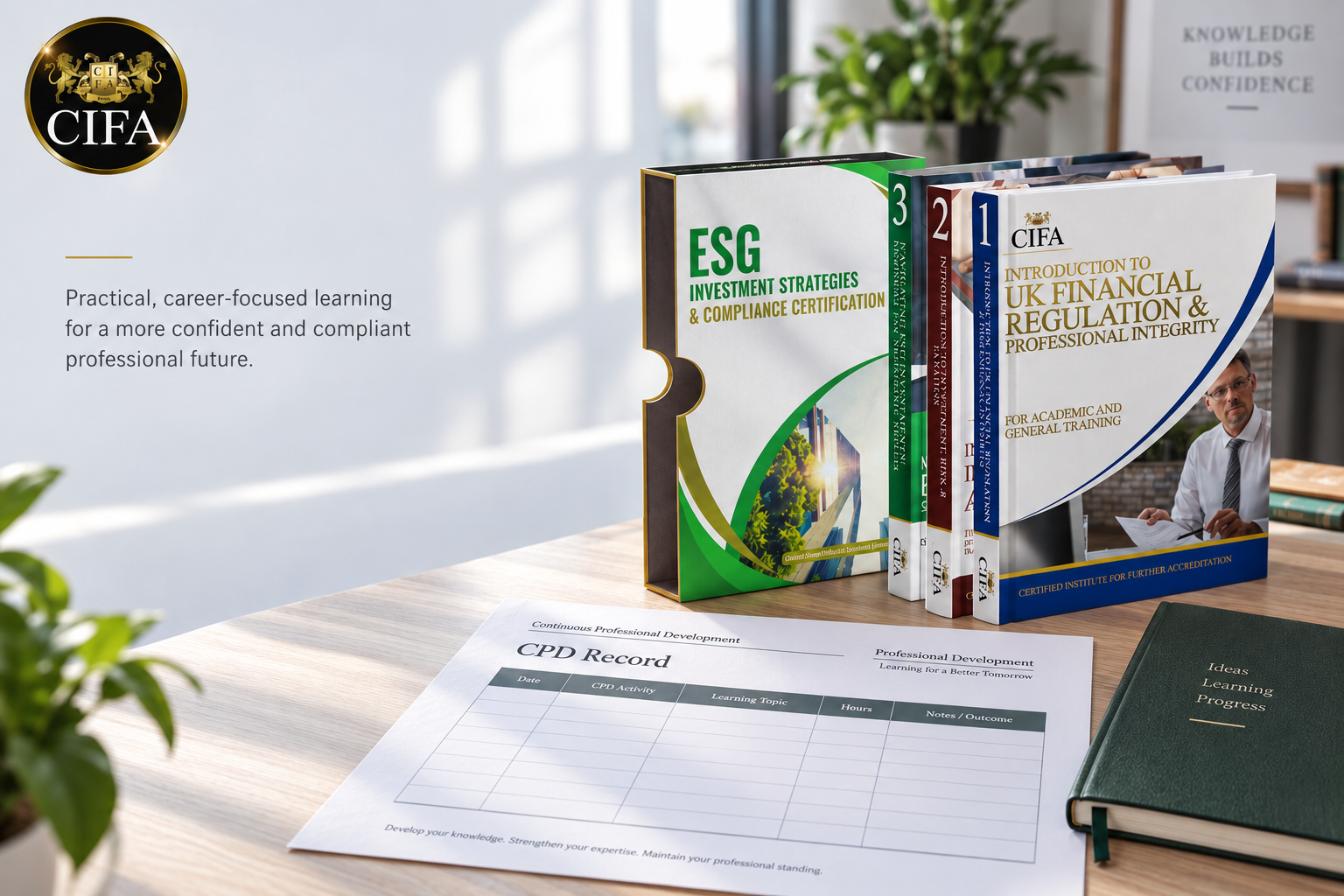
An ESG investment advisor certification may therefore appeal to professionals who want to study ESG investment and compliance topics in a more organised way than occasional seminars or independent reading allow. CIFA's ESG Investment Strategies & Compliance Certification is one programme that can be investigated on that basis.
That does not mean every person dealing with ESG investments is legally required to obtain a separate ESG certificate. Professionals need to consider the regulated activities they perform, their existing qualifications, employer expectations and the competence requirements applying to their particular role.
Certification is most valuable when it addresses a real professional-development objective rather than simply adding another credential to a CV.
ESG investing is part of a wider sustainable-finance discussion. Sustainable finance can encompass the way environmental and social considerations interact with investment, financial decision-making, risk, capital allocation and broader sustainability objectives.
A sustainable finance qualification may be useful for someone who wants that wider perspective rather than training focused narrowly on one ESG topic. CIFA's broader finance education can be explored by professionals deciding whether structured study fits their development plans.
Financial advisers may use such learning to strengthen their understanding of sustainable investment concepts. Investment professionals may want deeper analytical context. Compliance professionals may be more interested in disclosures, governance and regulatory developments. Graduates and career changers may use structured education to build knowledge before specialising further.
The value therefore depends on what the learner needs the qualification to accomplish.
There is no reliable single figure for ESG certification cost because programmes differ substantially.
A short online module will naturally have a different cost structure from an extended, assessed certification programme. Pricing can reflect programme depth, qualification level, duration, assessment arrangements, learning resources, delivery method, certification structure and the support included.
Instead of selecting the cheapest option, compare five things together: cost, relevance, quality, recognition and practical value.
A higher fee does not automatically indicate better education. Equally, a low-cost programme can represent poor value if it provides little depth or does not address the learner's actual professional requirements.
Because course fees and programme details can change, professionals wanting the current ESG certification cost for a CIFA programme should obtain the latest information directly rather than relying on an old third-party price or historical course listing.
There is no single regulated career route called "become an ESG adviser" that applies to everyone. ESG expertise can sit within financial advice, investment management, research, compliance, risk, asset management and other finance roles.
For someone researching how to become an ESG advisor, a realistic pathway begins with finance rather than ESG terminology alone.
First, develop a sound understanding of financial markets, investment principles and the professional responsibilities relevant to the intended role. ESG analysis makes more sense when it sits on top of this foundation.
Next, develop specialist knowledge of environmental, social and governance considerations. Study responsible investment, sustainability risks, stewardship, ESG analysis and the ways sustainability information can affect investment research and decision-making.
Broader sustainable finance education can then provide context, while ESG-specific certification may be appropriate for professionals seeking more structured specialisation.
Professional development continues after formal study. Relevant CPD helps keep knowledge current, particularly as market practices, disclosure frameworks and regulatory requirements develop.
Analytical and communication abilities are equally important. ESG professionals need to interpret information critically rather than accepting labels at face value, while advisers need to communicate complex concepts accurately without overstating what a product or strategy can achieve.
The final route depends on the professional role being pursued and the regulatory and qualification requirements attached to that role.
Online professional development has made ESG learning easier to fit around professional commitments. Self-paced modules, webinars, digital reading and online assessments allow advisers to spread learning throughout the year rather than concentrating it into a short period.
Independent research can be valuable too. ESG develops across regulation, investment practice, disclosures and sustainability research, so professionals often need to read beyond formal course materials.
There are limitations. Independent reading does not necessarily provide assessment, formal learning objectives or the independently verifiable evidence required for particular CPD purposes. A professional should therefore understand what their employer, professional body or applicable regulatory framework expects before assuming that every hour of self-study will count in the same way.
A balanced CPD plan may combine structured courses with targeted reading and continuing professional research.
Course selection becomes much easier once the learner stops asking which programme is "best" and starts defining what they actually need.
Begin with your current responsibilities. An experienced investment professional with a specific ESG knowledge gap has different requirements from a graduate building foundational knowledge. Likewise, a compliance professional may prioritise regulatory interpretation while an adviser may place greater emphasis on investment characteristics and client communication.
Ask yourself what you already understand and where your knowledge becomes uncertain. Then decide whether that gap requires a short CPD activity, a structured ESG course or a broader professional qualification.
Look closely at learning outcomes. Are they specific enough to tell you what you will learn? Does the programme have meaningful assessment? Is the level appropriate to your existing experience? Is any CPD recognition clearly explained rather than merely implied?
For UK finance professionals, regulatory relevance deserves particular scrutiny. ESG material can be international in scope, but a professional working in the UK should understand how the learning relates to their actual environment and responsibilities.
Finally, consider practical fit. A strong course that you cannot realistically complete may be less useful than a well-designed programme that fits your schedule and professional objectives.
ESG education has attracted considerable attention, which makes provider evaluation important. A polished course page is not evidence of educational quality by itself.
Look at the structure of the programme, stated learning outcomes, assessment arrangements, information about the provider, accessibility, student support and the transparency of any accreditation or CPD statements.
Professionals comparing providers can also review CIFA and its institutional information alongside its individual course descriptions. The purpose of that research should be to understand who is providing the education and whether the programme is appropriate for the learner's objectives.
Avoid choosing on reputation claims alone. Clear information about what is taught, how learning takes place and what the learner receives on completion is more useful than unsupported claims of being the "best" or "leading" provider.
A useful ESG development plan can be kept relatively simple.
Start by identifying what your role currently requires. Separate subjects you understand confidently from areas where your knowledge is outdated, incomplete or largely theoretical.
Turn those gaps into specific objectives. "Learn more about ESG" is vague. "Improve my understanding of sustainability disclosures and how they affect investment-product analysis" gives you something concrete to work towards.
Select appropriate activities. That could include a structured course, webinar, workshop, relevant professional reading or assessment-based learning depending on the objective.
Keep suitable evidence of what was completed. Good records should make it possible to understand the development need, activity and learning outcome rather than showing only that time was spent.
Consider how the learning changes your professional practice. Perhaps you can analyse sustainability claims more critically, interpret disclosures more confidently or explain an investment approach more accurately.
New gaps will appear. Responsibilities change, regulation develops and investment practices evolve. CPD works best as a continuing cycle rather than an annual rush to accumulate hours.
The CPD Requirements for ESG Investment Advisors are best understood within the broader obligation to maintain relevant professional competence, rather than as a standalone ESG-specific quota that applies identically to everyone.
For retail investment advisers within the relevant FCA requirements, defined annual CPD obligations apply. ESG professional development then needs to be considered according to the adviser's actual role, knowledge gaps and exposure to sustainability-related investment matters.
Useful development goes further than counting hours. It should improve the professional's ability to understand investment concepts, evaluate sustainability information, recognise limitations, keep pace with relevant requirements and communicate appropriately.
Structured courses and certifications can form part of that process, but they should be chosen for relevance rather than credentials alone. CIFA is one education provider professionals can investigate when comparing ESG, sustainable finance and wider professional-development options.
The strongest CPD plan is usually the one that can answer three straightforward questions: what did I need to learn, what did I learn, and how is that knowledge relevant to the work I perform?



0 comments